
Solar panel bird proofing is the work of sealing the gap under roof-mounted panels so pigeons cannot nest there, and for a UK home it typically costs £300 to £1,000 (EvoEnergy, 2026). With more than two million solar installations now on UK roofs (DESNZ via pv magazine, 2026), the warm, dry cavity beneath each array has become a standard aftercare job for installers.
This guide covers the method rather than the shopping list. It explains why birds colonise arrays, what they damage, how wildlife law limits when you can act, how mesh and clips go on, how to work safely at height, and how to price the job so the quote holds up against the customer's own online research.
Key Takeaways
- Bird proofing a typical UK array costs £300 to £1,000, and a roll of bird mesh is around £50 to £100 at retail (EvoEnergy, 2026).
- The UK passed 2,026,000 solar installations and 22.3 GW of capacity in April 2026, so the number of roofs with a nesting gap is growing every month (pv magazine, 2026).
- It is an offence to damage or destroy a wild bird's nest while it is in use or being built, so check for an active nest before any mesh goes on (legislation.gov.uk, Wildlife and Countryside Act 1981).
- Falls from height caused 31 of the 126 worker deaths in Great Britain in 2025/26, so access planning is part of the job, not an extra (Roofing Today, reporting HSE, 2026).
- Clip-on mesh that does not drill the module frame is the lowest-risk method for warranty and for the roof.
Why do birds nest under solar panels?
Birds nest under panels because the gap between module and roof covering is dry, shaded, warm and hard for predators to reach, which suits a feral pigeon. The mounting system lifts panels off the roof for ventilation, and that same clearance looks like a ready-made ledge with a roof over it.
Pigeons return to the same brood site once it is established, so a pair can become a colony within a season or two. The problem usually starts along the lower edge of the array, where the approach from the gutter is easy. Droppings, feathers and nest debris then spread across the roof. Thinking about exposed edges at survey stage helps, and our guide to solar panel roof layout shows how array position changes which edges are open.
What damage do pigeons cause to a PV system?
Pigeons cause thermal, electrical and structural damage at once. Nesting material blocks the airflow that keeps modules cool, and hotter modules produce less power. Droppings stain glass and corrode metal frames, and chewed or displaced cable creates a fault risk that is easy to miss from the ground.
The damage is cumulative. Debris washes into gutters and causes blockages, and nest material can hold moisture against fixings and cable runs. Treat every colony as a prompt to inspect DC cabling and connectors, which is easier if the original installation kept cable clear of the tiles, as set out in our solar PV string design guide. Folding that inspection into a solar panel maintenance visit turns a repair into a documented service.
Is bird proofing solar panels a legal issue?
Yes, and it is the part installers most often get wrong. The Wildlife and Countryside Act 1981 makes it an offence to take, damage or destroy a wild bird's nest while that nest is in use or being built (legislation.gov.uk, 1981). Eggs are protected as well.
The same legislation means it is not an offence to clear a nest that is not in use, and the government's own general licence guidance repeats that distinction (GOV.UK, GL12, 2026). In practice, inspect before you act. If you find eggs or chicks, the job waits until the young have left. Sealing the gap over an active nest is the mistake to avoid, because it traps birds and puts you on the wrong side of the Act. Record the pre-work check with a dated photo so you can show why a visit was rescheduled. If a site has an established colony and you are unsure of its status, take specialist pest-control advice before starting.
Bird proofing methods compared
Mesh is the method that lasts; the others are situational. The options below are ranked for an installer working to a warranty-friendly standard, with clipped mesh as the default recommendation.
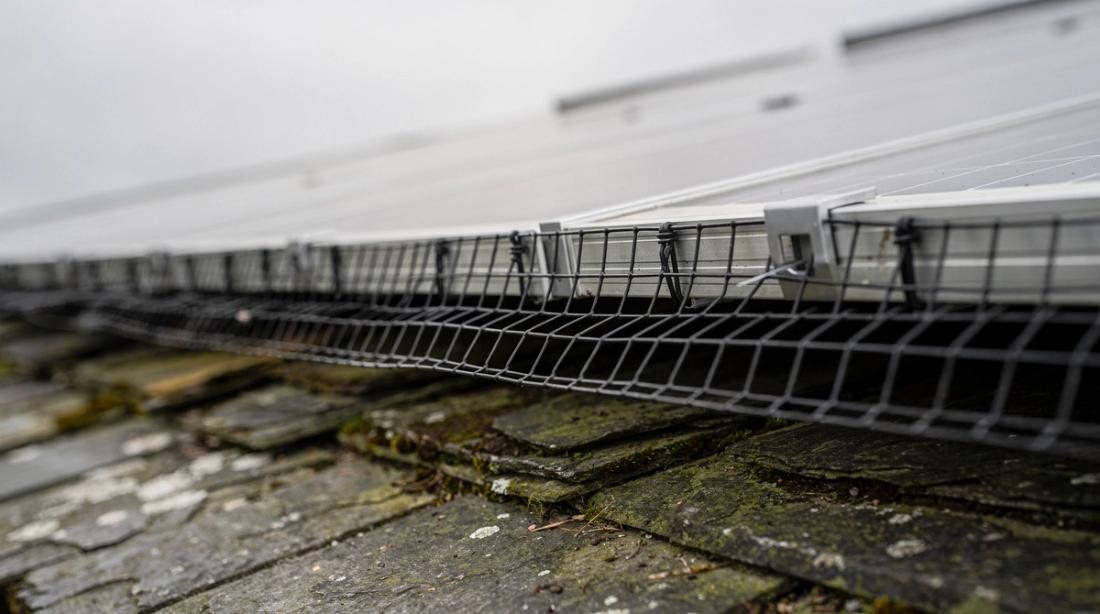
- Mesh with clips: high effectiveness, mid cost. Stainless or PVC-coated wire mesh clipped to the frame edge. It is the long-term standard and the least intrusive option.
- Solar panel skirt: high effectiveness, mid cost. A rigid perimeter skirt closes the gap with a cleaner finish, but it is slower to fit around vents and awkward edges.
- Bird spikes: low to medium effectiveness, low cost. They deter perching on rails but do nothing to stop entry to the cavity, so they are rarely a standalone fix. Retail spikes are around £25 a pack (EvoEnergy, 2026).
- Bird netting: medium effectiveness, mid cost. Retail netting runs about £150 to £200, but it can sag and trap debris on pitched domestic arrays (EvoEnergy, 2026).
- Optical and electric deterrents: low to medium effectiveness, variable cost. Electric repellents start from about £500 at retail and are rarely warranty-grade for an established colony (EvoEnergy, 2026).
How do you install solar panel bird mesh?
The method is a non-penetrating perimeter seal. Run mesh around the whole array edge and secure it with clips that grip the module frame, so nothing is drilled and the module warranty is not put at risk. Close, even clip spacing stops a determined pigeon pushing the mesh in.
Preparation is where quality shows. Cut the mesh to manageable lengths on the ground, pre-bend the lower edge so it tucks against the roof covering, and finish every corner so there is no gap at a hip, vent or array step. Work with the roof, not against it. The access discipline and fixings logic from solar panel mounting systems applies, and on slate you follow the extra care described in solar panels on a slate roof. Before you leave, check that the mesh does not cover any drainage path and that no rail, isolator or cable is pinched by a clip.
What does pigeon proofing solar panels cost?
For a standard home, professional pigeon proofing typically costs £300 to £1,000 (EvoEnergy, 2026). Retail materials are only part of that, because roof access, perimeter length and whether a colony needs clearing first move the price far more than the mesh does.
Build the quote from three lines: perimeter in metres, access method and cleaning scope. A job reachable from a ladder or tower prices very differently from one that needs scaffolding, and an established colony adds a clean-and-treat stage before any mesh goes on. Falling system costs also affect the conversation. Installed cost per kW fell 9% for 0 to 4 kW systems and 8% for 4 to 10 kW systems in 2025/26 (DESNZ via pv magazine, 2026), so customers compare a proofing quote against a cheaper system than a few years ago. State the access method and the warranty on mesh and clips in writing.
Why does safe roof access matter for bird proofing?
Because most of the risk in this job is the fall, not the bird. The Work at Height Regulations 2005 exist to prevent death and injury from falls and require work to be properly planned, supervised and carried out by competent people (HSE, 2026). Falls from height were responsible for 31 of the 126 worker deaths in Great Britain in 2025/26, around a quarter of the total (Roofing Today, reporting HSE, 2026).
Construction recorded 25 deaths in the same year, down from 35 the year before, and it still had the highest count of any industry. Treat a mesh job as roof work in its own right: assess the risk, choose edge protection or a tower where the pitch or height calls for it, and never rely on a ladder alone for a long perimeter run. A quote that includes proper access is a better quote, not a padded one.
Cleaning and biocide before you seal
Never seal a dirty cavity. Where pigeons have already nested, clear droppings and nest material from under the panels and treat the area before the mesh goes on. That protects the customer's health and removes the scent trail that draws birds back to the same spot.
Droppings carry a respiratory risk, so this is gloves and respiratory protection work, not a quick brush-off, and waste should be bagged and disposed of properly. The clean-out is also your chance to inspect what the birds have done. Check DC connectors for chewing, look for displaced tiles and clear the gutter below the array. A visit that records those checks gives the customer a clear reason to book regular servicing, and the wider checklist in our photovoltaic system maintenance guide shows what else to cover while you are on the roof.
Demand is not small. MCS certified nearly 150,000 solar installations in the first half of 2026, up 14% on the same period of 2025 (MCS, 2026), and every one of those roofs is a potential aftercare customer. If you track follow-on jobs alongside the original install in an installer platform such as Reonic, the aftercare pipeline stays visible instead of living in a notebook.
Frequently asked questions
Does bird proofing solar panels void the panel warranty?
Not when it is done with clips that grip the frame edge, because nothing is drilled and the module is not modified. Drilling the frame or fixing into the laminate is what puts a warranty at risk. If in doubt, check the manufacturer's installation manual before you fit anything.
Can I remove a pigeon nest from under the panels myself?
Only if it is not in use. The Wildlife and Countryside Act 1981 protects nests that are in use or being built, and eggs, so an active nest must be left until the young have fledged. Once it is clear the nest is inactive, remove it, treat the area and fit mesh to stop reuse.
How much does it cost to pigeon proof solar panels in the UK?
Professional proofing typically costs £300 to £1,000 for a home, according to EvoEnergy's 2026 guide. The final price depends on perimeter length, whether scaffolding or a tower is needed, and whether an existing colony has to be cleared first.
Is a solar panel skirt better than mesh?
Both close the gap and suit different roofs. A skirt gives a cleaner, more uniform look on a simple rectangular array, while mesh flexes around vents, hips and awkward edges. Many installers offer both and choose by roof geometry and the customer's appearance preferences.
Will bird proofing improve my solar output?
It protects output rather than boosting it beyond the design figure. If nesting material has been blocking ventilation, clearing it and sealing the array helps modules run cooler. On a clean array, proofing simply prevents that problem from developing.