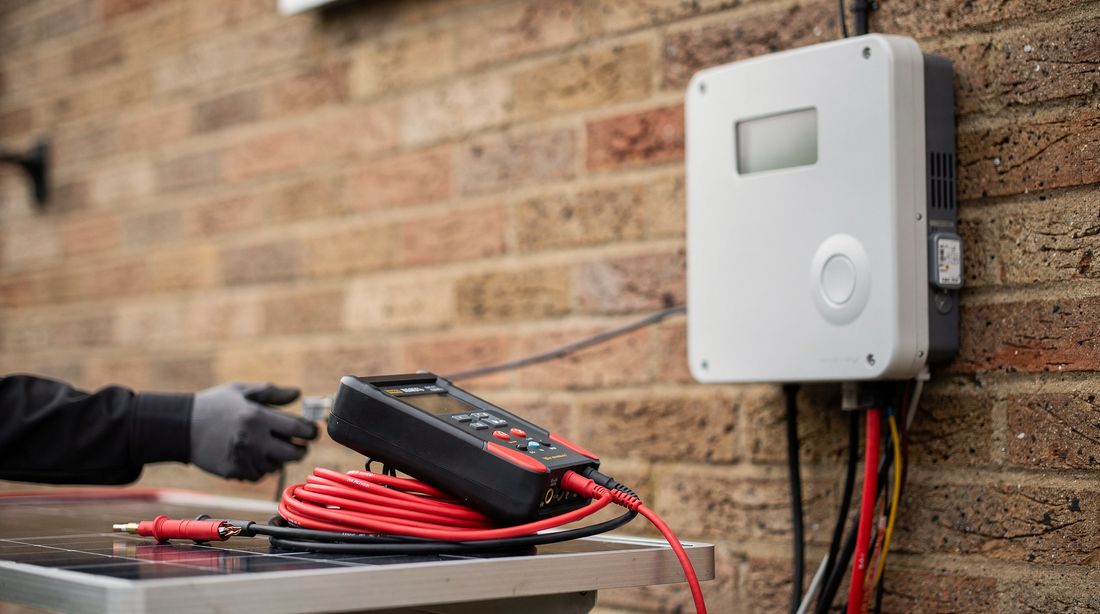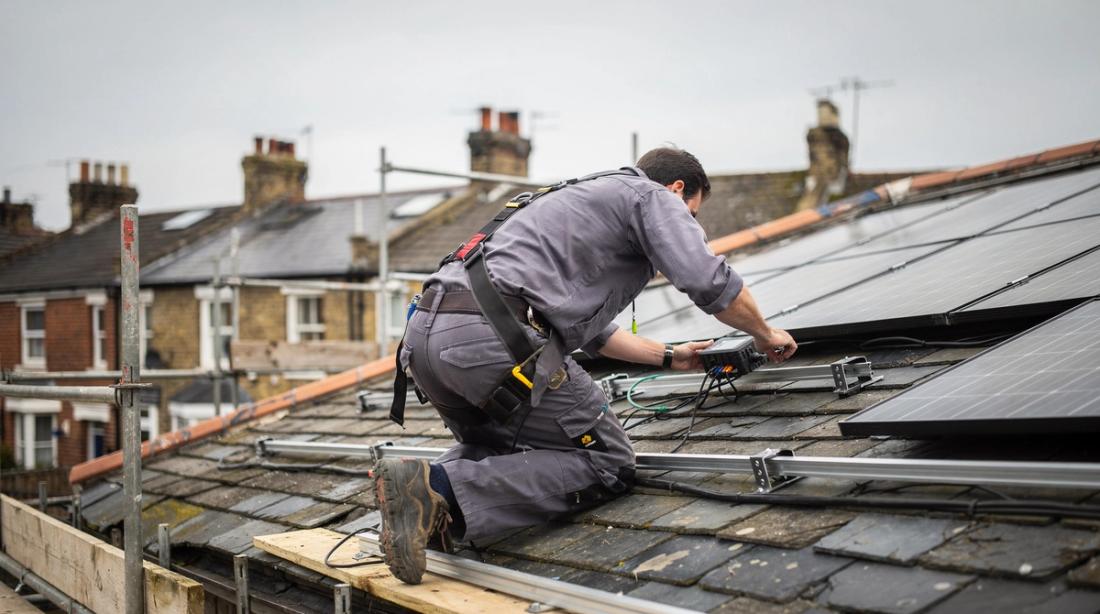

Installing solar panels to generate electricity counts as a construction operation under the Construction Industry Scheme, so most UK solar installers who subcontract or hire labour fall inside CIS whether they expected to or not (gov.uk CISR14090, 2026). HMRC's own manual is explicit on the point, and getting the scheme wrong means deducting the wrong tax, missing monthly returns, or losing payment to a 30% withholding you could have avoided.
This guide is written for solar and renewables firms, not accountants. It covers when CIS bites on a PV job, the deduction rates you face as a subcontractor, how registration works, whether gross payment status is worth chasing, and how CIS sits alongside the VAT reverse charge you already deal with. The rules below reflect the position for the 2026 tax year.
Key Takeaways
- Installing solar panels for electricity is a construction operation within CIS, but direct contracts with a private householder are outside the scheme (gov.uk CISR14090, 2026).
- A registered subcontractor has 20% deducted, an unregistered one 30%, and a subcontractor with gross payment status has nothing withheld (gov.uk, 2026).
- Deductions apply to labour only; VAT, materials, plant hire and fuel are stripped out of the calculation first (gov.uk, 2026).
- Gross payment status needs a net construction turnover of at least £30,000 per relevant person, with a £200,000 aggregate alternative for firms and companies (legislation.gov.uk, 2026).
- Contractors file a CIS300 return by the 19th of every month, and a single day late is a £100 penalty (gofile.co.uk, 2026).
Does the CIS scheme apply to solar installers?
Yes, for most firms that pay other businesses or self-employed workers for installation labour. HMRC's manual states that "the installation of solar panels to provide electricity will be a construction operation within CIS" (gov.uk CISR14090, 2026). If you subcontract any part of that installation, you act as a contractor and must operate the scheme. If a larger firm pays you to fit panels, you are their subcontractor.
The main carve-out is domestic. A contract made directly with a private householder sits outside CIS, so a one-person firm fitting panels straight for homeowners and never using subcontractors has no CIS duty (gov.uk CISR14090, 2026). The moment a developer, housebuilder, commercial client or EPC contractor sits between you and the roof, the payment chain is caught.
There is also a deemed-contractor trap for businesses that are not builders by trade. A company whose core activity is not construction still has to register and operate CIS once its rolling annual spend on construction operations passes £3 million (tlt.com, 2024). Commercial solar clients and property owners commissioning large arrays can cross that line without realising it.
The solar work that counts as CIS construction work
CIS turns on whether the work is installation of a building service system rather than a repair. Power supply systems, including the electrical wiring and cabling in a building, are inside the scheme, and so is the installation of solar panels that feed electricity into the property (gov.uk CISR14090, 2026). A full array fitted to a roof, wired through an inverter into the consumer unit, is squarely construction.
The line to watch is repair versus installation. HMRC treats rewiring a single defective circuit as a repair, which is outside CIS, while replacing a complete system counts as installation inside it (gov.uk CISR14090, 2026). Swapping one failed panel or a dead optimiser on an existing system looks like a repair. Stripping and refitting an array, or installing a new system from scratch, does not.
This matters on mixed jobs. A project that bundles a new PV array with a battery, an EV charger and consumer-unit work is mostly installation and should be treated as within the scheme. When you are unsure on a borderline maintenance call, the conservative position is to assume CIS applies and verify the subcontractor, because under-deducting leaves you, not them, owing HMRC the shortfall.
CIS deduction rates for solar subcontractors: 20%, 30% and gross
Three rates exist, and your registration status decides which one a contractor applies to your invoices. A registered subcontractor has 20% withheld, an unregistered one 30%, and a subcontractor holding gross payment status receives the full amount with nothing deducted (gov.uk, 2026). The 10-point gap between registered and unregistered is the single strongest reason to register before your first subcontracted job.
Crucially, the rate is never applied to the whole invoice. The contractor starts with the gross invoice, then removes VAT, materials the subcontractor paid for directly, plant hire, fuel used on site and consumable stores, and applies the CIS percentage only to what remains (gov.uk, 2026). On a panel-heavy install where hardware is most of the value, the deducted sum is far smaller than the headline rate suggests.
- Registered (net): 20%, Labour element, after materials and VAT removed.
- Not registered: 30%, Labour element, after materials and VAT removed.
- Gross payment status: 0%, Nothing withheld; full invoice paid.
In practice, the first CIS surprise for a young solar firm arrives the day a larger EPC contractor asks for your Unique Taxpayer Reference before releasing a single payment. Without registration that payment lands 30% light, and the missing tax only returns through your year-end tax position, long after the cash was needed on the next van of panels.
How do solar installers register for CIS?
Registration depends on which side of the payment you are on, and many solar firms are on both. You register as a contractor if you pay subcontractors, and as a subcontractor if you are paid for construction work by another business (gov.uk CISR14090, 2026). A firm that wins commercial contracts and also hires self-employed fitters registers twice, in both roles.
As a contractor you must verify each new subcontractor with HMRC before you pay them. Verification returns the rate to apply, either 20%, 30% or gross, so you cannot simply assume a worker is registered. Getting this wrong and paying at 20% when HMRC says 30% leaves you liable for the difference, which is why verification is a fixed step in a clean payment process rather than an optional check.
Setting up well before your first subcontracted job keeps cash flowing. New limited-company installers often fold CIS registration into the wider admin of launching, alongside installer insurance and accreditation, which our guide to starting a solar panel business in the UK walks through. Treat CIS as part of that first-quarter setup, not something to bolt on after the first contract dispute.
What is gross payment status and should you apply?
Gross payment status lets a contractor pay you in full with no CIS deduction, so you settle your own tax through self assessment or corporation tax instead of having cash held back all year. For a growing installer it protects working capital, which matters when you are financing panels and inverters months before a client settles. It is applied for, not automatic.
To qualify you must pass a turnover test: a net construction turnover, excluding VAT and materials, of at least £30,000 per relevant person, with a £200,000 aggregate alternative available to firms and companies (legislation.gov.uk, 2026). You also pass a compliance test, meaning tax returns and payments must be up to date. Since 6 April 2024, VAT compliance is part of that test, and HMRC's power to cancel gross status where fraud is found has been expanded (icaew.com, 2026).
The practical read is that gross status rewards clean books. If you file and pay on time, including VAT, the status is worth pursuing once your turnover clears the threshold. If your returns slip, chasing it is premature, because a later compliance failure can see the status withdrawn and the 20% deduction reinstated across every contract at once.
How does CIS interact with the VAT reverse charge?
They are separate schemes that bite on the same payments, and solar installers routinely deal with both at once. Since 1 March 2021, the VAT domestic reverse charge applies to most construction services supplied between VAT-registered businesses that are reported under CIS, which means the customer accounts for the VAT instead of the supplier (tlt.com, 2024). If a job is within CIS and both parties are VAT registered, the reverse charge usually applies too.
The link runs one way: the reverse charge follows CIS. When you supply a VAT-registered contractor with installation work caught by CIS, you do not charge VAT on your invoice; the contractor self-accounts for it. When your customer is an end user, such as a private householder, the reverse charge does not apply and normal VAT rules return. Our dedicated VAT reverse charge guide for solar installers sets out the invoicing wording and the end-user exception in full, and the 0% VAT position on residential solar sits on top of it.
Getting the two aligned on one invoice is where mistakes cluster. A CIS-caught job to a VAT-registered contractor should show no VAT charged, the reverse charge noted, and the correct CIS treatment flagged. Mismatching them, charging VAT on a reverse-charge job, is one of the most common corrections HMRC raises against construction suppliers.
CIS monthly returns and deadlines for contractors
As a contractor you file a monthly CIS300 return by the 19th of each month, covering the tax month that ran from the 6th of the previous month to the 5th (gofile.co.uk, 2026). The return reports every subcontractor paid, the deductions taken, and a declaration about their employment status. You file even in a quiet month, submitting a nil return if you paid no subcontractors.
Late filing penalties escalate quickly, so the 19th is a hard date rather than a target. A return one day late triggers an immediate £100, two months late adds a further £200, and at six and twelve months the penalty becomes £300 or 5% of the deductions, whichever is greater, each time (gofile.co.uk, 2026). On a firm paying several subcontractors, repeated late returns stack into real money fast.
- 1 day: £100 fixed.
- 2 months: Additional £200 (£300 total).
- 6 months: £300 or 5% of deductions, whichever is greater.
- 12 months: A further £300 or 5% of deductions, whichever is greater.
The deductions you withhold are paid to HMRC alongside your PAYE, by the 22nd if you pay electronically. Keeping subcontractor records, verification numbers and payment statements organised across a growing crew is where good installer admin software earns its place; our overview of digital tools for installers covers the systems that keep this tidy. Reonic's installer platform keeps job, payment and documentation records in one place so the monthly return is an export rather than a scramble.
Frequently asked questions
Is a one-person solar installer working only for homeowners inside CIS?
No. A contract made directly with a private householder is outside the scheme, and a sole trader who never pays subcontractors has no contractor duty either (gov.uk CISR14090, 2026). CIS applies once you subcontract installation work or are paid for it by another business rather than a homeowner, which is the point most firms cross as they grow.
Does CIS deduct tax from the cost of my solar panels?
No. The deduction is calculated after the contractor removes VAT, materials you paid for directly, plant hire and fuel from the invoice, so it only ever applies to the labour element (gov.uk, 2026). On a hardware-heavy PV install, the withheld sum is much smaller than the 20% or 30% headline rate implies.
What happens if I am not registered for CIS?
A contractor must deduct 30% from your payments rather than 20% (gov.uk, 2026). The extra 10% is not lost, since it counts towards your eventual tax bill, but it is held back all year and recovered only at year end, which is a heavy and avoidable drag on cash flow for a growing installer.
When should a solar firm apply for gross payment status?
Once net construction turnover clears £30,000 per relevant person, or £200,000 in aggregate for a firm, and your tax and VAT affairs are fully up to date (legislation.gov.uk, 2026). Applying with a patchy compliance record risks refusal or later withdrawal, so clean filing comes before the application, not after.
Do I charge VAT on a CIS job for another contractor?
Usually not. Where the job is within CIS and supplied to a VAT-registered contractor who is not the end user, the domestic reverse charge applies and the contractor accounts for the VAT instead of you (tlt.com, 2024). You invoice without VAT and note the reverse charge. For an end-user customer such as a householder, normal VAT rules apply.