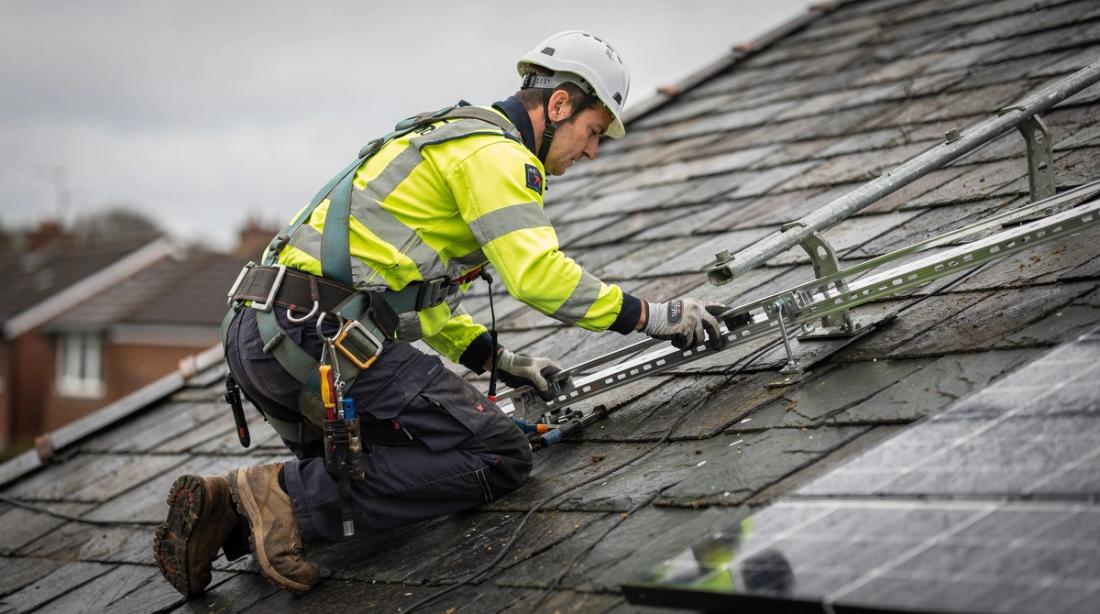

Fitting solar panels on a slate roof is a fragile-surface job, and falls from height now account for over a quarter of all work-related deaths in Great Britain, with 31 people killed in the past year (HSE, 2026). Slate splits along its grain and cracks under point loading, so a method that works on concrete tile will damage a slate roof.
Slate also costs more to do properly. One 2026 comparison puts a slate install at £9,134 against £7,026 on tile, about 30% more, and the job takes roughly five days against one or two (Home Energy Quotes, 2026). This guide covers hooks, the fitting sequence, MCS 012, safe access, planning rules and 2026 costs.
Key Takeaways
- Use slate-specific hooks that carry load to the batten or rafter, because MCS 012 requires brackets on slate to transfer no load to the covering or spread it evenly without damage (MCS, 2023).
- Treat the roof as fragile until a competent person proves otherwise; falls through fragile surfaces account for 22% of construction fall-from-height deaths (HSE, 2024).
- MCS 012 Issue 3.0 became mandatory on 10 May 2025, so record the certified kit against every job (MCS, 2025).
- Budget about 15 to 30% more than tile and 2 to 5 days of labour (Make My House Green, 2026).
- Planning rules for solar changed on 27 August 2026, with a transition to 26 August 2027 (Planning Design, 2026).
Can you fit solar panels on a slate roof?
Yes. A slate roof takes solar panels when the fixings suit the material and the battens are sound. Slate is a natural stone that splits along its grain, so it needs slate-specific hooks and a check of batten condition first, and a competent installer should not damage it (Make My House Green, 2026).
The failure mode is almost always the fixing method, not the panel. A hook shaped for a concrete tile profile bears on the slate face and can crack it once wind moves the array. The first slate you lift tells you a lot: a soft batten or a worn nail hole means replacement work before any hook goes on.
Age matters too. Victorian slate can be thin at the edges and nailed to battens that have lost their grip. A newer reclaimed slate roof behaves differently again. The survey decides whether adjustable hooks will do or whether the job needs rafter-fixed hooks and some replacement slates. That call is far cheaper to make from the ground than halfway through the fit.
Which roof hooks work on a slate roof?
Slate roofs need hooks that pass the stem between slates and transfer load to the batten or rafter. MCS 012 sets a minimum 1.0 kN/m² load test for brackets that spread load onto frangible coverings such as slate, clay or concrete tile (MCS, 2023). Standard tile hooks do not suit flat slate.
The common options, and where each earns its place:
- Adjustable slate hooks. Seat on the batten with the stem between courses. The default for sound natural slate.
- Rafter-fixed hooks. Bolt straight to the rafter for maximum pull-out strength where battens are worn.
- Replacement-slate plates. A lead or steel plate replaces one slate and carries the fixing, useful where slate is thin or brittle.
- Tile hooks (for contrast). Shaped for concrete or clay profiles and not suitable for flat slate.
Check that the kit you choose is listed as an MCS 012 certified pitched-roof product, and that its declared wind uplift resistance covers the site. Our solar panel mounting systems guide compares the main rail and hook families in more detail.
Fitting hooks without cracking slate: the sequence
Work from the batten up, never off the slate face. Expose the fixing point, secure the hook to timber, seal the penetration, then refit slates around the stem. Every avoidable slate you lift is a slate you might crack, so a methodical order protects both the roof and the weatherproofing.
A reliable fitting sequence:
- Survey the roof and treat it as fragile: check batten condition, slate thickness and pitch before anyone goes up.
- Set up scaffold and edge protection first, extending it two metres beyond the work area on each side (HSE NI, 2014).
- Lift only the slates needed to expose the batten and rafter at each fixing point.
- Fix the hook to rafter or batten as the MCS 012 kit instructions require, and check pull-out.
- Seal each penetration so the underlay keeps its weather performance.
- Refit slates around the stem and replace any cracked slate with a match.
Carry matching slates on the van, because a crack found at handover costs more than one replaced during the fit. Point loading is the enemy, so nobody walks on unsupported slate and every hook lands on timber.
What do MCS 012 and BS 5534 require on slate?
MCS 012 Issue 3.0, issued on 10 May 2023, became mandatory on 10 May 2025 and covers above-roof and roof-integrated mounting kits. It tests wind uplift to BS EN 14437 principles and requires that mounting does not decrease the weather performance of the declared roof type (MCS, 2025).
BS 5534 is the slating and tiling code, and the practical point is the same: the mounting must not undermine the underlay or the roof's weathertightness. Seal every penetration with a purpose-made product and photograph it.
MCS also tightened evidence rules. Our MCS 012 guide sets out the grace period, which ended on 10 November 2025, and the MIS 3002 clause 5.5.5 update that applied from 18 June 2026. Keep the kit datasheet, the fixing schedule and the sealed-penetration photos in the job file so the evidence is there if the install is questioned.
Working safely on a slate roof
HSE treats work near fragile surfaces as a hazard to avoid first: keep people away where possible, then use stagings, guard rails, fall restraint and safety nets, with warning notices on approach and trained, competent workers (HSE, 2024). Falls remain the leading cause of workplace death.
HSE NI guidance says edge protection should run along the eaves of the working slope, on a boarded platform with double guard-rails and toe-boards, and extend two metres beyond the work area on each side. Only a trained and competent scaffolder should erect, alter or dismantle it (HSE NI, 2014).
Fragile rooflights and old fibre-cement sections on outbuildings deserve the same caution as the slate itself. Load out materials in stages so the platform is never overloaded, and work off roof ladders or crawl boards rather than the slate. Wet slate is slick and cold slate is more brittle, so weather is a bigger factor than on tile.
A recent prosecution shows the cost of skipping this. A contractor was fined £20,000 plus £5,744 costs in August 2026 after a bricklayer fell about eight feet through a roof sheet with no risk assessment or safe system of work in place (HSE, 2026).
What does slate roof solar cost in 2026?
Expect slate to cost roughly 15 to 30% more than tile. One 2026 comparison finds £9,134 on slate against £7,026 on tile, about 30% more, with the premium driven mainly by labour rather than materials (Home Energy Quotes, 2026). Another puts it nearer 15 to 20%.
Indicative 2026 figures for a domestic job:
- Standard 4kW system. Typically £6,500 to £8,000 installed, before any slate premium (Heatable, 2026).
- Slate premium. Around 15 to 20% on the total price, from specialist equipment and extra labour (Make My House Green, 2026).
- Slate versus tile in one comparison. £9,134 against £7,026, about 30% more (Home Energy Quotes, 2026).
- Time on the roof. 2 to 5 days on slate against 1 to 3 days on a standard pantile roof (Make My House Green, 2026).
These are consumer-side comparison sites, so treat them as ranges, not quotes. Price the survey, scaffold and a slate contingency from the start rather than absorbing them when a breakage appears mid-fit.
Do you need planning permission for solar on a slate roof?
Usually not for a house, but heritage status changes that. Solar remains prohibited under permitted development on listed buildings, structures within a listed building's grounds and scheduled monuments, and conservation areas keep extra controls, so check the property's status before you quote (Planning Design, 2026).
Before 27 August 2026, panels on a pitched roof should project no more than 200mm from the roof slope (Planning Portal, 2026). The new rules separate houses from flats and apply from 27 August 2026, with a one-year grace period to 26 August 2027 for schemes under the old rules.
Slate roofs are common on period homes, so check the property's status first. Our solar panel planning permission guide covers the checks in detail.
Slate versus tile, metal and other roofs
Roof material decides the fixing, not the panel. Concrete and clay tile take profiled hooks that sit in the tile channel, which is why a tile method fails on flat slate. Corrugated metal takes fixings through the sheet crown with bonded washers, sealed against water ingress at every point.
On slate there is also a design choice. An in-roof system can look cleaner on a period property, but it changes the weatherproofing and the fixing entirely, so weigh it against a standard on-roof array before quoting. Our in-roof versus on-roof guide covers that trade-off, and our flat roof guide covers the other end of the roof range.
The right answer depends on slate condition, pitch and how much the customer will accept disturbing the roof covering. Once the array is up, our solar panel maintenance guide explains how to keep it performing. Reonic's design software lets installers log roof type, fixing and certified kit against each job so the design pack matches what goes on the roof.
Frequently asked questions
Can you fit solar panels on a slate roof?
Yes, provided the fixings suit slate and the battens are sound. Use slate-specific hooks that seat on the batten or rafter, not tile hooks that bear on the slate face. Survey batten condition and slate thickness first, and use replacement-slate plates where slate is thin or brittle.
What roof hooks do you use on a slate roof?
Adjustable slate hooks are the default, seating on the batten with the stem between courses. Where battens are worn, rafter-fixed hooks give more pull-out strength, and replacement-slate plates suit brittle slate. Standard tile hooks are shaped for concrete or clay profiles and should not be used on flat slate.
Does fitting solar panels crack slate tiles?
It can if the method is wrong. Cracks come from walking on unsupported slate or from hooks bearing on the slate face. Fixing hooks to timber, sealing penetrations and replacing any damaged slate with a match keeps the roof weathertight and avoids callbacks.
Do I need MCS 012 certified mounts for a slate roof?
Yes for MCS work. MCS 012 Issue 3.0 became mandatory on 10 May 2025 and covers pitched and roof-integrated kits. A certified kit gives documented wind uplift and load performance, so record the kit and its certification against the job.
How much more does slate roof solar cost?
Plan for roughly 15 to 30% more than tile. One 2026 comparison shows £9,134 on slate against £7,026 on tile, with the premium coming mostly from slower, safer access and slate-specific fixings rather than the panels or inverter.