
Solar panel mounting systems now sit under stricter rules than most installers expect. Every product certified to MCS 012 Issue 3.0 has been mandatory for UK flat-roof arrays since 10 August 2025 (MCS, 2025). The old bespoke-kit workaround under Clause 5.5.5 has closed for good. That single change reshaped how installers quote, order, and sign off almost every job this year.
This guide compares the mounting hardware actually specified on UK roofs and ground arrays. It covers rail-based hook systems for slate and tile, ground screws for solar mounting on open land, ballasted trays for flat commercial roofs, and tile-replacement in-roof kits. It is written for installers weighing solar pv mounting systems against cost, wind rating, and install speed, not for homeowners comparing panel brands.
Key Takeaways
- Since 10 August 2025, every UK flat-roof mount must be MCS 012 certified; bespoke uncertified kits are no longer allowed (MCS, 2025).
- UK MCS-certified solar installations hit 257,397 in 2025, up 32 percent on 2024, so mounting-system choice now touches more roofs than ever (MCS, 2025).
- Ground screws for solar mounting dominate ground-mount and commercial jobs because they need no concrete curing and carry load immediately (Ground Screw Centre, 2025).
- Commercial rooftop solar took roughly 12 percent of new UK capacity in 2025, and needs mounting systems rated for larger wind and snow loads than domestic kit (Solar Weekly, 2026).
- Falls from height caused 35 of 124 UK work-related deaths in 2024/25, so mounting-system choice is a safety decision as much as a technical one (HSE, 2025).
What are the main types of solar panel mounting systems?
UK installers specify five main solar mounting systems. These are rail-based hook systems for pitched slate or tile roofs, ground screws for open-land and commercial ground mounts, ballasted trays for flat commercial roofs, tile-replacement in-roof kits, and heavier commercial rail systems for warehouses. Each now needs MCS 012 certification to qualify for Smart Export Guarantee registration (MCS, 2025).
Every system does the same basic job. It transfers panel weight, wind uplift, and snow load from the array back into the building or the ground. What changes is how that load path works, what it costs, and how fast a crew can fit it. The rest of this guide takes each type in turn.
Rail-mounted hook systems for pitched roofs
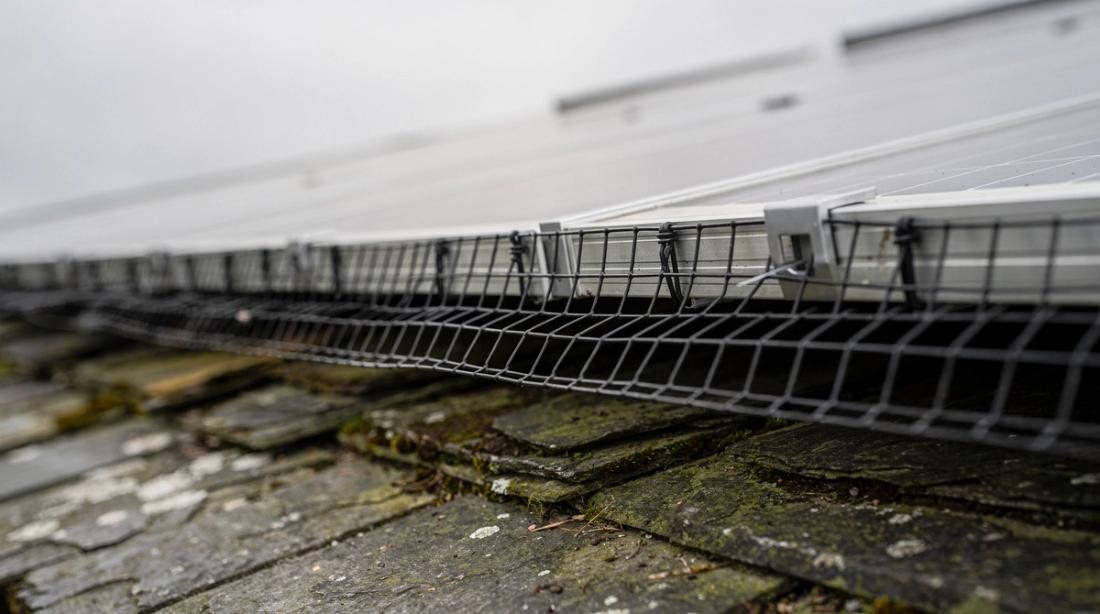
Rail-mounted hook systems are the standard fix for pitched slate, tile, and metal roofs across the UK. Installers lift a covering tile, then bolt stainless steel hooks to the rafters. Aluminium rails run across the roof to carry the panels (Solar Calculator HQ, 2026). Most designs use four anchor points per panel to transfer wind uplift back into the structure.
The rail carries every mechanical load: panel weight, wind uplift, wind pressure, and any snow on the array. It passes all of that back to the roof through the hook and coach screw (Solar Calculator HQ, 2026). Span tables from the rail manufacturer, not a rule of thumb, set the maximum hook spacing for a given wind zone. On a slate roof, hook spacing and slate overlap need checking together, which our slate roof fitting guide covers in more depth.
Labour cost follows roof complexity more than panel count. A straightforward south-facing slate roof with standard rafter spacing is quick to rail out. A dormered or multi-hipped roof with mixed coverings takes noticeably longer per kilowatt, even though the hardware itself is identical.
Ground screws for solar mounting: the fastest ground-mount foundation
Ground screws for solar mounting are steel foundations driven directly into soil. They replace poured concrete footings on ground-mount and larger commercial arrays. A skilled crew can install dozens of screw foundations in a single day, because the screws carry load immediately with no curing wait (Ground Screw Centre, 2025).
Most UK ground screws are hot-dip galvanised to resist corrosion over a design life that typically matches the panels themselves. They also come out cleanly. That makes a ground screw array fully reversible on leased land or agricultural sites, where the landowner may want the option to revert the field later. This reversibility is one reason ground screws for solar mounting have become the default for domestic ground mounts and solar carports alike.
Ground-mount volume has grown alongside commercial demand. Installers who skip a trial screw on clay-heavy or waterlogged ground often find the string needs re-driving deeper than the design assumed. A short trial run before ordering the full set avoids that rework and keeps the one-day install promise realistic.
Ballasted flat-roof mounting systems
Ballasted mounting systems hold tilted panel trays down with weight, usually concrete blocks, instead of piercing the roof membrane. They are the default choice on UK commercial flat roofs because they protect the waterproofing warranty. The added dead load, though, means a structural check always comes first (MCS, 2025).
A tilted ballasted array behaves like a sail in high wind. The ballast quantity has to resist that uplift without overloading the deck. This calculation depends on building height, site exposure, and array tilt, and it has to happen before anyone orders blocks. Felt and GRP membranes usually rule out mechanical fixings anyway, which is why ballast remains the standard route. Our flat roof mounting guide sets out the membrane compatibility checks in full.
Are tile-replacement in-roof systems worth it for UK homes?
Tile-replacement in-roof systems swap sections of roof covering for an integrated solar frame that sits flush with the surrounding tiles or slate. They cost more per kilowatt than a rail-mounted retrofit. They suit new-build and re-roofing jobs where appearance matters, and several kits now carry full MCS 012 certification (Marley, 2025).
The trade-off is timing and cost, not performance. Fitting an in-roof kit during a re-roof adds little extra labour, since the roofers are already stripping and relaying coverings. Retrofitting one onto an otherwise sound roof means removing good tiles that did not need touching. For most retrofit jobs, a rail-mounted on-roof system remains cheaper. Our in-roof versus on-roof comparison walks through when the flush finish justifies the premium.
Maintenance access is worth flagging to clients too. Lifting an in-roof panel for a fault, or for a future extension, disturbs the surrounding weatherproofing in a way a rail-mounted panel does not. The long-term service cost sits a little higher, even once the install itself is complete.
What do commercial solar mounting systems need that domestic ones don't?
Commercial solar mounting systems carry larger arrays, bigger wind catchment, and higher structural stakes than a house roof. Commercial rooftop solar took roughly 12 percent of the UK's new solar capacity in 2025. Most of that load sits on ballasted or heavy-rail systems engineered to site-specific wind and snow calculations, rather than off-the-shelf domestic kit (Solar Weekly, 2026).
Scale changes the paperwork too. The old 1 megawatt permitted development cap on non-domestic rooftop solar was removed in December 2023 (Solar Power Portal, 2024). That single change is why warehouse and factory arrays have grown so quickly since.
Permitted development still limits equipment to one metre above the roof's highest point, and one metre from any external edge. Anything larger than 50 kilowatts needs prior approval from the local planning authority. It is worth checking our planning permission guide before quoting a large commercial roof.
Structural sign-off matters more at this scale as well. A domestic rail job rarely needs a bespoke structural calculation beyond the manufacturer's span table. A large flat-roof commercial array almost always needs an engineer's assessment of the existing deck before ballast or fixings are specified, especially on older industrial buildings.
How much wind and snow load do solar panel mounting brackets need to withstand?
Solar panel mounting brackets must be sized against the wind zone for the postcode, calculated to BS EN 1991-1-4, alongside snow loading to BS EN 1991-1-3. UK systems are commonly rated to withstand wind speeds up to 60 metres per second, but actual spacing comes from the manufacturer's certified span table (Solar Calculator HQ, 2026).
On exposed coastal sites, the calculated bracket spacing is nearly always tighter than installers expect on a first pass. Cutting corners here is exactly where mounting failures start. Falls from height caused 35 of the 124 UK work-related deaths recorded in 2024/25, more than a quarter of the total (HSE, 2025). A bracket failure on a pitched roof is a safety event, not just a warranty claim.
Comparing solar mounting systems by roof type, cost and install speed
The right solar mounting system depends on roof type, budget, and how fast the job needs to complete. Rail-based hook systems suit most pitched roofs at the lowest cost. Ground screws suit open land and larger ground-mount work. Ballasted or tile-replacement systems suit flat roofs and premium finishes respectively.
- Rail-mounted hooks: best for pitched slate or tile roofs, low to medium cost, around a day per 4 kilowatt system, wind rating set by BS EN 1991-1-4 for the local zone.
- Ground screws: best for ground-mount arrays and solar carports, medium cost, dozens of foundations per day, load rating from the manufacturer's screw tables.
- Ballasted trays: best for flat commercial roofs, medium to high cost once ballast is included, one to two days per 10 kilowatts, rating set by a structural check plus BS EN 1991-1-4.
- Tile-replacement in-roof: best for new-build or re-roofing where finish matters, highest cost per kilowatt, slower unless tied to a re-roof, rating comes from the certified kit itself.
- Commercial rail systems: best for warehouses and large flat or pitched roofs, medium to high cost, speed scales with crew size, rating from a site-specific engineering calculation.
Frequently asked questions
What is the difference between solar mounting systems and solar PV mounting systems?
There is no real difference. Solar mounting systems and solar PV mounting systems describe the same hardware category: rails, hooks, ground screws, ballast trays, and in-roof kits. Installers and manufacturers use both terms interchangeably in specifications and on MCS 012 certificates, so a product listed under either phrase is the same certified mounting product.
Do ground screws work on all UK soil types?
Mostly, yes, though very rocky, waterlogged, or heavily contaminated ground can rule them out. A trial screw or ground investigation confirms load capacity before a full array is ordered. Where ground screws are not suitable, concrete pad or strip foundations remain the fallback, though they take longer to install and cannot be loaded on the same day.
How long do solar panel mounting brackets last?
Hot-dip galvanised aluminium and stainless steel brackets are typically warrantied for 20 to 25 years, matching panel warranties. Coastal or industrial sites with high salt or chemical exposure can shorten that life, so manufacturers often specify enhanced coatings for those locations. Checking the bracket warranty against the panel warranty at quote stage avoids an awkward mismatch later.
Is planning permission needed for commercial solar mounting systems?
Usually not, since the 1 megawatt permitted development cap on non-domestic rooftop solar was removed in December 2023. Height and edge-setback limits still apply, and any system over 50 kilowatts needs prior approval from the local planning authority. Listed buildings and conservation areas fall outside permitted development rights, so those always need a full application.
Can I install solar panels without drilling into my roof?
Yes, on a flat roof. Ballasted mounting systems hold panels in place with weight rather than fixings, so the waterproof membrane stays intact. On a pitched roof, hooks still need fixing through the tiles into the rafters, since there is no practical non-penetrating alternative that meets current wind-load standards.
Getting the mounting system right at survey stage protects both compliance and margin. The roof type, wind zone, and ground conditions decide the shortlist before cost ever enters the conversation. Tools like Reonic help installers capture that survey and structural detail in one place, so the right mounting system gets specified before the quote goes out, not after.