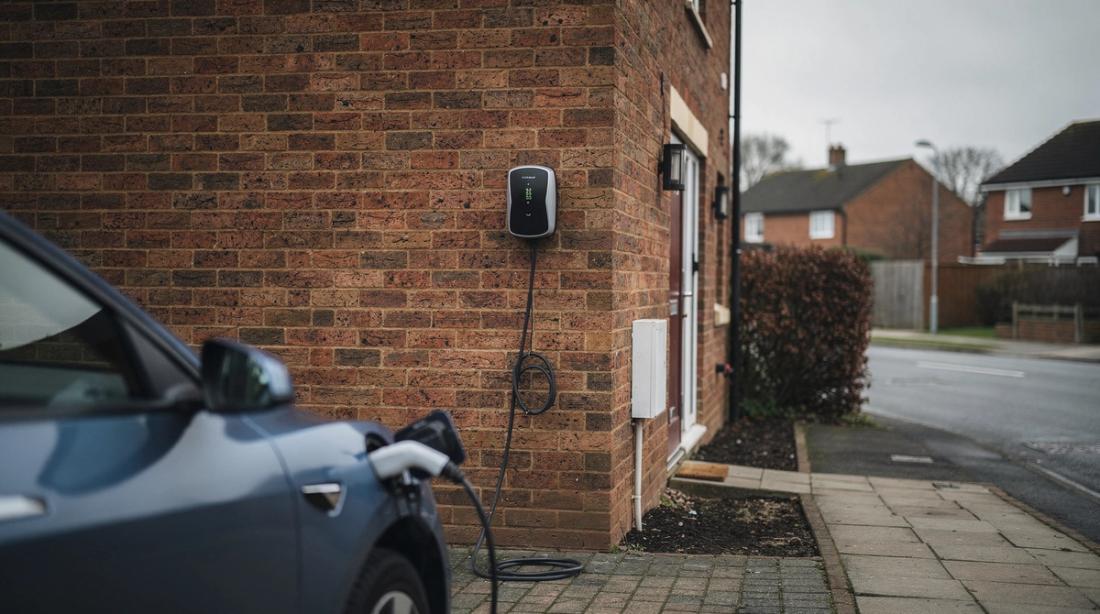

Most driveway EV charger installations in England have needed no planning permission since 29 May 2025, when the Town and Country Planning (General Permitted Development) (England) (Amendment) Order 2025 came into force (legislation.gov.uk, 2025). That single change cleared away a step that used to stall home jobs, and it landed alongside similar relaxations for air source heat pumps in the same order.
This guide is written for installers who quote and fit chargepoints and need to tell a customer, on the spot, whether the job needs planning consent. It covers what the 2025 rules changed, the permitted development limits that still apply to homes, the cases where full planning is unavoidable, and the building regulations you must notify on every install.
Key Takeaways
- Since 29 May 2025, a standard off-street home EV charger in England is permitted development and needs no planning application in most cases (legislation.gov.uk, 2025).
- Permitted development still carries limits: wall units must stay under 0.2 cubic metres and freestanding units under 1.6 metres tall.
- Flats, listed buildings, and homes in conservation areas or an Article 4 area can still need a planning application.
- Every install is notifiable under Part P and must be certified to BS 7671, whether or not planning applies.
- The chargepoint grant rose to 500 pounds per socket from 1 April 2026 and the scheme runs to 31 March 2027 (GOV.UK, 2026).
Do you need planning permission for a driveway EV charger?
For most homes in England the answer is no. Since 29 May 2025 an off-street chargepoint on a house counts as permitted development, so no planning application is required provided it sits within the property boundary and stays inside the size limits (legislation.gov.uk, 2025). The exceptions are specific and predictable, which makes them easy to screen for before you quote.
Permitted development is not the same as "no rules". It is a national grant of planning consent that applies only while the install stays inside defined conditions. Step outside them, or fit to a property type that is excluded, and the customer needs a full application to the local planning authority. Screening for that at survey stage protects your timeline and your reputation.
What the May 2025 rules changed
The 2025 Amendment Order revised Class D of Part 2 of the General Permitted Development Order, removing a condition that previously restricted where a domestic chargepoint could go (Explanatory Memorandum, 2025). In practice, a wall-mounted home charger can now face a highway, which was the main sticking point on terraced and front-garden installs before the change.
The government described the reform as deregulatory, cutting planning cost and delay with no significant new burden on business (Explanatory Memorandum, 2025). The same order also widened permitted development for off-street commercial chargepoints and support cabinets, so the change matters for workplace and forecourt jobs too, not only domestic driveways.
In day-to-day terms, the practical shift is on properties where parking sits at the front and the only sensible charger position points at the street. Before May 2025 those jobs often needed a conversation with the planning department or a compromise on cable routing. Now the same install proceeds as permitted development, which shortens lead times and removes a common reason for a homeowner to delay signing off a quote.
What are the permitted development limits for homes?
A home install stays within permitted development when it meets each of the physical limits below. Treat these as your survey checklist: if any line fails, the job likely needs a planning application.
- Wall-mounted unit size: no larger than 0.2 cubic metres (C+A Design, 2025).
- Freestanding unit height: no taller than 1.6 metres above ground level.
- Location: within the curtilage of the dwelling, on off-street parking the household controls.
- Position to highway: wall-mounted units may now face a highway following the May 2025 change.
- Property type: a house, not a flat or maisonette, unless full planning is obtained.
One point that trips up homeowners is the meaning of curtilage. The right applies to off-street parking within the property boundary, so a charger fitted to serve a space on the public verge or a shared access road is not automatically covered. On terraces with rear parking or shared drives, confirm who controls the ground before you treat the job as permitted development.
Keep the survey note. If a challenge ever arises, a dated record showing the unit dimensions and siting is the evidence that the install was permitted development on the day it was fitted. In practice we find that a photo of the wall position with a tape measure against the unit is enough to close out any later query from a buyer's solicitor.
When does planning permission still apply?
Planning permission is still required for chargepoints on flats and maisonettes, and for any install on a listed building, where listed building consent is a separate and stricter process (Property Passport, 2026). These are the cases most likely to catch out a homeowner who has read that "planning permission was scrapped".
Conservation areas, National Parks, Areas of Outstanding Natural Beauty, and World Heritage Sites can also restrict permitted development, especially where the council has issued an Article 4 Direction that withdraws the right locally (C+A Design, 2025). Always check the address against the local plan before you promise a no-consent install. A quick lookup at survey stage avoids an awkward call later.
Commercial and workplace EV chargers: what are the rules?
Off-street commercial and workplace installs also gained wider permitted development in 2025. A site can now install up to five wall-mounted or freestanding chargepoints under permitted development, with units up to 2.7 metres tall, provided they sit within the site boundary and, if freestanding, not within 2 metres of a highway (C+A Design, 2025). That covers most small car parks without a planning application.
Support infrastructure is treated separately. An equipment cabinet is permitted development when it is no taller than 3 metres and under 29 cubic metres in volume (C+A Design, 2025). Larger schemes, higher unit counts, or sites in a designated area still route through full planning, so scope the site early on commercial quotes.
Building regulations and Part P: what installers must notify
Planning and building regulations are separate approvals, and skipping the second is the more common installer error. A chargepoint almost always adds a new dedicated circuit, which makes it notifiable electrical work under Part P in England, certified to BS 7671 (NICEIC, 2026). This applies whether or not planning permission was needed.
If you are registered with a Competent Person Scheme such as NICEIC or NAPIT, you self-certify the work: you issue an Electrical Installation Certificate, notify your scheme, and the scheme issues a Building Regulations Compliance Certificate. The IET Code of Practice for Electric Vehicle Charging Equipment Installation sets the design detail, including BS 7671 Section 722 and PEN fault protection. Following it is how you demonstrate competence.
The certification pack matters beyond compliance. Homeowners increasingly need the Electrical Installation Certificate and the Building Regulations notification when they sell or remortgage, and a missing certificate can hold up a conveyance. Handing over a complete pack at the end of the job is a small step that saves you a support call months later and marks you out as the installer who does it properly.
How does the DNO fit in?
A single domestic 7kW charger usually needs a notification to the Distribution Network Operator rather than prior approval, but the rules tighten as load rises or where multiple low-carbon devices already sit on the supply. Where a property already has solar, a battery, or a heat pump, the cumulative demand can trigger a fuller application, so check the existing setup during survey.
Load management is the practical answer on constrained supplies. A charger with dynamic load balancing can share a domestic main fuse with other loads and often keeps a job inside the notify-only route. The same DNO discipline that governs solar export applies here, and our G99 application and DNO approval guide covers the thresholds in detail. Where the customer already has solar, pairing the charger with a self-consumption strategy adds value, and our solar diverter guide shows how surplus generation can be routed to the car or hot water.
Do EV charger grants still apply in 2026?
Yes, but they are now targeted rather than universal. From 1 April 2026 the grant rate rose from 350 to 500 pounds per socket, and the scheme is confirmed to run for one more year to 31 March 2027 (GOV.UK, 2026). The main routes now cover households who can only park on the street, landlords fitting chargers for tenants, and employers installing for staff.
The scale of the schemes is worth quoting to customers. Home charging grants have funded 410,081 installations since 2013, and the renters and flat owners route has funded 24,759 sockets (GOV.UK, 2026). Confirming eligibility before you quote lets you present a net price and win the job on clarity, not just headline cost. For a full cost breakdown, see our guide to EV charger installation cost.
Fitting it into your workflow
Screening for planning at survey is quick once you know the triggers: property type, designated area, and unit size. The same visit should confirm the Part P route, the DNO position, and any grant eligibility, so the quote you send is complete and defensible. Getting all four checks on one survey sheet is what separates a smooth EV job from a stalled one. A tool like Reonic can hold that survey checklist alongside the electrical design so nothing is missed on handover.
The heat pump side of the 2025 order followed the same logic, and if you also fit ASHPs it is worth reading our heat pump planning permission guide next. For the electrical certification detail behind every install, our Part P building regulations guide sets out what you sign and notify.
Frequently asked questions
Do I need planning permission for a driveway EV charger in England in 2026?
In most cases no. Since 29 May 2025 an off-street home charger is permitted development, provided the unit stays under 0.2 cubic metres if wall-mounted or 1.6 metres tall if freestanding and sits within your property. Flats, listed buildings, and conservation areas can still require a planning application.
Can a wall-mounted EV charger face the road now?
Yes. The May 2025 Amendment Order removed the condition that previously restricted a domestic chargepoint facing a highway, so a wall-mounted unit facing the road is now permitted development on most houses. Listed buildings and Article 4 areas remain exceptions that need a check before you fit.
Is an EV charger install notifiable under building regulations?
Yes. A chargepoint usually adds a new circuit, which is notifiable under Part P in England and must be certified to BS 7671. A Competent Person Scheme member self-certifies, issues an Electrical Installation Certificate, and the scheme issues a Building Regulations Compliance Certificate.
Do commercial EV chargers need planning permission?
Off-street commercial sites can install up to five chargepoints up to 2.7 metres tall under permitted development, with support cabinets up to 3 metres and 29 cubic metres. Larger schemes, higher counts, or sites in designated areas still need full planning, so scope commercial jobs early.
Is the EV chargepoint grant still available in 2026?
Yes, at 500 pounds per socket from 1 April 2026, running to 31 March 2027. The grant is now targeted at street-parking households, landlords, and employers rather than all homeowners, so confirm the customer qualifies under one of those routes before you include it in a quote.