
Wiring solar panels in series or parallel is the first electrical decision on every one of the 267,032 solar systems UK installers certified in 2025, a 31% jump past the record set in 2011 (MCS, 2026). It decides whether your array lands inside the inverter's MPPT window or falls outside it. The stakes are not small. At that volume, getting string wiring right is what separates a clean commissioning from a callback.
The rule itself is short. Series adds voltage and current stays flat. Parallel adds current and voltage stays flat. From that one split flows cable sizing, isolator ratings, shade behaviour and grid paperwork. This guide takes the installer's view. It covers how each method behaves on a real roof, how BS 7671 and the G98 and G99 rules bound your options, and how to pick the layout that commissions first time.
Key Takeaways
- Series raises voltage, parallel raises current. Three 40V panels in series give 120V at the same amps. The same three in parallel give 40V at triple the amps.
- The inverter MPPT window decides string length. Cold open-circuit voltage must stay under the inverter's maximum input. Operating voltage must sit inside the tracking range.
- Shading hits series strings hardest. The weakest module caps current for the whole string, so partial shade on one panel drags the rest down until bypass diodes react.
- UK rules bound the choice. G98 covers systems up to 3.68kW per phase. BS 7671 Section 712 requires every DC component rated for the full system voltage with temperature correction (SurgePV, 2026).
- Parallel strings usually need fuses. Once three or more strings run in parallel, fault current from the healthy strings can exceed a module's reverse-current rating.
What does wiring solar panels in series or parallel actually change?
Series and parallel change which electrical quantity stacks up. Wire panels in series, positive to negative down the string, and the voltages add. Current stays equal to one panel. Wire them in parallel, all positives joined and all negatives joined, and the currents add. Voltage stays at one panel's level. Everything downstream follows from that split.
Take a common 440W panel, rated near 40V at maximum power and about 11A. Put ten in series and the inverter sees roughly 400V at 11A. Split those ten into two parallel strings of five, and it sees roughly 200V at 22A. Same 4.4kW of modules. Two very different electrical shapes. Only one may fit a given inverter's input.
This post sits alongside our deeper solar PV string design guide, which works the full voltage-window maths step by step. Here the focus is narrower. It is the series versus parallel decision itself, and when each one wins.
Series wiring: when higher voltage pays off
Series wiring suits most UK domestic strings because higher voltage travels better. Push power at 350V to 450V rather than 50V, and current drops for the same watts. DC cable losses fall with it, and thinner conductors often do the job. A single series string also needs just one DC run back to the inverter. That keeps roof penetrations and connector count down.
String inverters are built for this. Their MPPT trackers expect a few hundred volts, and a series string delivers that from a handful of panels. The ceiling is the inverter's maximum DC input voltage. You must not exceed it, even on the coldest morning when open-circuit voltage peaks. UK residential arrays typically run between 200V and 600V DC on the string (SurgePV, 2026).
The trade-off is shade sensitivity and that voltage ceiling. A string sitting at 600V in summer heat can breach 700V on a frosty, bright January morning. So string length is always set by cold-weather open-circuit voltage, never by the nameplate figure.
Parallel wiring: when current and shade tolerance win
Parallel wiring earns its place when you need to hold voltage down or keep output up under uneven shade. Splitting an array into parallel strings lowers the peak voltage each conductor carries. That helps on large arrays, on lower-voltage battery-coupled inverters, and wherever a single series run would overshoot the input ceiling.
Parallel strings also fail more gracefully. Put one string under a chimney shadow for part of the day, and the others keep producing at full current. They are electrically separate paths. That independence is why multi-orientation roofs, east-west splits for example, usually give each face its own string or its own MPPT input rather than chaining them into one series run.
The cost is higher current. More amps means fatter DC cable to hold volt-drop in check, and it means overcurrent protection. Our guide on 4mm or 6mm solar cable shows where the sizing line falls for typical UK string currents.
How does shading change the series vs parallel decision?
Shading is where the two methods split most sharply. In a series string, current is common to every module. So the least-lit panel sets the current for the whole string. One shaded module can drag a long series string down until its bypass diodes conduct and route current around the shaded cell group (Fronius, 2023).
Bypass diodes limit the damage. They do not erase it. When a diode conducts, that cell group drops out entirely, so the string loses a third or two-thirds of a module rather than the whole panel. Half-cell modules improve on this again. Shade the lower half of such a module, and the upper half can still produce at full output.
Parallel layouts help by isolating strings. For scattered shade, though, the sharper fix is module-level electronics. Where dormers, flues and trees break up a roof, optimisers or microinverters often beat any pure series-or-parallel layout. We compare the two in our solar optimisers vs microinverters guide.
Series vs parallel: the installer's comparison
The table below sums up how each method behaves on the metrics that decide a UK design. Read it as a first filter. Then confirm against the specific inverter datasheet and the coldest expected site temperature before you commit string lengths.
- Voltage: Series adds up (panels stack); parallel stays at one panel.
- Current: Series stays at one panel; parallel adds up (strings stack).
- DC cable size: Series thinner, lower current; parallel thicker, higher current.
- Shade behaviour: Series weakest panel limits string; parallel strings fail independently.
- Overcurrent protection: Series often none needed; parallel string fuses from 3+ strings.
- Typical UK use: Series standard domestic string; parallel large arrays, multi-orientation.
- Main risk: Series cold Voc exceeding inverter max; parallel volt-drop and reverse fault current.
Most UK domestic jobs end up as one or two series strings feeding a string inverter. Parallel is reserved for larger or split-roof work. The choice is rarely either-or across a whole system. It is made per MPPT input.
How do UK grid and wiring rules shape your choice?
UK rules do not dictate series or parallel directly. They bound the array that your wiring has to deliver. Systems up to 3.68kW per phase, which is 16A per phase, connect under G98 with notification to the DNO within 28 days. Anything above needs G99 approval before connecting (Selectra, 2026). That AC-side threshold often sets the inverter, which then sets the string voltage you must hit.
On the DC side, BS 7671 Section 712 governs, in its 2018 plus Amendment 2 2022 edition. It requires every component, cables, connectors, isolators and inverter, rated for the maximum system voltage including temperature correction (SurgePV, 2026). A higher-voltage series string lifts the rating every DC part must meet. Your DC isolator must also sit within three metres of the inverter and carry that voltage and short-circuit current.
Export limitation can steer the design too. Where a DNO caps export, a limitation device holds grid feed-in below the agreed figure. It does not restrict what the panels generate for self-consumption. So the array, and its string layout, need not shrink to match the export cap.
String sizing and the inverter MPPT window
String sizing is where the decision gets locked in. The rule is simple to state and strict to meet. The string's open-circuit voltage at the coldest expected temperature must stay below the inverter's absolute maximum DC input. The operating voltage must stay inside the MPPT range all year. Miss the top and you risk the inverter. Miss the bottom and it stops tracking.
Open-circuit voltage rises as temperature falls. A string sized on summer figures can overshoot in winter. UK designers correct Voc to the lowest expected ambient, often around minus 10C to minus 15C by region. That can add roughly 8% to 10% over the nameplate Voc. The correction is what caps how many panels go in one series string.
Cable and testing rules then follow the layout. PV DC cable to EN 50618 is rated for 1000V or 1500V DC and a range of minus 40C to plus 90C. Commissioning requires an insulation resistance result of at least 1 megohm, tested at twice the open-circuit voltage (SurgePV, 2026). The DC isolator must carry the same worst-case voltage.
What wiring mistakes cost UK installers most?
The costliest errors are predictable. Sizing a series string on nameplate Voc rather than cold Voc is the classic. The system passes in July and trips the inverter on the first hard frost. On parallel work, the frequent miss is skipping string fuses once three or more strings share a combiner. A faulted string can then take reverse current above a module's rated limit from the healthy strings.
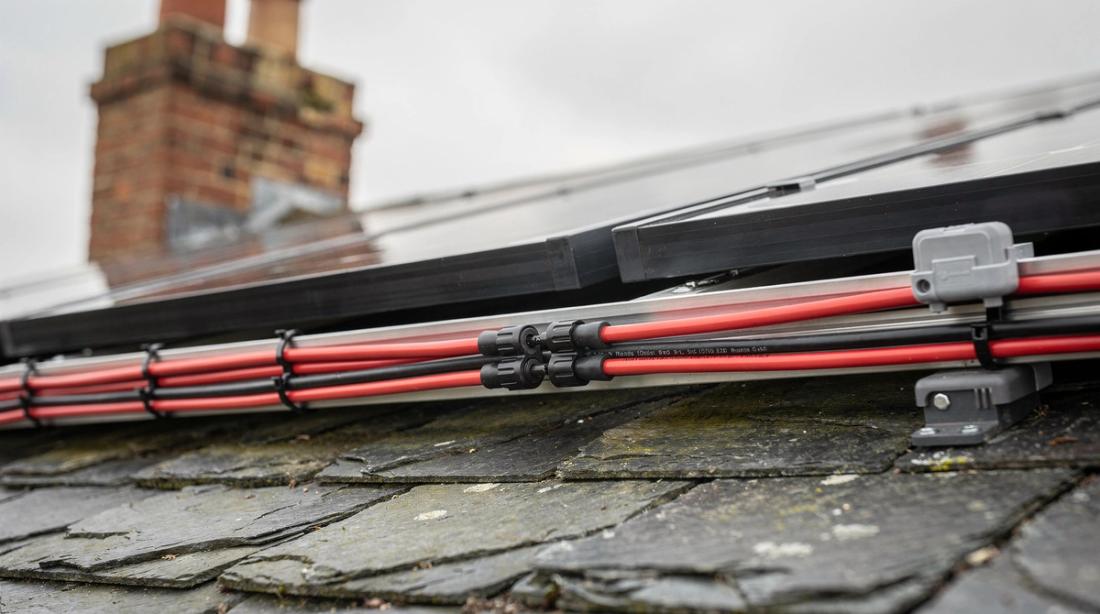
A field note from repeat callbacks: connector discipline matters more than the series-or-parallel choice itself. Crossing a positive and negative between adjacent strings causes grief. So does mixing MC4-style connectors from two brands that look identical but are not intermateable. Those errors cause more commissioning failures than voltage-window mistakes. Label each string at the isolator, and keep connector brands consistent down a run.
A second field lesson is to design per MPPT, not per roof. The record year bears this out, with 36% of 2025 solar installs landing on new builds where roof shapes are increasingly complex (Energy Manager, 2025). On east-west splits, putting each face on its own tracker almost always recovers more annual yield than forcing both into one compromise series string.
For installers standardising this call across many jobs, keeping string voltage limits, G98 thresholds and cable sizing in one design workflow saves rework. Reonic's design tools lock the series or parallel decision to each inverter before anyone climbs a ladder.
Frequently asked questions
Is it better to wire solar panels in series or parallel?
Neither is universally better. It depends on the inverter and the roof. Most UK domestic systems use series strings, because higher voltage cuts current, cable loss and connector count, and suits string inverters. Parallel wins on large arrays, low-voltage inverters, or shaded and multi-orientation roofs where independent strings protect yield. The decision is made per MPPT input, not per system.
Does series or parallel produce more power?
Neither produces more power from the same panels in full sun. Watts equal volts times amps either way. The difference is behaviour. Series concentrates voltage, parallel concentrates current. The better choice is the one that keeps the array inside the inverter's MPPT window and handles the site's shading. Power is only lost when the layout pushes the string outside that window.
How many solar panels can I wire in series?
There is no fixed count. The limit is the inverter's maximum DC input voltage, checked against the string's open-circuit voltage at the coldest expected temperature. Cold weather can lift Voc by roughly 8% to 10% over nameplate, so designers size to minus 10C or lower. A typical UK string runs 6 to 14 panels, but always confirm against the inverter datasheet.
Do I need fuses for parallel solar strings?
Usually yes, once three or more strings run in parallel. With two strings, a fault in one can only draw from one other, which most modules tolerate. With three or more, combined reverse current from the healthy strings can exceed a module's maximum reverse-current rating. String fuses or a protected combiner are then required. One or two parallel strings often need none.
What UK regulations apply to series and parallel PV wiring?
BS 7671 Section 712, in the 2018 plus Amendment 2 2022 edition, governs DC design. It demands every component rated for the full system voltage with temperature correction (SurgePV, 2026). On the AC side, G98 covers up to 3.68kW per phase with 28-day DNO notification, and G99 applies above that with prior approval (Selectra, 2026).