
Choosing between 4mm or 6mm solar cable comes down to two numbers, current-carrying capacity and voltage drop, and a 4mm2 H1Z2Z2-K cable already carries around 57A when laid freely in air (KBE Elektrotechnik, 2025). That figure sits far above any single UK domestic string current, so for most residential arrays the 4mm2 cable that ships pre-fitted to the panels is electrically adequate on ampacity alone.
The real decision is whether voltage drop over the cable run pushes you up to 6mm2. DC cable sizing in the UK is governed by BS 7671 Section 712 and the MCS installation standard MIS 3002, not by habit or by whatever is on the van. Undersize the cable and you lose yield and risk overheating. Oversize every run and you waste copper and money. This guide works through the current, temperature and volt-drop rules so you can size 4mm or 6mm cable with evidence rather than guesswork.
Key Takeaways
- A 4mm2 solar cable carries about 57A laid freely in air, and 6mm2 carries more with lower resistance. Both sit well above a typical string's operating current, so ampacity is rarely the deciding factor for domestic work.
- Voltage drop usually decides the size. UK practice targets 3% or less across the DC side, and every 1% of voltage drop costs roughly 1% of annual yield.
- Cables derate on hot roofs. Current-carrying capacity falls by about 5% for every 10C above 30C ambient, so summer rooftop conditions erode the margin.
- Use only EN 50618 H1Z2Z2-K solar cable rated 1500V DC and rated from -40C to +90C. Standard building cable is not permitted on the DC side.
- Step up to 6mm2 for long DC runs, paralleled strings, higher-current modules, or any run where 4mm2 would breach the 3% voltage-drop target.
What is the difference between 4mm and 6mm solar cable?
The difference is cross-sectional area, and it drives both resistance and heat. A 6mm2 conductor has more copper than a 4mm2 one, so it has lower resistance, a lower voltage drop over the same run, and a higher current-carrying capacity. As a rule of thumb, doubling the cross-section adds roughly 40% more current-carrying capacity (KBE Elektrotechnik, 2025). Both sizes share the same H1Z2Z2-K construction and voltage rating.
Physically the two are almost interchangeable at the connector. Both accept standard MC4-type crimps, both are single-core double-insulated cable, and both are rated the same 1500V DC and -40C to +90C (Eland Cables, 2026). What changes is the electrical headroom and the price per metre. The list below sets out the practical differences an installer weighs on site.
- Current-carrying capacity (laid freely in air): 4mm2 around 57A; 6mm2 around 40% higher than 4mm2.
- Relative resistance and voltage drop: 4mm2 higher; 6mm2 lower.
- Typical use: 4mm2 for pre-fitted module leads and short to medium DC runs; 6mm2 for long DC runs, paralleled strings and high-current modules.
- Voltage and temperature rating: both 1500V DC and -40C to +90C.
- Copper content and cost per metre: 4mm2 lower; 6mm2 higher.
How much current can 4mm and 6mm solar cable carry?
A 4mm2 H1Z2Z2-K cable carries about 57A when laid freely in air, and 6mm2 carries proportionally more (KBE Elektrotechnik, 2025). Compare that with a modern module, whose short-circuit current is typically in the low teens of amps, and it is clear that a single string rarely troubles either cable on ampacity. The headroom is deliberate, because roof conditions cut it down.
Two factors erode the free-air figure. Bundling cables together, or running them in conduit or trunking, reduces heat dissipation and therefore capacity, and derating factors from IEC 60364-5-52 must then be applied (KBE Elektrotechnik, 2025). Temperature does the same: capacity falls by roughly 5% for every 10C above 30C ambient. On a south-facing slate roof in summer, surface temperatures sit well above 30C, so the usable rating is lower than the datasheet headline. In practice we derate rather than trust the free-air number, then check the result against the string design.
Why voltage drop usually decides the cable size
For domestic strings the limiting factor is almost never ampacity, it is voltage drop over the run. UK sizing practice, following BS 7671 and MCS guidance, targets a DC voltage drop of 3% or less from array to inverter, with 2% treated as good and 1% as best in class (TradeCalcs, 2026). The reason is direct: every 1% of voltage drop in the DC cabling removes about 1% of annual energy yield (ELEK, 2025).
A worked example shows how the sizes diverge. A short string run of a few metres in 4mm2 will sit comfortably under 1% drop. Stretch that run to 30m or more, or parallel two strings so the current doubles in the shared cable, and 4mm2 can push past the 3% target while 6mm2 brings it back inside. The calculation is standard resistance times current times length, so a longer run or a higher current both point the same way, towards the larger conductor. This is why two identical arrays can justify different cable sizes purely on cable-run geometry.
When should you use 6mm solar cable?
Reach for 6mm2 whenever 4mm2 would breach the 3% voltage-drop target, and that happens in four common situations: long DC runs from a far roof plane back to the inverter, paralleled strings where current adds up in the shared home run, higher-current modules or larger commercial strings, and hot or bundled routing where derating bites hardest. In each case the extra copper buys back either voltage-drop margin or thermal margin.
Cost sits on the other side of the scale. A 6mm2 cable holds more copper, and with the copper price above 1,200 EUR per 100kg in mid-2026 the material premium is real on a large job (KBE Elektrotechnik, 2025). In practice the 4mm2 tails moulded onto most modules set a floor, so there is little point running 6mm2 string cable back to a 4mm2 panel lead unless the run length genuinely demands it. Size the home run on the numbers, and keep the string interconnects at whatever the modules ship with.
What do BS 7671 and MCS require for DC cable sizing?
BS 7671 Section 712 covers solar photovoltaic power supply systems and supplements the general wiring rules with PV-specific requirements for DC wiring, isolation, protection, earthing and labelling (SurgePV, 2025). Appendix 4 of BS 7671 provides the method for cable sizing, including the derating factors to apply and the typical current-carrying capacities for common cable types. The current edition is BS 7671:2018+A3:2024, whose Amendment 3 took effect on 31 July 2024 and clarified protective-device arrangements for PV and battery systems (Electrical4Less, 2024).
MCS layers its own installation standard on top. MIS 3002 sets the solar PV installation requirements that MCS-registered contractors must meet, and it references correct conductor sizing and protection as part of a compliant install (MCS, 2025). For an installer the practical reading is simple: size the DC cable by the BS 7671 method, keep the voltage drop inside the accepted target, document the calculation, and the choice between 4mm or 6mm becomes a defensible design decision rather than a preference.
Do you need string fuses with 4mm or 6mm cable?
Cable size and string fusing are separate questions, but they interact. String overcurrent protection is generally not required for one or two parallel strings, because there is no other string able to push fault current back into a faulted one. Once three or more strings are paralleled, string fuses or protection become necessary, and each fuse is rated above the module short-circuit current, commonly the module Isc multiplied by 1.25 (Viox, 2025).
Where fusing is present, the cable must carry the prospective fault current without damage, which is another reason the ampacity headroom in 4mm2 and 6mm2 matters. The fuse protects the cable, and the cable must be rated to sit behind that fuse. On a two-string domestic array with no string fuses, the modules themselves limit the current, and 4mm2 handles it with room to spare. On a larger multi-string array, confirm the protection scheme first, then size the shared conductors to suit.
Getting cable type and installation right
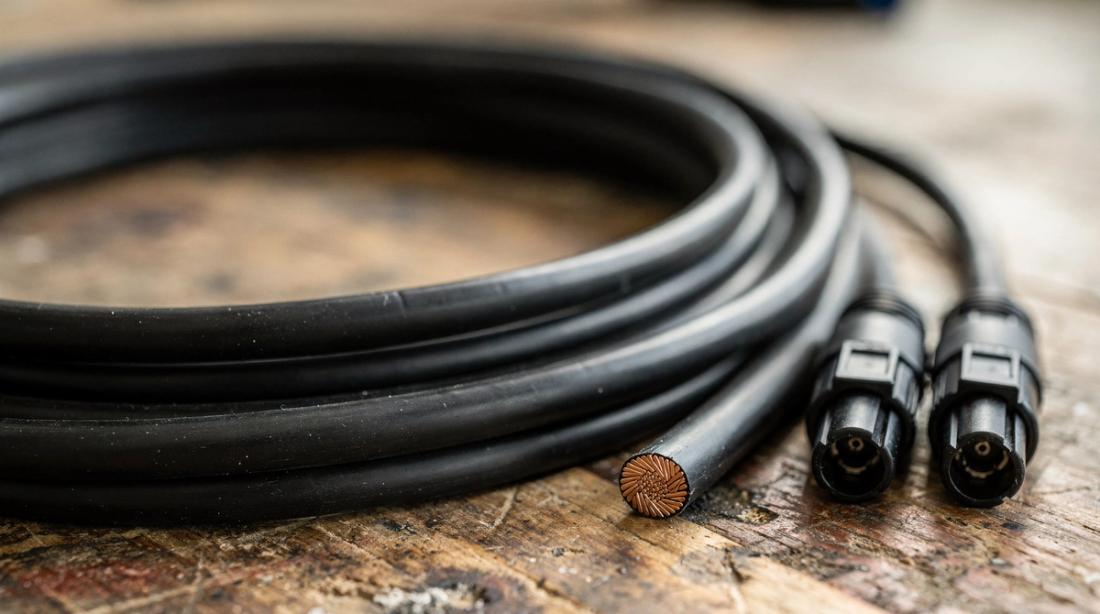
Use only cable designed for the DC side. The harmonised type designation is H1Z2Z2-K to EN 50618, which superseded the older PV1-F, built with a Class 5 flexible tinned-copper conductor and low-smoke zero-halogen cross-linked insulation and sheath (Eland Cables, 2026). It is UV and ozone resistant, water resistant to AD8, and rated for continuous operation up to 90C with a short-term maximum conductor temperature of 120C. Standard building cable such as NYY is not UV or DC rated and must not be substituted.
Installation drives real-world performance as much as the size on the drum. Support cable to avoid strain on connectors, keep positive and negative separated where practical to reduce loop area, and avoid tight bundling that traps heat. Extend cable only with matching connectors and the same cross-section, never a size step in the middle of a run. These details protect the voltage-drop budget you calculated and keep the installation inside its thermal rating for the full 25-year design life expected of quality solar cable.
Sizing 4mm or 6mm cable: an installer's checklist
Work the decision in order rather than defaulting to a size. First, take the string operating and short-circuit currents from the module datasheet and the array single-line diagram. Second, measure the real home-run length, roof plane to inverter, not the straight-line distance. Third, calculate the DC voltage drop for 4mm2 and check it against the 3% target. If it passes with margin, 4mm2 is the answer. If it is close or over, step to 6mm2 and recalculate.
Then apply the environmental and protection checks: derate for rooftop temperature and any bundling, confirm the string-fusing scheme for three or more parallel strings, and record the calculation in the design pack. Tools such as the Reonic platform can hold the string design and cable schedule alongside the rest of the job file, which keeps the sizing evidence with the MCS and DNO application paperwork. The habit that separates a clean install is treating cable size as a calculated output, documented and defensible, not a rule of thumb pulled from memory.
Frequently Asked Questions
Is 4mm solar cable enough for a domestic solar system?
For most UK domestic strings, yes. A 4mm2 cable carries around 57A laid freely, far above a single string's current, and modules usually ship with 4mm2 tails already fitted. The check that matters is voltage drop over the home run. If a short-to-medium run stays under the 3% target, 4mm2 is compliant and economical.
When is 6mm solar cable worth the extra cost?
Move to 6mm2 when 4mm2 would breach the 3% voltage-drop target, which happens on long DC runs, paralleled strings where current adds up, or higher-current modules. The larger conductor cuts resistance and voltage drop, buying back yield. Since every 1% of drop costs about 1% of annual generation, the copper premium often pays for itself on longer runs.
Can I mix 4mm and 6mm solar cable in one string?
You should avoid changing conductor size mid-run. Extensions must use matching connectors and the same cross-section, so a run stays one size end to end. It is normal, though, for the module's factory-fitted 4mm2 leads to meet a separately sized home-run cable at a connector, provided each section is rated for the current it carries.
What current can 6mm solar cable carry?
A 6mm2 H1Z2Z2-K cable carries meaningfully more than 4mm2, following the rule of thumb that doubling cross-section adds about 40% capacity, so from a roughly 57A free-air figure for 4mm2 the 6mm2 sits higher again. Rooftop temperature and bundling derate that value, so always apply the correction factors rather than the free-air headline.
Does cable size affect solar panel performance?
Yes, through voltage drop. Undersized cable raises resistance, and every 1% of DC voltage drop removes roughly 1% of annual energy yield. Oversized cable wastes copper and money for little further gain once you are already inside the 3% target. The aim is to size the conductor so voltage drop sits comfortably within the accepted limit for the whole run.