
Heat pump planning permission is not required for most air source installations in England, because the government scrapped the 1 metre boundary rule and widened permitted development on 29 May 2025 (pv magazine, 2025). For installers, that means fewer jobs stall before they start, but the handful of conditions that survived the reform are the ones that still catch people out on site.
The rules live in Class G, Part 14 of the General Permitted Development Order, most recently amended by the 2025 Order (legislation.gov.uk, 2025). This guide sets out when an air source heat pump is permitted development, when it still needs a full application, and how the MCS 020a sound calculation decides the result on the majority of domestic jobs.
Key Takeaways
- Most domestic air source heat pumps in England are permitted development and need no planning application, as long as they meet the Class G limits and pass the MCS 020a noise condition.
- The 1 metre boundary rule ended on 29 May 2025, so an outdoor unit can now sit against a fence or wall where the sound assessment allows it.
- A house may carry an outdoor unit up to 1.5 cubic metres; a detached home can have two units under permitted development, while other houses and blocks of flats are limited to one.
- Listed buildings, scheduled monuments and Article 4 areas sit outside permitted development and need a planning application every time.
- From 28 May 2026, MCS 020a becomes the only certification scheme accepted for permitted development, so the noise calculation is not something you can skip.
Do air source heat pumps need planning permission?
In most cases, no. Air source heat pumps have counted as permitted development on domestic premises in England since 1 December 2011, and the 2025 reforms widened that scope again (Planning Portal, 2026). A planning application is only triggered when a Class G limit is breached or the property sits on protected land.
That default matters commercially. The reform sits inside the Warm Homes Plan and the government target of 600,000 heat pump installations a year by 2028 (Logic4training, 2025), and cutting planning out of most jobs is central to reaching it. The burden sits with the installer to prove compliance, not with the council to grant it, so your paperwork is what protects the job if a neighbour later complains.
One caveat is worth stating early. Planning is devolved, and the Planning Portal guidance described here applies to England, with Wales, Scotland and Northern Ireland running their own permitted development regimes (Planning Portal, 2026). If you install across a border, treat each nation's rules as separate and check the local position before quoting the job as permitted development.
What changed for heat pump planning on 29 May 2025?
The Town and Country Planning (General Permitted Development) (England) (Amendment) Order 2025 came into force on 29 May 2025 (legislation.gov.uk, 2025). It removed the 1 metre boundary rule, raised the outdoor unit size cap to 1.5 cubic metres, allowed two units on detached homes and brought air-to-air systems into scope.
MCS confirmed the same four changes when it reissued its planning standard: the boundary rule gone, the size limit lifted from 0.6 to 1.5 cubic metres, the count doubled from one to two on detached dwellings, and air-to-air units that also cool now supported (MCS, 2025). Together these open up terraced and semi-detached streets where the old 1 metre rule had blocked the only sensible unit position.
The permitted development limits at a glance
These are the core Class G limits you check before treating a job as permitted development (Planning Portal, 2026). Miss any one of them and the installation needs a full planning application before work starts.
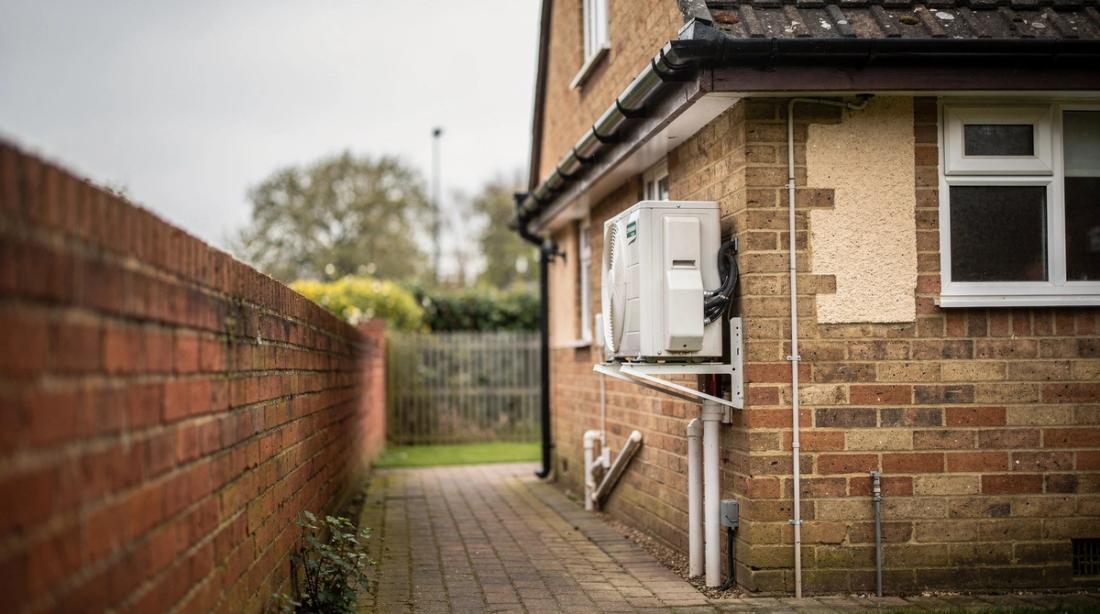
- Outdoor unit volume: up to 1.5 cubic metres on a house, or 0.6 cubic metres on a block of flats.
- Number of units: two on a detached house, one on any other house or on a block of flats.
- Boundary distance: no minimum since 29 May 2025, so the unit may sit on the boundary if the sound calculation passes.
- Roof mounting: not permitted on a pitched roof; on a flat roof every part must be at least 1 metre from the external edge.
- Existing wind turbine: none may already be present, or the heat pump loses its permitted development status.
- Use and removal: the unit must not be for cooling only, and must be taken down once it is no longer needed for microgeneration.
When does a heat pump still need planning permission?
A full application is needed whenever the property is a listed building or a scheduled monument, when a second unit is added to a house that is not detached, or when permitted development rights have been withdrawn locally by an Article 4 Direction (Planning Portal, 2026). Each of these puts the job back into the formal system.
Two site conditions trip installers up most often. On land inside a conservation area or World Heritage Site, the unit must not go on a wall or roof that fronts a highway, or nearer to that highway than the building itself. And a pitched-roof mount is never permitted development, so a unit slung on tiles always needs an application regardless of noise.
Exceeding the volume or unit count also removes the right. Reviewing regulation alongside our heat pump regulations guide helps you spot where the wider compliance regime overlaps with the planning question on a given site.
How the MCS 020a sound assessment decides it
Permitted development hinges on passing the MCS 020a sound calculation, which caps noise at 42 dB(A) at the nearest neighbour's habitable room window (MCS, 2025). Compliance has been mandatory for permitted development installations since 20 September 2025, whether or not the installation itself is MCS certified.
MCS split the old standard in March 2025 into MCS 020a for air source heat pumps and MCS 020b for small wind turbines (MCS, 2025). The 020a Excel tool now models up to two units for a permitted development job and up to four where full planning is being sought, and it draws the sound power level from the figure held on the MCS Product Directory.
In the field the assessment result usually turns on two things the revised standard clarified: what counts as a solid barrier, and where the assessment position sits relative to reflective surfaces. A close fence or a facing wall can swing a borderline calculation, so we run the sheet at the exact proposed position rather than a hopeful one, then keep the printout with the job file.
Unit selection feeds straight into that number. Because the tool pulls the declared sound power level from the Product Directory, a quieter model can be the difference between a pass and a fail on a tight plot, and it is far cheaper to specify the right unit at quotation than to add an acoustic barrier after a complaint. We note the target position and the chosen unit together so the calculation reflects what actually gets installed.
Getting the acoustic and design detail right early avoids a redesign later, which is why we pair the noise check with the heat loss survey and confirm the emitter plan through our radiator sizing guide on the same visit.
What about flats, conservation areas and listed buildings?
These three property types carry the tightest limits (Planning Portal, 2026). A block of flats is capped at one outdoor unit of no more than 0.6 cubic metres, and a leaseholder still needs the freeholder's consent under the lease, which is a separate legal step from planning and easy to forget.
In a conservation area or World Heritage Site, permitted development survives only where the unit avoids any wall or roof fronting a highway. A listed building is different again: no heat pump qualifies as permitted development within its curtilage, so the job needs a planning application and will usually need listed building consent for any fixing into historic fabric.
Air-to-air systems now sit inside the same Class G framework, which matters for the growing number of cooling-capable retrofits covered by the air to air heat pump grant. The unit still must not be used solely for cooling if it is to stay within permitted development.
The installer's pre-installation planning checklist
A short site check before you quote saves a stalled installation later. Confirm the property type and whether it is detached, because that sets the unit count. Check for listed status, a conservation area boundary or an Article 4 Direction on the local authority map, since any one of them removes the automatic right.
Then run the MCS 020a sheet at the real proposed position and record the result. On tight terraced plots we now place units against the boundary that the pre-2025 rule would have blocked, and the calculation still governs, so a compliant number on paper is what turns that position from risky into routine.
Keep the Class G checklist and the sound calculation in the handover pack so the audit trail is complete if anyone queries the job. Tools like Reonic can hold that paperwork next to the DNO and MCS records for each installation, which keeps a growing book of work tidy without extra admin. For the grid-side steps, our G98 notification guide covers what follows once the planning question is settled.
Frequently asked questions
Do I need planning permission for an air source heat pump in England? Usually not. Since 1 December 2011 domestic air source heat pumps have been permitted development, and the 2025 reforms widened that (Planning Portal, 2026). You only need an application if you breach a Class G limit or the property is listed or in an Article 4 area.
How close to the boundary can a heat pump be in 2026? There is no fixed minimum. The 1 metre boundary rule was removed on 29 May 2025, so a unit can sit against a fence or wall (pv magazine, 2025). The real constraint is the MCS 020a sound calculation, which must still pass at that position.
Does a heat pump on a listed building need permission? Yes. No air source heat pump within the curtilage of a listed building qualifies as permitted development (Planning Portal, 2026). The job needs a planning application, and any fixing into historic fabric will usually also need listed building consent from the local authority.
Is MCS 020a compulsory for permitted development? Yes, since 20 September 2025 (MCS, 2025). The sound calculation must be completed for any permitted development installation, certified or not. From 28 May 2026 MCS 020a becomes the only certification scheme accepted for the permitted development route.
Do air-to-air heat pumps count as permitted development? They can. The 2025 Order brought air-to-air systems, including reversible cooling units, into Class G (legislation.gov.uk, 2025). The unit must not be used solely for cooling, and it still has to meet the same size, siting and MCS 020a noise conditions.