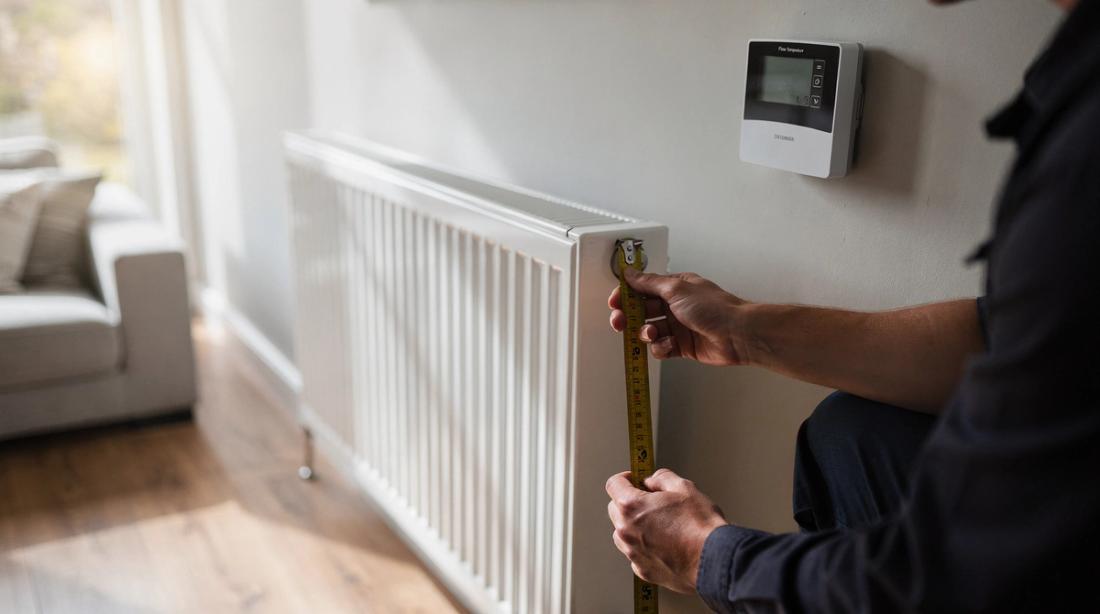

Radiator sizing for heat pumps is the difference between a system that holds temperature and one that never quite gets there, because at a 45C flow temperature a typical radiator delivers only about 42% of its rated output (squote, 2026). Design a heat pump job around the catalogue figure printed on the box and the house will feel cold on the days it matters most.
The stakes keep rising as heat pumps scale. MCS has now certified more than 250,000 heat pump installations, with 2025 the strongest year on record, up 34% on 2024 (MCS, 2026), much of it driven by grant-backed replacements of oil and gas boilers. This guide sets out the sizing method an installer uses to get emitters right the first time.
Key Takeaways
- Radiators are rated at delta T 50 (75/65/20C), a condition a heat pump almost never reaches, so the catalogue figure overstates real output.
- At a 45/40C flow and return, a radiator gives roughly 42% of its rated output, so most emitters need upsizing to run at low flow temperatures.
- Convert output with the correction factor: actual output equals rated output times (delta T divided by 50) raised to about 1.3.
- Size to a room-by-room heat loss, not a whole-house average, as required by the MCS Heat Pump Design Standard MIS 3005-D.
- A lower design flow temperature raises efficiency but demands larger emitters, so sizing and system performance are the same decision.
Why radiator sizing changes for heat pumps
A gas boiler pushes water out at 70 to 80C, so small radiators cope. A heat pump works best at 35 to 45C, where the same radiator gives a fraction of its rated heat. The updated MIS 3005-D, mandatory for MCS contractors since 2025, makes low-temperature design the baseline (MCS, 2025).
The reason is physics, not brand. A radiator moves heat by the difference between its surface and the room. Drop the water temperature and you shrink that difference, so output falls fast. Every emitter in the house has to hand over its full design heat at the flow temperature the pump will actually run, on the coldest day of the year.
What is a radiator's rated output, really?
The watts on a data sheet are measured at delta T 50, meaning 75C flow, 65C return and a 20C room, under the EN 442 standard (Zehnder, 2026). Delta T is the gap between the mean water temperature and the room, so 50 here is a boiler condition, not a heat pump one.
This single point causes most undersizing. A radiator marked 1,500W is a 1,500W radiator only at delta T 50. Run it at heat pump temperatures and the honest figure is far lower. The EN 442 standard exists so you can compare products fairly, but it was never meant to describe how an emitter behaves on a low-temperature system.
How much output do you lose at low flow temperatures?
A lot. At 45/40C flow and return, which is delta T 22.5 against a 20C room, a radiator delivers about 42% of its rated output (squote, 2026). Drop lower still and the loss deepens, which is why emitter area, not boiler-era habit, drives the design.
At delta T 30, roughly a 55/45C system, output sits around 51% of the rated figure (P&H Engineering, 2026). The table below shows how quickly the catalogue watts fall away as flow temperature drops, using a 20C room as the reference.
- 75/65C, delta T 50: 100% of rated output, the EN 442 catalogue baseline.
- 55/45C, delta T 30: about 51% of rated output (P&H Engineering, 2026).
- 45/40C, delta T 22.5: about 42% of rated output (squote, 2026).
- 45/35C, delta T 20: roughly 30% of rated output, derived from the delta T rule.
- 40/30C, delta T 15: roughly 21% of rated output, derived from the delta T rule.
Read those numbers as a warning against reusing gas-era radiators without checking. The same steel panel that heated a room on a boiler can leave it two or three degrees short on a heat pump running at 45C.
How do you apply the correction factor?
Use one formula. Actual output equals rated output times the ratio of your delta T to 50, raised to the power of about 1.3, the EN 442 radiator exponent. So a 1,500W radiator at delta T 22.5 gives roughly 630W. Work in watts, per room, at your design flow temperature.
Set your design flow temperature first, then match each radiator to its room heat loss at that temperature. If a room loses 800W and the fitted radiator gives 630W at your design condition, it is undersized by 170W and needs a larger panel or a second emitter. Good heat loss software applies the correction factor automatically, but you should know the maths behind it.
Do you always need bigger radiators?
Not always, but often. To run at 45C, existing radiators typically need upsizing by around 2.4 times, or you switch to low-temperature emitters such as underfloor heating or fan coils (squote, 2026). Some already generously sized rooms pass as they are, which is why you check each one.
Depth and double panels help more than length in tight spaces, and a type 22 often replaces a type 11 without moving pipework. Where emitters cannot grow, a lower design flow temperature with underfloor heating is the cleaner answer. System hydraulics matter too, so factor in whether the design needs a buffer tank or volumiser to hold volume and protect defrost cycles.
Sizing to the room, not the house
Each room is its own calculation. The MCS Heat Emitter Guide takes a room-by-room heat loss and pairs it with the emitter, and a design at 40 to 45C flow scores four stars for expected performance (MCS Heat Emitter Guide). A whole-house average hides the one cold bedroom that generates every callback.
This is why radiator sizing starts with a proper heat loss survey to BS EN 12831. The survey gives you the watts each room needs. The correction factor tells you what each emitter delivers at your flow temperature. Sizing is simply making the second number meet the first, room by room, with a sensible margin for recovery.
Common radiator sizing mistakes
The mistakes repeat across jobs: sizing at delta T 50, averaging the whole house, and quietly raising the design flow temperature to make undersized radiators work. We have seen a system spec change from 45C to 55C late in design just to avoid two radiator swaps, which then costs the homeowner in running efficiency for the life of the system.
Design the emitters for the flow temperature you promised, size every room to its own heat loss, and keep the correction factor in front of you the whole time. A costing tool like Reonic that carries the design flow temperature through to the quote helps stop a late compromise turning into a lifetime of poor performance.
Frequently asked questions
Can I use my existing radiators with a heat pump?
Sometimes, but you must check each one at your design flow temperature, not assume it. Radiators sized generously for a gas boiler occasionally pass, while most need upsizing to give enough heat at 45C. The only safe method is a room-by-room calculation with the correction factor applied to every emitter.
What flow temperature should I design radiators for?
A design flow temperature of 40 to 45C is a sound target, scoring four stars in the MCS Heat Emitter Guide for expected performance. Lower flow temperatures raise efficiency but need larger emitters. The right figure balances the radiators the house can take against the seasonal efficiency the homeowner wants.
How do I convert a radiator's rated output to heat pump conditions?
Multiply the rated output by your delta T divided by 50, raised to the power of about 1.3. Delta T is the mean water temperature minus the room temperature. At delta T 22.5, roughly 45/40C flow and return, that gives about 42% of the catalogue watts, so a 1,500W radiator delivers near 630W.
Are bigger radiators always the answer?
No. Upsizing panels or moving to double convectors solves most rooms, but underfloor heating and fan coils give low-temperature output where wall space is tight. The design goal is enough emitter surface at your chosen flow temperature, whether that comes from larger radiators or a different emitter type in the room.
What is delta T in radiator sizing?
Delta T is the difference between the mean water temperature in the radiator and the room air temperature. Radiators are rated at delta T 50, a boiler condition. Heat pumps run at a much smaller delta T, which is exactly why output falls and why sizing has to be recalculated for every low-temperature job.