
Solar optimisers sit between the simplicity of a string inverter and the panel-level independence of microinverters, and for many UK roofs they are the pragmatic middle path. A power optimiser performs maximum power point tracking on each panel and conditions the DC voltage before a central string inverter converts it to AC, which can lift yield on shaded or complex arrays by roughly 5 to 25% (Solar Advice UK, 2025). Choosing between optimisers, microinverters, and a plain string inverter is one of the first design calls an installer makes.
This comparison sets out how the three architectures differ, what each costs in the UK, where module-level power electronics earn their place, and the safety and reliability trade-offs that matter on real roofs. The goal is a clear decision framework you can apply per site rather than a blanket rule, because the same array that justifies optimisers on a shaded terrace can be over-specified on a clean south-facing roof next door.
Key Takeaways
- A power optimiser does panel-level MPPT and feeds a central string inverter; a microinverter converts DC to AC at each panel; a string inverter handles everything centrally.
- Optimisers and microinverters both beat plain string inverters on shaded, multi-orientation, or partially soiled arrays because each panel is tracked independently.
- In UK pricing, string inverter jobs run roughly £500 to £2,600, optimiser systems add about 10 to 20% over a basic string setup, and microinverter jobs run about £600 to £3,900.
- Module-level power electronics add rooftop safety through voltage reduction on shutdown, but also add failure-prone components in a hot, hard-to-reach location.
- Match the architecture to the roof: string for clean unshaded roofs, optimisers or microinverters where shade, orientation, or safety drive the design.
What is a solar optimiser and how does it work?
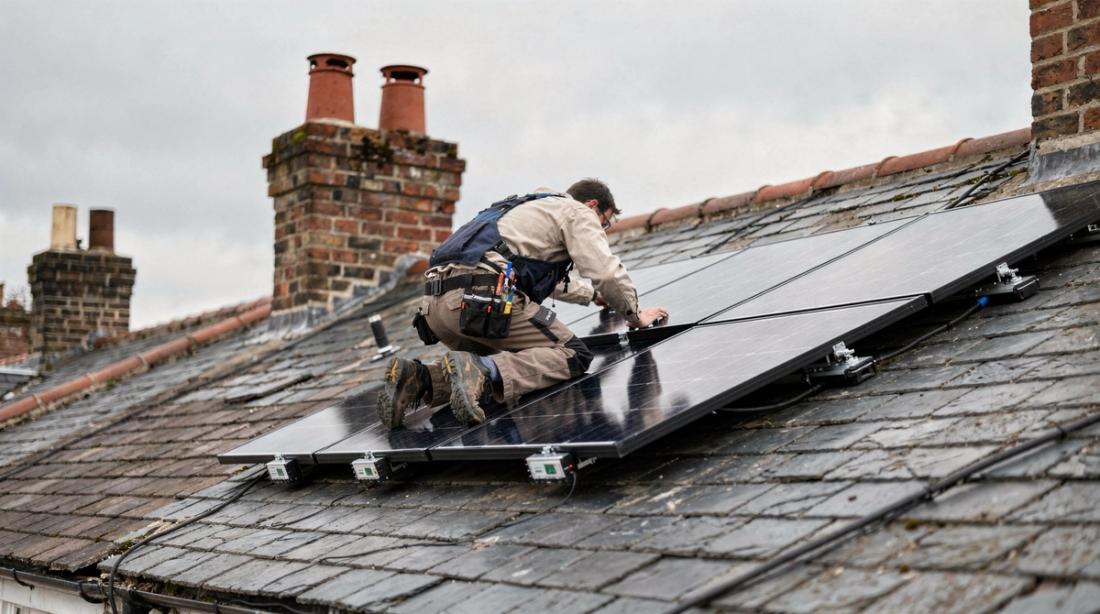
A power optimiser is a small module-level device fitted behind each panel that performs maximum power point tracking locally, then adjusts the DC voltage before sending power to a single central string inverter (Solar Power Portal, 2026). It keeps the low-cost central inversion of a string system while removing the biggest weakness of that design, where one weak panel drags down the whole series string.
Because the optimiser tracks each panel separately, a shaded, soiled, or ageing module no longer forces its neighbours down to its output. That is the core reason optimisers exist, and it is why they suit the mixed conditions found on many UK roofs, from chimney shading to split east-west arrays.
The other advantage is design flexibility. Panel-level tracking relaxes the strict string-matching rules that constrain a plain string inverter, so panels of different orientations, tilts, or even lengths can share the same input without dragging each other down. On a fragmented UK roof with dormers, valleys, and multiple pitches, that flexibility often lets an installer fit more capacity than a rigid string layout would allow.
Optimisers versus microinverters versus string inverters
The three architectures answer the same question, how to convert panel DC into usable AC, in different places. A string inverter does it centrally and cheaply. A microinverter does it at each panel, giving full per-panel independence and no high-voltage DC on the roof. An optimiser is the compromise, panel-level tracking with central conversion (Plug In Solar Explained, 2026).
Here is how they compare on the factors installers weigh most:
- String inverter: lowest cost, simplest, one MPPT point per string, weakest under shade, single point of failure at ground level where it is easy to service.
- Power optimiser: panel-level MPPT, central conversion, strong under shade, module-level monitoring, extra electronics on the roof, typical yield uplift 5 to 25%.
- Microinverter: full per-panel AC conversion, no high-voltage DC, best for complex or heavily shaded roofs, highest component count on the roof, usually the highest cost.
- Monitoring: optimisers and microinverters both give per-panel data; a plain string inverter reports only at string level.
How much do optimiser and microinverter systems cost in the UK?
Cost tracks complexity. UK figures put a string inverter installation at roughly £500 to £2,600, while microinverter installations range from about £600 to £3,900, and hybrid inverter setups from around £1,100 to £3,200 (Solar Power Portal, 2026). Optimiser systems typically add about 10 to 20% over a basic string install while delivering many of the benefits of per-panel electronics (Solar Advice UK, 2025).
Use this indicative pricing table when scoping a quote:
- String inverter install: about £500 to £2,600, lowest upfront cost.
- Optimiser add-on: roughly 10 to 20% above the equivalent string system.
- Microinverter install: about £600 to £3,900, highest per-panel cost.
- Hybrid inverter install: about £1,100 to £3,200 where storage is planned.
- Value driver: the extra spend pays back only when shade, orientation, or safety genuinely reduce a plain string system's yield.
When do module-level power electronics earn their place?
Module-level power electronics, the umbrella term covering optimisers and microinverters, earn their cost where panels do not all see the same conditions. That means chimney or dormer shading, trees, split roof orientations, and the diffuse, cloudier light common in the northern reaches of the UK (Solar Advice UK, 2025). On a clean, unshaded, single-orientation roof, a well-designed string system, backed by proper string design and honest shading analysis, often captures the same energy for less money.
There is a yield point worth being honest about with customers. The 5 to 25% uplift is a range, not a guarantee, and the high end only appears where shading is genuinely significant across part of the day. On a lightly shaded roof the real-world gain may sit in the low single digits, which rarely justifies the added hardware cost on its own. Quoting the uplift as a certainty is how installers end up with disappointed customers a year later.
The second driver is monitoring and future flexibility. Per-panel data makes fault-finding faster and gives homeowners visibility that a string-level reading cannot. If a customer values granular monitoring, or the roof is likely to gain shading as nearby trees grow, module-level electronics can be justified even where the shade analysis today looks mild. Whichever architecture you choose, capture it on the single-line diagram and match the DC cable sizing from the outset.
Are optimisers and microinverters safer on the roof?
They can be, because both reduce the module-level DC voltage when the system shuts down. In a SolarEdge optimiser system an insulation or earth fault drives the optimisers into a safety mode that reduces string current toward zero, and the devices bring per-module voltage down to a low value for safe intervention (Solar Power Portal, 2025). SolarEdge reports having surpassed one million rapid-shutdown systems installed globally (SolarEdge, 2025).
That safety benefit is not free of trade-offs. Rapid shutdown is mandatory in some markets but remains a debated design choice in the UK, and adding more power electronics to a hot, exposed rooftop introduces more of a failure-prone component in a place that is awkward to service (Solar Power World, 2025). The safety case is strong, but it should be weighed against long-term maintenance access.
The reliability trade-offs installers should weigh
The reliability question is about location as much as the component. A string inverter is a single unit at ground level or in a loft where it can be inspected and swapped in an hour. Optimisers and microinverters distribute the electronics across the array, so a failure means going back onto the roof, and every added device is another connection that must stay watertight for decades (Solar Power World, 2025).
Manufacturer warranties on module-level electronics are typically long, often 12 to 25 years, which reflects confidence in the hardware. The practical installer view is that reliability is acceptable when the units are correctly torqued, weather-sealed, and matched to panels within spec, but the servicing cost of a rooftop fault is real and belongs in the conversation with the customer. A single ground-level string inverter can be swapped in an hour; a failed optimiser behind a panel in the middle of a full array is a scaffold job.
Optimisers, microinverters and UK compliance
All three architectures answer to the same regulatory framework, and the differences show up mainly on the DC side. BS 7671 Section 712 governs PV-specific DC wiring, isolation, protection, and earthing, and domestic string systems typically run DC circuits in the 200 to 600V range, with the standard reaching up to 1000V (SurgePV, 2026). Optimiser and string systems carry that DC up to the inverter, so Section 712 isolation and labelling apply in full, while microinverters convert at the panel and shift most of the compliance onto the AC side.
Grid connection is the other shared gate. Systems up to 16A per phase follow the ENA G98 notify-after-install route for type-tested equipment, and anything above that needs a G99 application to the network operator (SurgePV, 2026). Whichever inverter architecture you choose, the products should be MCS-listed for grant and export eligibility, and DC cables must pass insulation resistance testing at a minimum of 500V. None of this favours one architecture outright, but it does mean the roof-side electronics you pick change where the compliance effort lands.
Frequently asked questions
Are solar optimisers better than microinverters?
Neither is universally better. Optimisers keep a cheaper central inverter while adding panel-level tracking, which suits most moderately shaded UK roofs. Microinverters give full per-panel AC conversion and remove high-voltage DC entirely, which suits complex or heavily shaded roofs where maximum independence matters. The right choice depends on shade, roof layout, budget, and how much rooftop electronics you are willing to maintain.
Do power optimisers actually increase output?
On arrays with shade, mixed orientation, or soiling, yes. Panel-level MPPT can raise yield by roughly 5 to 25% compared with a plain string system, because a weak panel no longer drags its string down. On a clean, unshaded, single-orientation roof the uplift is small, so the extra cost is often not justified against a well-designed string inverter setup.
Do I need optimisers or microinverters for a shaded roof?
For meaningful, recurring shade they are usually worth it. Both track each panel independently, so partial shading from a chimney, dormer, or trees affects only the shaded panels rather than the whole string. If shade is minor and occasional, a string inverter with careful string layout and shading analysis may still be the more cost-effective route.
Is high-voltage DC on the roof a safety concern?
It is the reason rapid-shutdown electronics exist. String and optimiser systems carry DC up to the inverter, while microinverters convert to AC at the panel and avoid rooftop high-voltage DC. Optimisers reduce module voltage on shutdown to make intervention safer. The overall UK fire record for compliant PV is strong, so the concern is managed through correct design rather than avoided outright.
How long do solar optimisers last?
Manufacturer warranties commonly run 12 to 25 years, reflecting the expected service life of the hardware. Real-world longevity depends on correct installation, weather sealing, and keeping the units within their voltage and current ratings. The main practical consideration is that a rooftop failure is more disruptive to service than a single ground-level string inverter, so installation quality directly affects lifetime cost.