
Commercial heat pumps are the next growth frontier for UK installers, and the numbers explain why. More than 125,000 heat pumps were sold in the UK in 2025, up 27% on the year, yet the vast majority went into homes while non-domestic buildings remain a small fraction of the market despite representing a large share of national heat demand (HPA UK, 2026). For installers ready to move up from domestic work, the commercial opportunity is opening fast.
This guide is a pillar reference for the commercial air source heat pump: how sizing and cascade design differ from domestic work, what a project costs, which grants apply, and where the regulatory and refrigerant landscape is heading. It is written for installers scoping their first non-domestic jobs and for those formalising an established commercial offer.
Key Takeaways
- Commercial heat pumps typically fall in the 20kW to 200kW band, with installed costs commonly starting around £20,000 and running well beyond £100,000 on larger estates.
- Cascade systems, where multiple units run in parallel, give modularity, resilience, and phased decarbonisation, and R290 designs can scale to around 1,600kW across up to 16 units.
- The Public Sector Decarbonisation Scheme, funded at over £1bn with a further £1.17bn for Phase 4 across 2025 to 2028, is the main capital route for public buildings.
- The Future Homes and Buildings Standard will mandate low-carbon heating in non-domestic new builds from 2028, and the Climate Change Committee expects 88% of non-residential heating to be low carbon by 2040.
- Commercial sizing is a building-load discipline, not a scaled-up domestic calculation, and refrigerant choice, flow temperature, and siting drive the design.
How is a commercial heat pump different from a domestic one?
The difference is scale, control, and design method rather than the underlying technology. A commercial air source heat pump serves loads that a single domestic unit cannot, so systems are built from larger units or multiple units in cascade, with more sophisticated controls, buffering, and hydraulic separation. The relevant sizing band for many commercial buildings runs from 20kW to 200kW (Clean Energy Project Builder, 2025).
The design discipline also changes. Domestic sizing works from a room-by-room heat loss calculation; commercial work builds on that same foundation as domestic heat pump sizing but adds diversity factors, occupancy patterns, domestic hot water demand at scale, and often simultaneous heating and cooling. Getting the building load right is the single most important step, because oversizing wastes capital and undersizing leaves a building cold on the coldest days.
Metering and existing plant data give commercial work an edge domestic jobs rarely have. Many non-domestic buildings already have half-hourly electricity or gas metering, and a year of that data reveals the true heating profile far more reliably than a fabric calculation alone. The strongest commercial designs cross-check the modelled load against measured consumption, then size the lead units for the bulk of the year and let cascade staging cover the coldest spells.
Sizing a commercial heat pump
Commercial sizing starts from a measured or modelled building heat load, then selects units to meet it with sensible margin and redundancy. Most commercial projects land in the 20kW to 200kW range, with a growing number of larger estates going further through cascades (Clean Energy Project Builder, 2025). The load model should reflect the building fabric, ventilation, hot water profile, and how the space is actually used.
A structured approach keeps commercial sizing defensible:
- Establish the design heat load from fabric, ventilation, and occupancy, not a rule of thumb per square metre.
- Separate space heating from hot water demand, since the two have different temperature and timing profiles.
- Choose flow temperature to match the emitters, as covered in radiator sizing for heat pumps, because lower flow temperatures raise seasonal efficiency and SCOP.
- Plan redundancy so a single unit failure does not take the whole building offline.
- Size buffering and hydraulics, including any buffer tank, to manage defrost cycles, minimum run times, and simultaneous loads.
What is a heat pump cascade and when do you use it?
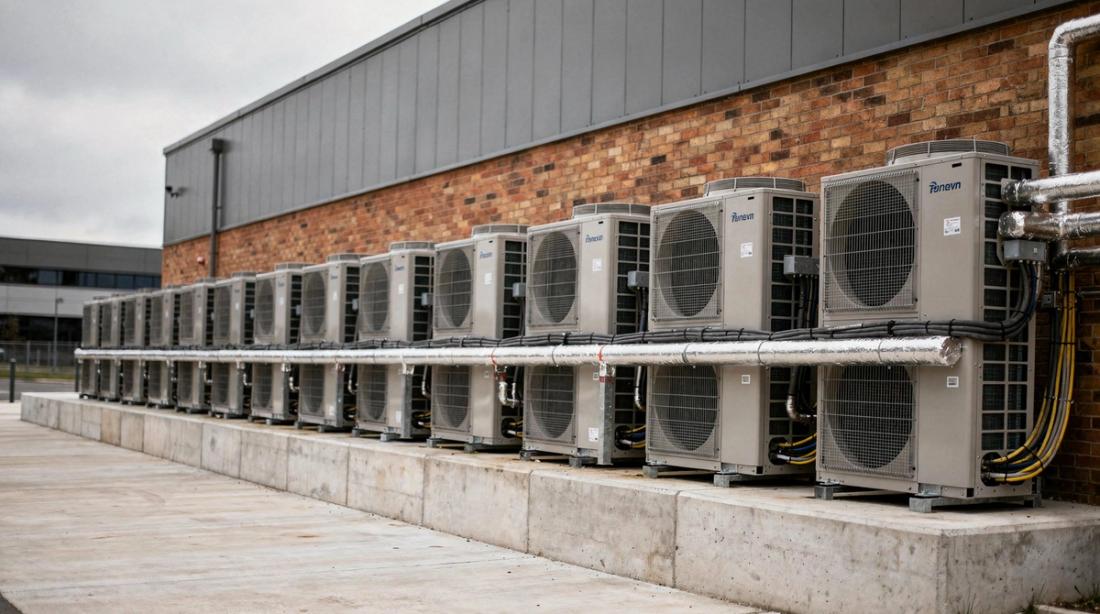
A cascade is a set of heat pump units piped and controlled to act as one larger plant, staging on and off to follow the building load. Commercial estates benefit from modular cascades because they give resilience, allow phased decarbonisation, and let capacity track demand instead of running one oversized machine at part load. R290 cascade designs can reach roughly 1,600kW across up to 16 units (Renewable Energy Hub, 2026).
Cascades suit larger or phased projects for practical reasons. Multiple smaller units modulate more efficiently across the year than a single large one, a fault takes out only part of the capacity, and a building can decarbonise in stages as budget allows rather than in one disruptive switchover. The trade-off is more complex controls and hydraulics, which is where commercial design expertise pays for itself.
Commercial heat pump costs in the UK
Commercial project costs vary widely with building load and complexity. Installed costs commonly start around £20,000 for smaller non-domestic systems and move well beyond £100,000 for larger estates and cascades (Clean Energy Project Builder, 2025). Unlike domestic work, there is no single headline price, because the plant, hydraulics, controls, electrical supply, and any building upgrades all scale with the project.
Use these bands as a scoping guide rather than a quote:
- Small non-domestic system: from around £20,000, single or twin units in the lower kW range.
- Mid-size commercial system: tens of thousands of pounds, multiple units with buffering and controls.
- Large estate or cascade: well beyond £100,000, staged units up to hundreds of kW.
- Cost drivers: electrical supply upgrades, plant room works, hydraulic separation, and controls integration.
- Whole-life view: running-cost savings and grant support materially change the payback picture over the plant life.
What grants and funding support commercial heat pumps?
The headline capital route for public buildings is the Public Sector Decarbonisation Scheme, a fund exceeding £1bn, with a further £1.17bn earmarked for Phase 4 across 2025 to 2028 to cover heat decarbonisation in hospitals, schools, and similar estates (Kensa, 2026). The scheme targets non-domestic public sector buildings and is delivered as capital grants for eligible projects.
For private commercial buildings the picture is less settled. The Heat Pump Association has called for clarity on future funding after the announced closure of the earlier scheme to new applications, and has pressed government to reduce the high cost of electricity relative to gas for non-domestic users (HPA UK, 2026). Installers should confirm current scheme status and eligibility for each project rather than assume last year's rules still apply.
Refrigerants and flow temperatures for commercial work
Refrigerant choice shapes both performance and compliance. R290, or propane, has a very low global warming potential of around 3 and can deliver flow temperatures up to about 75°C, which makes it strong for radiator-led retrofits and commercial hot water where higher temperatures are needed (Grant UK, 2025). Commercial R290 units can reach a seasonal coefficient of performance up to around 3.81 at low flow temperatures.
The trade-off is safety and siting. R290 is flammable, so risk assessment, ventilation, and location must be designed in from the start rather than added later (Modern Building Services, 2025). Lower flow temperatures always improve efficiency, so pairing the refrigerant strategy with generous emitters or well-designed distribution is what turns a compliant install into an economic one.
What certification and compliance apply to commercial installs?
Certification scope is the first thing to check on a non-domestic job. MCS certification covers renewable heat installations up to 45kW per unit, and up to 70kW total design heat load where multiple units share one installation (Renewable Energy Hub, 2025). Larger commercial plant sits outside the MCS grant framework and is handled under standard construction and building-services routes instead.
Refrigerant handling adds a second layer. Systems containing fluorinated or hydrocarbon refrigerants require F-gas certification under the UK F-gas regime, and R290 is an A3 flammable hydrocarbon, so a standard F-gas ticket does not automatically cover it and specific qualification is needed (HTAA, 2025). On the electrical side, the heat pump's power draw usually triggers a G99 application to the distribution network operator, and larger three-phase plant may need a formal connection agreement. Building Regulations Part L and the relevant commissioning standards complete the picture, so a commercial install is a multi-discipline compliance exercise rather than a single certificate.
Where the commercial heat pump market is heading
Policy is pulling the market toward non-domestic electrification. The Future Homes and Buildings Standard will mandate low-carbon heating in non-domestic new builds from 2028, and the Climate Change Committee expects 88% of non-residential heating to come from low-carbon sources by 2040 (HPA UK, 2026). Those two signals give installers a clear multi-year runway to build commercial capability.
Momentum is already visible in the wider market. UK heat pump sales hit a record in 2025 and domestic manufacturing grew, with 36% of units made in the UK, up 38% on the prior year (edie, 2026). Government is targeting 450,000 annual installations by 2030, a level that will require sustained double-digit growth and a much larger commercial contribution than the market delivers today.
For installers, the read is straightforward. Domestic volume is where the numbers sit now, but the policy signals, the 2028 new-build mandate and the 2040 low-carbon heating expectation, point to sustained non-domestic demand that few firms are yet equipped to serve. Building commercial capability now, through training, design partnerships, and a few reference projects, positions a business ahead of the retrofit wave rather than chasing it later. Installers building a non-domestic offer often pair heat pumps with commercial solar PV design, and design-and-proposal tools such as Reonic's help keep multi-unit projects consistent from survey to quote.
Frequently asked questions
What size range covers most commercial heat pumps?
Most commercial air source heat pumps fall in the 20kW to 200kW band, sized to a modelled building heat load rather than a per-square-metre rule. Larger estates go further using cascades of multiple units, and R290 cascade designs can reach around 1,600kW across up to 16 units. Correct load modelling matters more than any single unit's headline capacity.
How much does a commercial heat pump cost to install?
Installed costs commonly start around £20,000 for smaller non-domestic systems and rise well beyond £100,000 for larger estates and cascades. There is no single price because plant, hydraulics, controls, electrical supply upgrades, and plant-room works all scale with the building. Whole-life running savings and any grant support should be included when presenting the cost to a client.
What grants are available for commercial heat pumps?
The Public Sector Decarbonisation Scheme is the main capital route for public buildings, funded at over £1bn with £1.17bn for Phase 4 across 2025 to 2028. Private commercial funding is less certain following the closure of the earlier scheme to new applicants, so installers should verify current eligibility and scheme status for each project before quoting.
Is a heat pump cascade better than one large unit?
For larger or phased projects, usually yes. A cascade of smaller units modulates more efficiently across the year, keeps part of the capacity available if one unit fails, and lets a building decarbonise in stages. The cost is more complex controls and hydraulics, so the benefit is clearest on bigger estates where resilience and phased budgets matter.
Which refrigerant is best for commercial heat pumps?
R290 (propane) is widely used because it has a very low global warming potential of around 3 and delivers flow temperatures up to about 75°C, suiting retrofits and commercial hot water. It is flammable, so ventilation, siting, and risk assessment must be designed in. Refrigerant choice should follow the building's temperature needs and safety constraints, not habit.