
Weather compensation is a heat pump control strategy that raises or lowers the flow temperature automatically as the outdoor temperature changes, and MCS treats it as a core requirement for certified installs (Energy Saving Trust, 2025). Get the curve right and the same heat pump runs at a higher seasonal efficiency, with no extra hardware.
A well-tuned weather compensation curve can lift seasonal COP by 15% to 25% against a system stuck at a fixed 55C flow temperature (autarc, 2026). This guide explains what weather compensation does, how it differs from load compensation, where OpenTherm fits, and how to set the curve without leaving performance on the table.
Key Takeaways
- Weather compensation varies flow temperature against outdoor temperature. It is the foundational efficiency control on a modern heat pump (Energy Saving Trust, 2025).
- A tuned curve can raise seasonal COP by 15% to 25% versus a fixed 55C flow temperature, at no hardware cost (autarc, 2026).
- MCS certified heat pump installs must use weather compensation or load compensation under MIS 3005 (MCS, 2025).
- Load compensation reads indoor temperature. Weather compensation reads outdoor temperature. The best systems often blend both (Heat Geek, 2025).
- OpenTherm is the common open protocol that lets a control and heat pump exchange setpoints, temperatures and fault codes (OpenTherm, 2025).
What is weather compensation on a heat pump?
Weather compensation continuously adjusts the flow temperature in response to outdoor conditions, so the heat pump only ever sends water as hot as the weather demands (Energy Saving Trust, 2025). An outdoor sensor drives a heating curve. As it gets colder outside, the flow temperature rises, and as it warms up, the flow temperature falls.
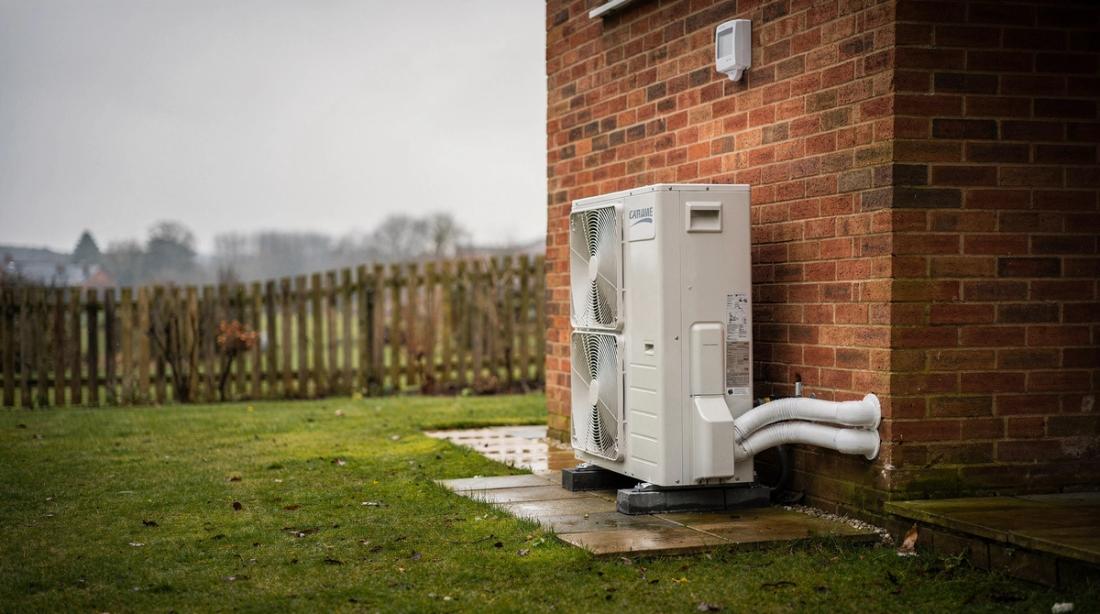
The outdoor sensor is a simple NTC probe, usually mounted on a north facing wall to avoid direct sun skewing the reading (idm, 2025). It samples the air every minute or two. The controller then looks up the target flow temperature on the curve you set and asks the heat pump to hit it.
There is no room feedback in pure weather compensation. The curve links the outdoor sensor straight to the flow temperature. That simplicity is the point. The heat pump avoids the on off cycling of a fixed high setpoint and instead runs long, steady and efficient.
A worked example makes it concrete. On a mild 12C day the curve might call for 30C flow. At a design outdoor temperature of minus 2C it might call for 45C. The heat pump spends most of the season near the low end of that range, and that is where the efficiency gain comes from (idm, 2025).
Why does weather compensation improve heat pump efficiency?
A heat pump gets more efficient as flow temperature drops, because the gap it has to bridge between outside air and the water it heats shrinks (Staffordshire Training, 2025). Flow temperatures above 50C noticeably cut efficiency and raise running costs (Wunda, 2026). Weather compensation keeps flow temperature as low as comfort allows.
The numbers are meaningful. A UK heat pump with weather compensation typically sees a seasonal COP of 3.0 to 3.5, against 2.5 to 3.0 without it (Axiom Eco Homes, 2026). For most of the heating season the outdoor temperature sits well above design, so the curve holds flow temperatures low for weeks at a time.
That is why running a fixed 55C is wasteful. It sizes every day for the coldest day of the year. Our SCOP heat pump guide shows how flow temperature feeds directly into the seasonal figure you record at design.
Weather compensation vs load compensation: what is the difference?
Weather compensation reads the outdoor temperature. Load compensation, also called room compensation, reads the indoor temperature and adjusts output to actual demand (Heat Geek, 2025). Both aim to keep flow temperature as low as possible, but they use different inputs to decide how hard the heat pump works.
Neither is automatically better. Weather compensation reacts to the outside world before the house feels a change, which suits well insulated homes. Load compensation reacts to what the rooms actually need, which handles gains from sun, cooking or occupancy. Many manufacturers now let you run both together for the tightest control.
Control strategies compared
- Weather compensation: outdoor sensor drives the flow temperature curve. Strong for steady, well insulated homes. Needs a correctly set curve to perform.
- Load compensation: indoor sensor trims output to real room demand. Handles internal heat gains well. Depends on good sensor placement.
- Fixed flow temperature: a single setpoint such as 55C, simple but wasteful, and it cycles more and costs more to run (Wunda, 2026).
Is weather compensation required for MCS certification?
Yes. MCS certified heat pump installations must include weather compensation or load compensation under the MIS 3005 standard (MCS, 2025). The standard also drives correct heat loss assessment, sizing, hydraulic balancing and a handover pack, so the control does not sit in isolation.
MCS 031, updated in 2025, requires the seasonal performance estimate to be calculated and recorded in the design documents (Easy MCS, 2025). Because SCOP is calculated on weather compensated operation at variable flow temperatures, the paperwork assumes the curve is actually set and left enabled after commissioning.
In other words, weather compensation is not a nice to have. It underpins both the compliance path and the efficiency figure you promise the customer. Skipping it, or fitting it and leaving the factory curve, undermines the design you signed off. Our heat loss calculation guide is the other half of that design chain.
How to set the weather compensation curve
The weather compensation curve is defined by its gradient, or slope, and its offset, a parallel shift up or down (autarc, 2026). The slope should match the building's insulation and its emitters. Radiators sized for low flow temperatures need a gentler curve than undersized ones.
Start from the design flow temperature at the design outdoor temperature, then reduce the slope until the house just holds temperature on a cold day (Renewable Heating Hub, 2025). Adjust the offset if the house is uniformly a touch cool or warm. Change one variable at a time, and give the system a day to settle between tweaks.
In the field, the most common fault we see on an underperforming system is a factory default curve nobody touched. The heat pump was fit for purpose, but it was left running a steep, high curve suited to a poorly insulated house. A short commissioning visit to flatten the curve often recovers most of the lost efficiency.
Emitter sizing sets the ceiling on how low you can go. If a room cannot hold temperature at 40C flow, the fix is a bigger emitter, not a steeper curve. Our radiator sizing guide and heat pump sizing guide cover the design side that makes a low curve achievable.
Monitoring closes the loop. If you can read flow temperature and room temperature across a cold spell, you can see whether the curve holds the house without overshooting. Small, evidenced tweaks beat guesswork. They also give you a record to hand the customer at handover.
Where OpenTherm and heat pump controls fit
A weather compensation control has to talk to the heat pump, and OpenTherm is the most common open protocol for that link (OpenTherm, 2025). It carries setpoints, actual temperatures and fault codes both ways, so the control and the appliance stay in step rather than fighting each other.
OpenTherm connectivity lets a single control run weather compensation, load compensation and modulation together (Ideal Heating, 2025). The practical lesson is compatibility. Check the manufacturer's supported protocol and control list before you specify third party thermostats, because a mismatch forces the system back to crude on off control.
There is a compliance angle to controls too. Leaving a heat pump on crude on off control, because a thermostat would not talk to it, wastes the efficiency the MCS design assumed. Specifying compatible controls at the quote stage avoids that trap and protects the SCOP you recorded.
Common weather compensation commissioning mistakes
The equipment rarely fails. The commissioning does. The frequent errors are a curve left at factory defaults, an outdoor sensor mounted in direct sun or near a flue, and a thermostat set so low it overrides the curve and forces the heat pump off. Each one quietly drags the seasonal figure down.
Another is leaving a high fixed setpoint as a comfort insurance policy. It defeats the whole point of the curve and pushes the system toward the 2.5 to 3.0 COP band rather than 3.0 to 3.5 (Axiom Eco Homes, 2026). Set the curve properly, document it in the handover, and show the customer not to fight it with the room stat. A buffer or volumiser can also affect how the curve behaves, as our buffer tank guide explains.
A five minute check at the next service pays for itself. Confirm the curve is still enabled, the outdoor sensor is clean and shaded, and no one has parked a high fixed setpoint back on the controller (Energy Saving Trust, 2025). Settings drift as households experiment, so a quick review keeps the system on its design efficiency.
Frequently asked questions
Does weather compensation actually save money?
Yes. By holding flow temperature as low as comfort allows, weather compensation raises seasonal COP from around 2.5 to 3.0 up to 3.0 to 3.5 on a typical UK system (Axiom Eco Homes, 2026). Higher COP means less electricity for the same heat, so the running cost falls without any change to the hardware.
Can I use weather compensation and load compensation together?
Often, yes. Many heat pumps let you enable both, using the outdoor curve as the base and room feedback to trim output (Heat Geek, 2025). This handles internal heat gains from sun or cooking while keeping flow temperature low. Check the manufacturer's control options, as not every model supports blended operation.
Is weather compensation mandatory for MCS?
MCS certified heat pump installs must use weather compensation or load compensation under MIS 3005 (MCS, 2025). You can choose which, or combine them, but the install cannot rely on a fixed flow temperature alone. The control choice should be recorded in the design and commissioning documentation.
Where should the outdoor sensor go?
Mount the outdoor sensor on a north facing wall, away from direct sun, flue plumes, extract vents and other heat sources (idm, 2025). Direct sun makes the sensor read warm and drop the flow temperature when the house still needs heat. Correct placement is a small step that protects the whole curve.
Why is my heat pump running at 55C all the time?
Usually because weather compensation is disabled or set to a steep, high curve, or a fixed setpoint was left in place (Renewable Heating Hub, 2025). A constant 55C sizes every day for the coldest day and wastes energy. Enabling and flattening the curve, within the emitters' limits, is the fix.