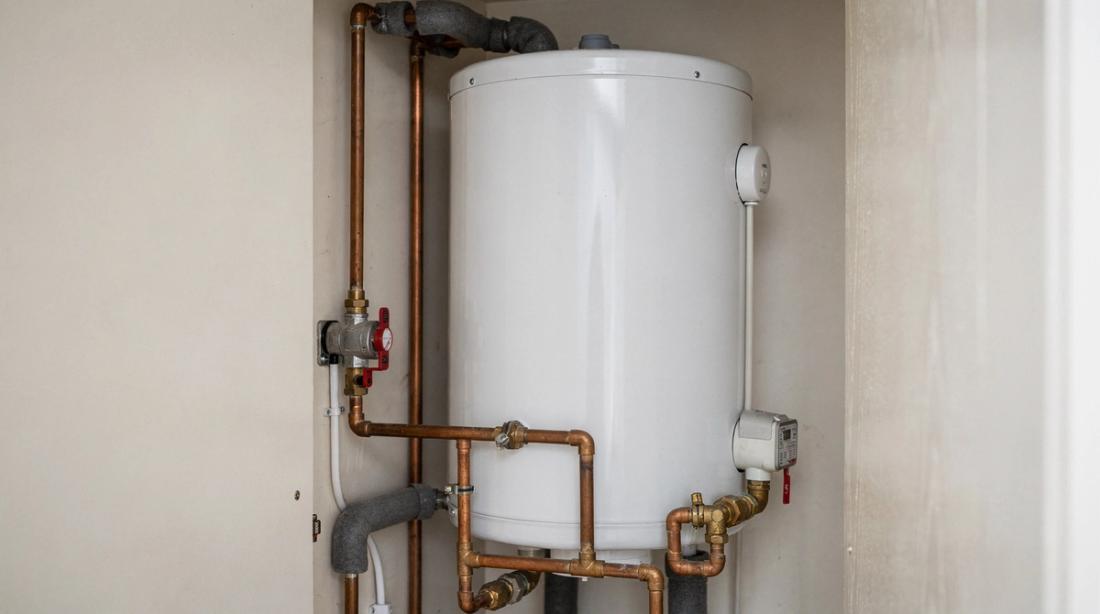

Unvented cylinder sizing for a heat pump starts from stored volume, not boiler habits: allow roughly 45 litres of storage per occupant and then size up a step, because a heat pump reheats far more slowly than a gas boiler and the household leans harder on what is already in the tank (Ensign, 2025). Undersize it and the family runs out of hot water on a winter evening; oversize it and the heat pump spends longer heating a tank that never fully empties.
The cylinder is where more heat pump jobs go wrong than almost anywhere else, usually because a boiler-era cylinder is reused or a standard-coil unit is fitted. A cylinder that looked fine behind a gas boiler can leave a heat pump home short of hot water and running inefficiently, and the fix after the fact means a second visit and a second install. This guide covers the volume calculation, the larger coil a heat pump needs, store and design flow temperatures, Legionella control, and the Part G building regulations that apply to every unvented install.
Key Takeaways
- Size by occupancy, then step up: budget around 45 litres per person and go one size larger for heat pumps due to slow reheat (Ensign, 2025).
- Heat pumps need a big coil: a heat pump cylinder needs roughly 3.0m2 to 4.5m2 of coil surface area, against 0.8m2 to 1.2m2 on a standard boiler cylinder (Clima-Tech, 2026).
- Store around 50C to 55C: a heat pump heats the cylinder to about 50C to 55C, well below a boiler's, so volume matters more (Heat Pump Checker, 2026).
- Pasteurise weekly at 60C: Legionella grows between 20C and 45C, so the cylinder must reach at least 60C once a week (Heat Pump Checker, 2026).
- Part G applies: every unvented cylinder needs two independent safety devices, a G3-competent installer and Building Control notification (Approved Document G, 2024).
How do you size an unvented cylinder for a heat pump?
Begin with occupancy. The CIBSE Guide G lineage allows about 45 litres of stored hot water per dwelling occupant, so a four-person home lands near 180 litres before any heat pump adjustment (Ensign, 2025). Then step up one size, because a heat pump cannot reheat quickly enough to lean on rapid recovery the way a 24kW boiler does.
Also factor in demand peaks the average misses: a large bath, a rain shower at 15 litres a minute, or two bathrooms used back to back. Size to the busiest realistic morning, not the annual mean. Getting the space heating side right matters too, and our heat pump sizing guide covers matching the unit to the building's heat loss calculation.
What size cylinder do you need by occupancy?
As a starting point before the heat pump step-up, unvented cylinders are sized roughly at 35 to 45 litres per person (Anglian PHE, 2025). The bands below are a boiler-era baseline; for a heat pump, move up to the next size to give the slower system more stored buffer.
- 1 to 2 people: 120 to 150 litres baseline; consider 180 litres for a heat pump (Anglian PHE, 2025).
- 3 to 4 people: 180 to 210 litres baseline; 210 to 250 litres for a heat pump home.
- 5 or more people: 250 to 300 litres baseline; 300 litres or a larger unit for a heat pump.
- Two bathrooms or high peak demand: size up regardless of headcount to cover simultaneous draw-off.
- Footprint check: a 200 litre cylinder needs roughly a 600mm by 600mm floor area plus service clearance, so confirm the space early.
Why do heat pump cylinders need a bigger coil?
A heat pump delivers heat at a much lower temperature than a boiler, so the internal coil has to be far larger to transfer that heat into the water fast enough. Heat pump cylinders typically carry 3.0m2 to 4.5m2 of coil surface area, compared with 0.8m2 to 1.2m2 on a standard boiler cylinder (Clima-Tech, 2026). Fit a standard-coil cylinder on a heat pump and reheat times balloon and the unit runs inefficiently.
This is why a boiler-era cylinder should almost never be reused on a heat pump changeover. The coil is the single most important spec on the sheet, and it is worth confirming the surface area in square metres rather than trusting a badge that says heat pump ready. A properly matched coil lets the heat pump charge the store efficiently at a modest flow temperature, so the compressor spends less time running and holds a higher seasonal efficiency across the year. Undersized coils are one of the most common causes of a heat pump that technically works but disappoints on both comfort and running cost.
Store and design flow temperatures for heat pump DHW
A heat pump usually heats the cylinder to around 50C to 55C for daily hot water, which is comfortable for baths and showers and keeps the heat pump efficient (Heat Pump Checker, 2026). That is lower than a boiler's typical 60C to 65C store, which is exactly why stored volume and coil area have to compensate.
Keep the DHW cycle separate in your head from the space heating design flow temperature, which on a well-designed system runs lower still, often 35C to 45C to protect the seasonal efficiency behind a good SCOP. The cylinder's higher charge temperature is a short daily event; the heating circuit runs cool the rest of the time. Sizing the emitters and the cylinder are two separate calculations that both feed the same unit, and getting the radiator sizing right at that low flow temperature is as important as the store itself.
How do you control Legionella in a heat pump cylinder?
Because a heat pump stores water at 50C to 55C, and Legionella bacteria multiply between 20C and 45C, the cylinder must be raised to at least 60C periodically, typically once a week, to pasteurise the stored water (Heat Pump Checker, 2026). Most heat pumps run a scheduled weekly cycle, using the compressor where it can reach 60C or an immersion heater as a boost.
Set and document the pasteurisation schedule at commissioning, and make sure the immersion is wired and rated to carry it if the heat pump alone cannot hit 60C. This is a safety requirement, not an optional efficiency tweak, and skipping it to chase a better headline SCOP is the wrong trade. The weekly cycle costs little energy against the risk it removes.
Building regulations: Part G3 and unvented safety
Every unvented hot water system falls under Part G3 of the Building Regulations. The storage vessel must carry at least two independent safety devices in addition to its thermostat, such as a temperature relief valve and an expansion or pressure control, to prevent the stored water exceeding safe temperature and pressure (Approved Document G, 2024). These are life-safety devices, not optional extras.
Installation is notifiable work: an unvented cylinder must be fitted by an operative holding the relevant unvented hot water (G3) competency, and the work notified to Building Control, usually through the installer's competent person scheme (Approved Document G, 2024). The discharge pipework from the relief valves has to terminate safely, and the system should be serviced annually to keep those safety devices working.
How long does a heat pump cylinder take to reheat?
A heat pump cylinder typically takes 45 to 90 minutes for a full reheat, considerably longer than a boiler-fed cylinder that might recover in 20 to 30 minutes (Best Builders, 2026). That slower recovery is the core reason heat pump systems favour more stored volume and why sizing generously pays off in real use.
Plan the reheat schedule around the tariff and the household's routine, charging the cylinder overnight on a cheaper rate and topping up before the evening peak. A slightly larger, well-insulated cylinder holds its heat between cycles and reduces how often the heat pump has to fire, which is gentler on efficiency than a small tank reheating repeatedly. Keep the domestic hot water store distinct from any buffer tank on the heating side: one stores usable hot water, the other stabilises the heating circuit, and conflating the two leads to a cylinder that satisfies neither job well.
Sizing a cylinder on survey: the installer checklist
On survey, count occupants and bathrooms, ask about baths versus showers and any high-flow fittings, and note the available floor space and its clearances. Confirm the incoming mains flow rate and pressure, because an unvented cylinder is only as good as the supply feeding it, and a weak main will disappoint whatever the tank size. A quick bucket test at the kitchen tap tells you more about real performance than the spec sheet does. Then apply the occupancy figure, step up for the heat pump, and check the coil surface area against the unit.
Record the store temperature, the weekly pasteurisation schedule and the G3 notification on the job file so nothing is missed at commissioning. Design tools that keep the cylinder, emitters and heat loss in one model, such as Reonic's installer platform, make it easier to size the store against the real demand rather than reaching for a default 210 litre unit. A cylinder sized to the household beats a cylinder sized to habit every time.
Frequently asked questions
What size cylinder do I need for a heat pump?
Budget about 45 litres of storage per occupant, then step up one size for the heat pump's slow reheat (Ensign, 2025). A typical four-person home lands around 210 to 250 litres. Size to the busiest realistic morning and to peak fittings like baths, not to the annual average demand.
Can I reuse my old cylinder with a heat pump?
Almost never. A boiler-era cylinder has a small coil of 0.8m2 to 1.2m2, while a heat pump needs 3.0m2 to 4.5m2 to transfer heat at a lower temperature (Clima-Tech, 2026). Reusing a standard-coil cylinder gives slow reheat and poor efficiency, so a heat pump changeover almost always needs a new cylinder.
What temperature should a heat pump cylinder be set to?
Around 50C to 55C for daily hot water, which keeps the heat pump efficient while staying comfortable (Heat Pump Checker, 2026). The cylinder must also reach at least 60C once a week to control Legionella, using the compressor or an immersion heater to run that pasteurisation cycle.
Do unvented cylinders need Building Control approval?
Yes. Unvented hot water systems are notifiable under Part G3 and must be fitted by a G3-competent installer and notified to Building Control (Approved Document G, 2024). The vessel needs at least two independent safety devices beyond its thermostat, and the system should be serviced annually.
Why does a heat pump cylinder reheat so slowly?
Because it charges at around 50C to 55C rather than a boiler's 60C to 65C, and transfers heat through a larger coil at lower temperature, a full reheat takes 45 to 90 minutes against 20 to 30 for a boiler (Best Builders, 2026). That is why heat pump systems favour more stored volume and generous sizing.