
Solar panel efficiency is the share of sunlight a panel converts into electricity, and in 2026 the panels UK installers fit typically run at 15 to 22%, with premium modules reaching 23 to 24% (UK Home Energy, 2026). That single number decides how much power you can fit on a constrained roof, which is why customers ask about it and why the honest answer is more nuanced than a spec sheet.
The headline figures now start with a 2. Front-of-market modules have crossed 25% conversion efficiency, and a laboratory cell has passed 31% (Clean Energy Reviews, 2026). For a working installer the useful skill is separating that marketing ceiling from what a specific panel will deliver on a specific British roof across 25 years.
Key Takeaways
- Real-world range: UK panels fitted in 2026 mostly convert 15 to 22% of sunlight; premium models reach 23 to 24%.
- Market leaders: the most efficient production panels now exceed 25%, led by modules around 25.6 to 25.9%.
- Heat costs output: panels lose roughly 0.3 to 0.5% per degree above 25C, so the UK's cool climate is a quiet advantage.
- Degradation is slow: good panels lose 0.3 to 0.5% a year and still hold 80 to 90% of output after 25 years.
- Efficiency is about area: on a small roof it earns its premium; on a large one, cheaper panels often win on cost per kWh.
What does solar panel efficiency actually mean?
Efficiency is the percentage of incoming solar energy a panel turns into electricity under standard test conditions. Most panels UK installers fit in 2026 sit between 15 and 22%, with premium modules at 23 to 24% (Sheffield Renewables, 2026). A 22% panel is not slightly better than an 18% one; it produces roughly a fifth more power from the same physical area.
That area link is the whole point. Two panels of the same physical size but different efficiency give different wattages, so a higher-efficiency module packs more capacity onto each square metre of roof (Solar Love, 2026). Modern domestic panels are typically 380 to 430 watts, and rising efficiency is the main reason that figure keeps climbing for the same footprint.
Test-condition efficiency is a laboratory rating, not a promise. Real output depends on irradiance, temperature, shading, orientation and age. The rated number is a fair way to compare panels against each other, but it always describes a best case that a UK roof rarely sees in full.
What are the most efficient solar panels in 2026?
The most efficient production panels in 2026 have moved past 25% conversion efficiency, with JinkoSolar's Tiger Neo range opening a 25.9% tier and AIKO's INFINITE ULTRA at 25.6% (Clean Energy Reviews, 2026). At laboratory scale LONGi has reached a 31.6% cell, though that record technology is years from a rooftop near you.
Ranked by module efficiency, the panels UK installers most often quote line up roughly like this:
- AIKO Neostar 3N+: around 24.8%, back-contact cells and strong shade tolerance.
- LONGi Hi-MO X10: up to 24.8%, high wattage per panel.
- SunPower Maxeon 7: around 24.5%, with a 40-year product warranty.
- REC Alpha Pure-RX: around 22.3%, a strong mainstream premium option.
- JA Solar, Trina, Canadian Solar: roughly 21.8 to 22.0%, high-volume workhorse modules.
The gap between the top tier and a solid mainstream panel is only two or three percentage points (SurgePV, 2026). That difference matters on a small or awkward roof where every panel counts, and matters far less on a large simple roof where you can add another module for less than the efficiency premium costs.
The efficiency race is really a cell-technology race. PERC, the old baseline, has largely given way to TOPCon as the volume standard, while back-contact designs move the busbars to the rear of the cell to capture more light and push the top modules past 25% (Clean Energy Reviews, 2026). Knowing which technology a panel uses tells you more about its real behaviour, in shade and heat, than the rated figure alone.
How does temperature affect panel efficiency?
Panels lose output as they heat up, at roughly 0.3 to 0.5% for every degree above 25C (SurgePV, 2026). On a hot roof where module temperature reaches 60C, that can mean a 10 to 15% drop against the rated figure (8MSolar, 2026). It is a real loss, and it is exactly the loss the UK climate helps you avoid.
Cell technology changes how hard heat bites. Temperature coefficients by type:
- PERC: about -0.35% per C, the older mainstream baseline.
- TOPCon: about -0.29% per C, now the volume standard.
- HJT: about -0.24% per C, the best mainstream heat behaviour.
For a UK install this is a genuine, if quiet, advantage. Cooler ambient temperatures mean panels spend more of the year near their rated efficiency than they would in southern Europe (8MSolar, 2026). When two panels are close on rated efficiency, the one with the better temperature coefficient will usually edge ahead on a warm, bright British afternoon.
How much do solar panels degrade over time?
Good panels degrade slowly, losing around 0.3 to 0.5% of output a year, so a 0.5% panel still holds about 88% of its original output after 25 years (Solar4Good, 2026). Across the market, most panels retain 80 to 90% of their starting efficiency at the 25-year mark, which is why performance warranties are written around those figures.
Degradation is not uniform. Panels often lose a little more in year one as they stabilise, then settle into a steady, gentle decline (Solar4Good, 2026). The degradation rate quoted on a datasheet is as important as the headline efficiency, because a slightly less efficient panel that ages more slowly can out-produce a flashier one over the system's life.
This is where I tell customers to read the warranty, not the brochure. A panel advertised at 23% but guaranteed to only 85% at year 25 can deliver less lifetime energy than a 22% panel guaranteed to 90%. The starting number sells the job; the ageing curve pays it back.
Efficiency, wattage and area: what actually matters on a roof
Efficiency, wattage and physical size are three views of the same thing. A higher-efficiency panel produces more watts from the same area, so it lets you reach a target system size on a smaller or more broken-up roof (Solar Love, 2026). The decision that matters is cost per usable kilowatt-hour over 25 years, not the percentage on the label.
On a constrained roof, efficiency earns its premium. If the customer wants 5 kW and the roof only fits ten panels, high-efficiency modules may be the only way to get there. On a large, simple roof, adding one more mainstream panel is often cheaper than paying the premium for fewer, higher-efficiency ones (SurgePV, 2026).
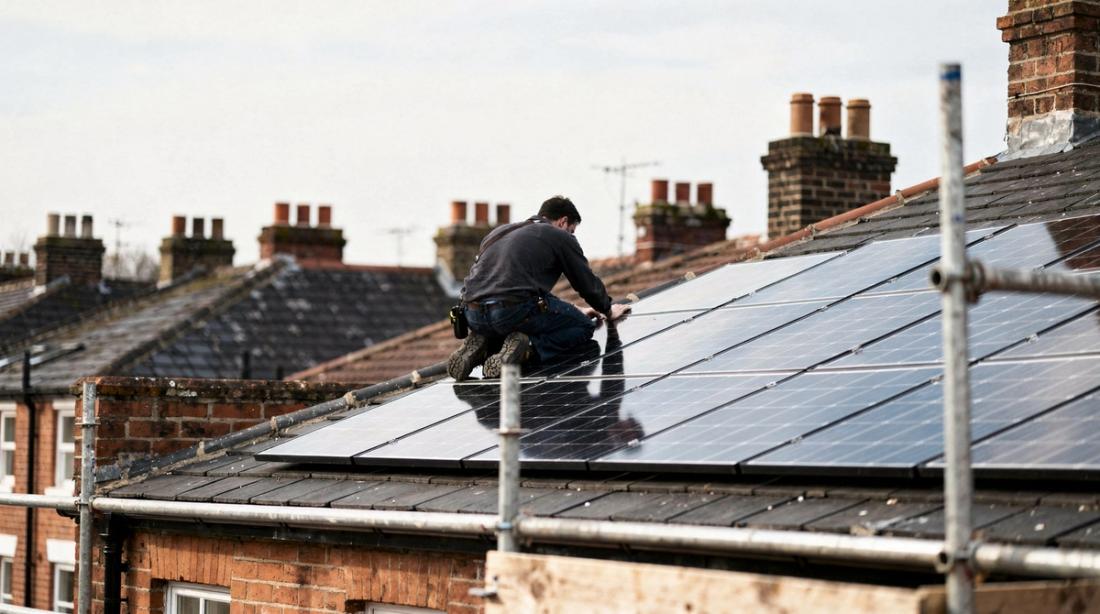
Layout decides how much of that rated efficiency you keep. Careful solar panel roof layout and a proper shading analysis protect more real output than a two-point efficiency upgrade, and choosing between in-roof and on-roof mounting changes running temperature and therefore performance.
A worked example makes the trade concrete. On a 20 square metre roof, ten 430-watt high-efficiency panels reach 4.3 kW where ten cheaper 380-watt panels reach only 3.8 kW, so efficiency buys real capacity when space is fixed. Give the same customer a 40 square metre roof and the cheaper panels simply take up more of it to hit the same target, usually at a lower total cost.
Does higher efficiency justify the price?
Higher efficiency is worth paying for when roof area is the binding constraint, and often is not when it is abundant. Take the common Aiko versus Maxeon question: Aiko now matches or edges Maxeon on peak efficiency and wattage at a lower price, while Maxeon answers with a 40-year warranty and a long durability record (Alliant, 2026).
So the trade is efficiency and price against warranty and proven longevity, not a single winner (Alliant, 2026). For a small premium roof where the customer plans to stay for decades, the longer warranty can be the deciding factor. For a value-led job with plenty of roof, a mainstream high-volume panel usually gives the best cost per kWh.
Frame it for the customer as lifetime yield per pound, not headline percentage. A clear read of the solar panel warranty and a look at how the panels behave in low light and winter, covered in our guide to solar panels in winter, tells you more about real returns than the rated efficiency alone.
Frequently asked questions
What is a good solar panel efficiency in 2026?
For a UK install in 2026, anything from 20% upward is a strong mainstream panel, and 23 to 24% is genuinely premium (UK Home Energy, 2026). The most efficient production modules now exceed 25%. Below about 18% you are usually looking at older stock, which can still make sense on a large roof where price matters more than area.
What is the most efficient solar panel you can buy?
The most efficient production panels in 2026 exceed 25%, led by modules around 25.6 to 25.9% from makers such as AIKO and JinkoSolar (Clean Energy Reviews, 2026). A LONGi laboratory cell has reached 31.6%, but that is a research record, not a product you can specify for a customer's roof today.
Do solar panels work less well in hot weather?
Yes. Panels lose roughly 0.3 to 0.5% of output per degree above 25C, so a hot roof at 60C can run 10 to 15% below its rating (8MSolar, 2026). This is why the UK's cooler climate is a modest advantage, and why a panel's temperature coefficient matters alongside its headline efficiency.
How long do efficient solar panels last?
Quality panels lose about 0.3 to 0.5% of output a year and still hold 80 to 90% of their original efficiency after 25 years (Solar4Good, 2026). The physical panel often keeps working beyond that. The degradation rate on the datasheet matters as much as the starting efficiency for judging lifetime energy yield.
Is monocrystalline more efficient than polycrystalline?
Yes. Monocrystalline panels, including modern TOPCon and back-contact designs, dominate the high-efficiency tiers and are what almost every UK installer now fits (SurgePV, 2026). Polycrystalline modules are cheaper but noticeably less efficient, so they only make sense where roof area is plentiful and upfront cost is the priority.
Specifying for efficiency without overpaying
Solar panel efficiency is climbing fast, with production modules past 25% and the UK's cool climate helping panels hold their rating for more of the year (Clean Energy Reviews, 2026). The installer's job is to translate that into the right panel for a specific roof, not simply to chase the highest number on the datasheet.
Match the panel to the constraint: high efficiency where roof area is tight, value modules where it is not, and always weigh the degradation curve and warranty alongside the headline figure. Reonic's design and proposal tools let you model panel choices against a real roof and shading picture, so you can show a customer the lifetime yield behind the percentage rather than just the spec-sheet claim. Pair that with sound solar panel maintenance and the system holds its efficiency for the long run.