
A solar carport is an engineered canopy over a car park that carries solar panels overhead while sheltering the vehicles below, and at commercial scale it typically installs for £900 to £1,400 per kWp, with the steel and foundations alone accounting for around 45% of that cost (SurgePV, 2026). For a commercial client with a large car park and a daytime electricity load, it is one of the strongest solar cases going.
This pillar guide is written for installers scoping commercial solar carport projects in the UK. It covers what a solar canopy is, what it costs, the planning route, the structural design that sets it apart from roof mounting, how EV charging fits underneath, and the policy shift that is turning car parks into a live pipeline. Solar carport cost and payback run throughout.
Key Takeaways
- A commercial solar carport typically costs £900 to £1,400 per kWp, or roughly £6,000 to £12,000 per parking bay all-in.
- Steel and foundations make up around 45% of the build, because a carport is a real structure rated for wind and snow loads.
- Most UK solar canopies proceed under permitted development, with a 4 metre height limit and a 1 MWp site cap as the usual constraints.
- Adding EV charging turns solar-charged miles into roughly 10p per kWh against grid rates of 30p to 47p.
- France already mandates solar on large car parks, and the UK ran a 2025 call for evidence on doing the same.
What is a solar carport?
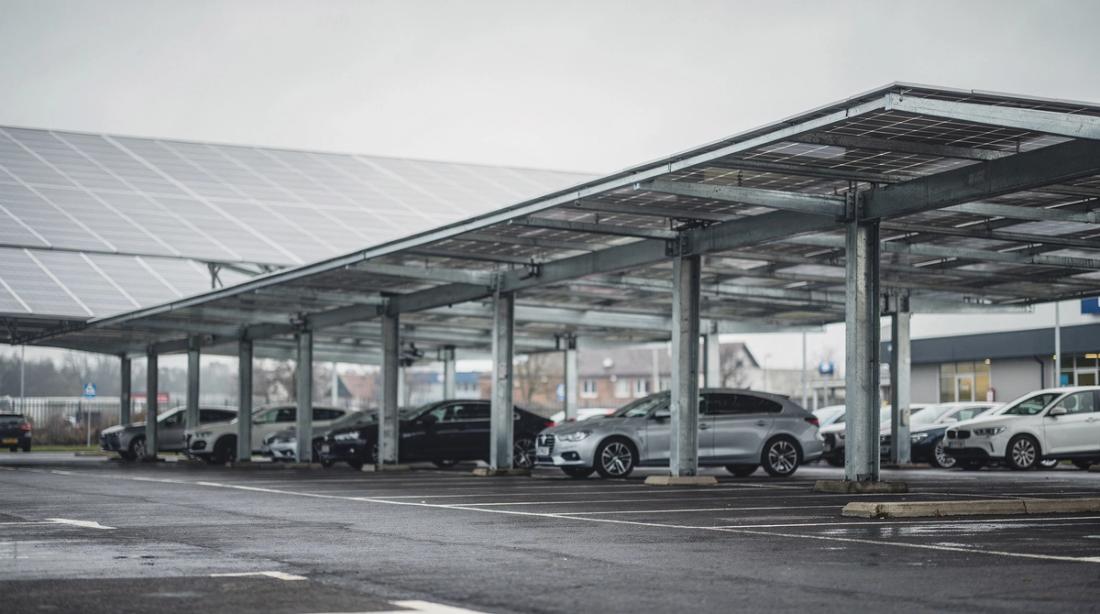
A solar carport, sometimes called a solar canopy, is a raised steel structure over parking bays with a solar array as its roof. Unlike a rooftop system it is a standalone engineered structure, which is why it costs more per kWp but opens up sites with no suitable roof. Elevated canopies run £900 to £1,400 per kWp at commercial scale, rising to £1,200 to £3,000 per kWp on smaller or structurally complex sites (Solar Info, 2026).
The appeal is dual use. The same footprint parks vehicles and generates power, and the generation sits right next to a large daytime load such as an office, retail unit, or depot. That co-location is what drives the high self-consumption behind a carport's returns, and it is the pitch that lands with a commercial client sitting on acres of tarmac. A rooftop system competes with roof condition, orientation, and lease terms, whereas a car park is usually clear, south-open, and owned outright by the same business that will use the power.
What does a solar carport cost in the UK?
Costs are best quoted two ways: per kWp for the array and per bay for the client. At commercial scale a carport runs £900 to £1,400 per kWp, which works out at roughly £6,000 to £12,000 per parking bay all-in (SurgePV, 2026). Steel and foundations account for around 45% of that, a share that surprises clients expecting a panel job.
The numbers below frame a typical commercial solar carport quote and are worth putting in a proposal early, because the structural share is what separates a carport from a rooftop cost model.
- Array cost: £900 to £1,400 per kWp at commercial scale, higher on small or complex sites.
- Per bay, all-in: roughly £6,000 to £12,000 including civils and electrical integration.
- Structural share: around 45% of total spend goes on steel and foundations.
- Service life: 25 to 30 years, subject to structure and module quality.
- Payback: typically 5 to 10 years with high daytime self-consumption.
Those figures assume a real engineered canopy, not a panel bolted to a pole. The cost model sits closer to our commercial solar PV design guide than to a domestic rooftop, and the difference is mostly steel.
Do solar carports need planning permission?
Most commercial solar canopies proceed under permitted development rather than a full application, though the thresholds matter. The usual operative constraints are a 4 metre height limit and a 1 MWp site capacity, and where full planning is required, installers should budget £6,000 to £20,000 and 8 to 14 weeks, with approval rates running above 90% (Commercial Solar Canopy, 2026).
Permitted development is not a free pass. Building control still applies to the structural elements, the electrical installation under Part P, and any EV charging under Part S. Our solar panel planning permission guide covers where the permitted development line sits, and a carport that breaches height or capacity needs the full route factored into the programme from day one.
Structural design: wind, snow and foundations
The structure is where a carport earns its cost. It must carry the dead weight of the array, resist wind uplift across a large exposed surface, and take snow load, all through foundations sized for the ground conditions. This is the same engineering discipline as roof mounting but scaled up, and it is why steel and foundations dominate the budget rather than the panels.
Wind is usually the governing case. A canopy presents a large sail area at height, so uplift and overturning drive the column and foundation design far more than panel weight does. Get the load path wrong and the failure mode is dramatic, which is why carport structures are signed off to the same standards as any other permanent steel-framed building. The structural approach mirrors our mounting structure design guide, and it means a chartered structural input and proper ground investigation are non-negotiable parts of a carport quote, not optional extras.
Adding EV charging under the canopy
EV charging is the feature that lifts a carport from a generation asset to a fleet enabler. Installers commonly add 7 to 22 kW AC chargers under the same canopy, and solar-charged miles then come in at roughly 10p per kWh against grid rates of 30p to 47p (SurgePV, 2026). For a client with vans or staff EVs, that gap is the business case on its own.
Charging adds compliance load. EV points fall under Part S of the building regulations, and the civils and cabling need designing alongside the canopy rather than retrofitting afterward. The cleanest projects run the charger infrastructure and the array as one design, so the daytime solar feeds the chargers directly and only the surplus goes to the grid or a battery.
How solar carports pay back
Payback rests on self-consumption. Because the array sits over a working car park next to a daytime load, most generation is used on site at avoided grid cost rather than exported cheaply, which is why commercial carports typically pay back in 5 to 10 years over a 25 to 30 year life (Excel Energy, 2026). The steeper upfront cost is offset by that high on-site usage.
Surplus power still has value. Export earns through the Smart Export Guarantee, and a battery can shift midday generation into evening demand, both of which sharpen the return. Our Smart Export Guarantee rates guide and commercial battery storage cost guide cover how export and storage stack on top of a carport's self-consumption base.
Are car park solar canopies about to be mandated?
Policy is moving toward carports, which is the reason to build a commercial capability now. France already mandates solar on car parks with 80 or more spaces, requiring 50% coverage by 1 July 2026 for car parks above 10,000 square metres and by 1 July 2028 for all outdoor car parks above 1,500 square metres (New Power, 2025).
The UK is watching closely. In early 2025 the government launched a call for evidence on mandating solar canopies on new outdoor car parks, with exemptions under consideration such as limiting any obligation to new car parks and excluding smaller or multi-storey sites (Shoosmiths, 2025). Whether or not a mandate lands, the direction of travel points to rising demand from commercial car park owners.
Grid connection and where to start
Larger carports need a grid connection application, and the size of the array decides the route. Anything beyond the small-scale limit needs a G99 application to the DNO, which sits on the critical path and should be started early. Our G99 application guide covers the approval timeline that can otherwise hold up a commissioned carport.
Scoping a solar carport well means treating it as three linked projects: a structure, an array, and often an EV and storage system. Sizing the array to the site's daytime load, getting the structural and planning routes right, and starting the grid application early are what turn a car park into a booked commercial job. Reonic's installer platform helps carry the design, quote, and compliance record for a commercial carport through one project so nothing falls between the structural and electrical scopes.
Frequently asked questions
How much does a solar carport cost in the UK?
A commercial solar carport typically costs £900 to £1,400 per kWp, or roughly £6,000 to £12,000 per parking bay all-in. Steel and foundations make up around 45% of that, because the canopy is an engineered structure rated for wind and snow, not a simple roof mount. Smaller or structurally complex sites can run £1,200 to £3,000 per kWp.
Do you need planning permission for a solar carport?
Most commercial solar canopies proceed under permitted development, with a 4 metre height limit and a 1 MWp site capacity as the usual constraints. Where full planning is needed, budget £6,000 to £20,000 and 8 to 14 weeks, with approval rates above 90%. Building control still applies to the structure, the electrics under Part P, and EV charging under Part S.
How long does a solar carport last and when does it pay back?
A commercial solar carport has a service life of 25 to 30 years, subject to the quality of the structure and modules. Payback is typically 5 to 10 years, driven by high daytime self-consumption where generation is used on site at avoided grid cost. Export income and battery storage can shorten that further.
Can you add EV charging to a solar carport?
Yes, and it is one of the strongest reasons to build one. Installers commonly fit 7 to 22 kW AC chargers under the canopy, so solar-charged miles cost roughly 10p per kWh against grid rates of 30p to 47p. EV points fall under Part S, so the charging civils and cabling should be designed alongside the canopy rather than retrofitted later.
Will solar carports be mandatory in the UK?
There is no UK mandate yet, but the direction is clear. France already requires solar on car parks with 80 or more spaces, phased through 2026 and 2028. In early 2025 the UK government ran a call for evidence on mandating solar canopies on new outdoor car parks, with exemptions under consideration, so commercial car park owners face growing pressure to act.