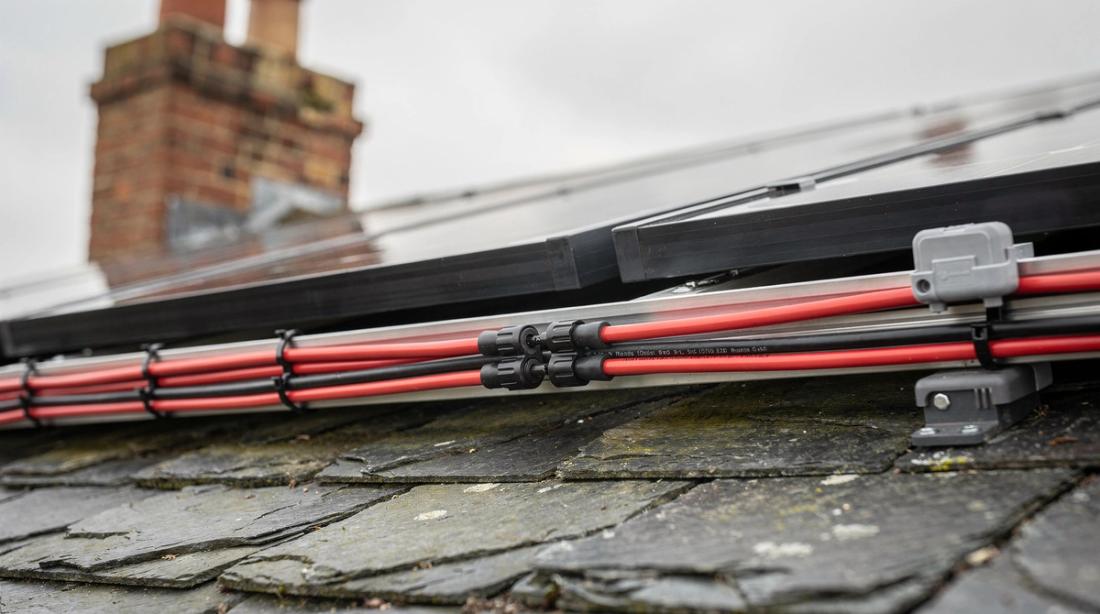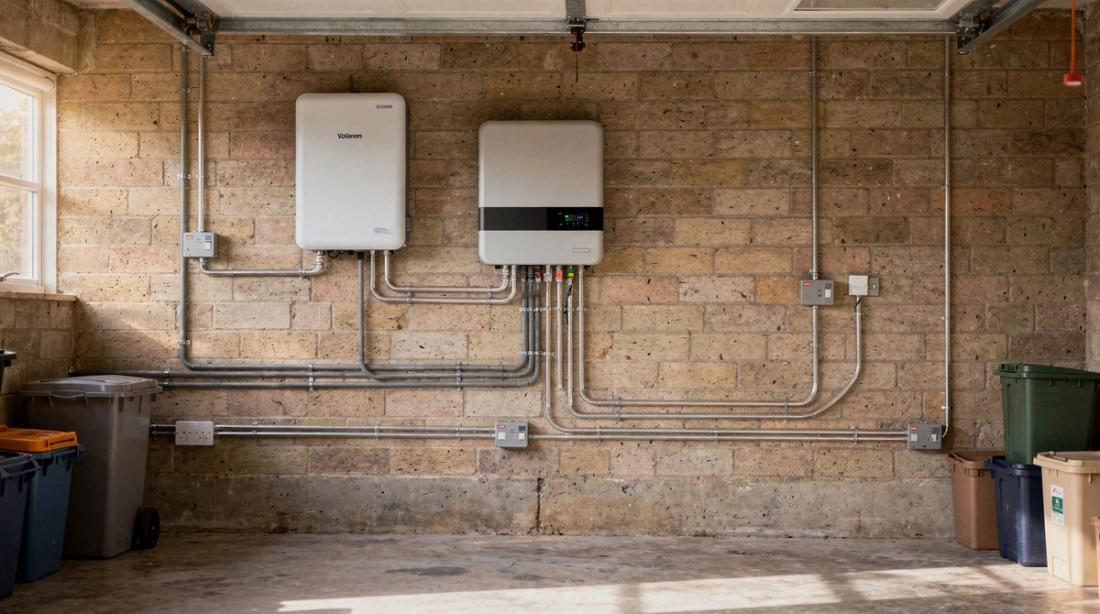

A hybrid inverter is a single unit that both converts solar DC into usable AC and manages charging and discharging of a battery, replacing the older setup of a separate string inverter and battery inverter. That integration is now the default for UK solar-plus-storage, and demand is surging: certified battery storage installations rose 122 percent year on year to reach 59,000 by the end of September 2025 (MCS, 2025).
This guide is for installers specifying and sizing hybrid inverters on UK jobs, not for homeowners comparing brands. It covers what the hybrid does, how to size it against the array, the DNO connection thresholds that decide your paperwork, the MCS product rules, and the DC versus AC coupling choice that shapes efficiency.
Key Takeaways
- A hybrid inverter combines PV inversion and battery management in one unit, simplifying solar-plus-storage installs.
- UK battery storage is booming, up 122 percent year on year to 59,000 certified installs by end-September 2025.
- The 16 A per phase (about 3.68 kW) threshold decides whether you notify under G98 or apply under G99.
- Hybrid inverters are usually DC-coupled, which avoids the extra conversion steps of an AC-coupled retrofit.
- The inverter must be MCS-certified and listed on the MCS Product Directory to certify the job.
What is a hybrid inverter and how does it work?
A hybrid inverter converts the direct current from your solar array into alternating current for the home, and at the same time controls a battery's charging and discharging, all in one box. A traditional setup needed a string inverter for the panels plus a separate battery inverter, with the two coordinating across an AC connection. The hybrid folds both jobs into a single unit with shared electronics.
The practical benefit is fewer components, one point of monitoring, and a cleaner DC path from panels to battery. Because solar energy can flow straight into the battery as DC without being converted to AC first, a hybrid loses less energy on the way to storage. That efficiency, plus simpler wiring, is why hybrids dominate new solar-plus-storage designs rather than string-plus-battery-inverter combinations.
Sizing a hybrid inverter for a UK installation
Sizing balances the inverter against the array and the battery. The inverter's AC output rating is matched to the expected system output, while the DC input side is sized to the panel array, often with a modest degree of oversizing. In UK conditions, where panels rarely hit their nameplate rating because of cloud and low sun angles, arrays are commonly built with a DC capacity somewhat larger than the inverter's AC rating to capture more annual yield.
Mild oversizing is standard practice because the small amount of clipping on rare bright peaks costs less than the yield gained across the year. The battery is then sized to the household's evening and overnight demand, not to the array alone. Getting these three ratings to work together is the design skill, and it is worth documenting the logic in the single-line diagram so the DNO and the client can follow it.
When does a hybrid inverter need a G99 application rather than G98?
The dividing line for single-phase domestic connections is 16 A per phase, roughly 3.68 kW of AC output. At or below that, you can usually connect under G98 and notify the network operator after the fact. Above it, you generally need a G99 application and DNO approval before energising. A hybrid inverter's rated AC output, and whether it is export-limited, determine which route applies.
Many hybrid installs sit above the single-phase G98 threshold once battery discharge is included, which pushes them into G99 territory. You can sometimes stay under G98 by hard export-limiting the inverter, subject to the DNO accepting the arrangement. Our G99 application guide walks through the approval process and timescales in detail.
Export limitation rules for hybrid systems
Where a DNO caps how much you can export, the hybrid's export limitation function has to meet defined performance rules. A customer export limitation scheme must reduce exported current to at or below the agreed maximum export capacity, typically within 15 seconds and no more than 60 seconds, be fail-safe, and have its settings sealed so they cannot be changed without written DNO agreement (National Grid, 2026).
That fail-safe and sealed requirement is easy to overlook when configuring a hybrid inverter's built-in limiter. If the export limit is set in software that an installer or homeowner can freely alter, it may not satisfy the DNO. Confirm that the specific hybrid model's export limitation is DNO-recognised before you rely on it to keep a job under a connection cap.
- Single-phase G98 limit: 16 A per phase, about 3.68 kW
- Above the G98 limit: G99 application and DNO approval before energising
- Export limitation response: Reduce to cap within 15 seconds, 60 seconds maximum
- Export limiter integrity: Fail-safe and settings sealed against unauthorised change
- Product eligibility: Inverter must be MCS-certified and on the Product Directory
Does a hybrid inverter have to be MCS-certified?
Yes, if the installation is to be MCS-certified and eligible for schemes such as the Smart Export Guarantee. MCS-certified solar-plus-storage installs must use modules, inverters, and storage units that appear on the MCS Product Directory, under standards including the solar PV installation standard and the battery installation standard MIS 3012:2025. Specifying an uncertified inverter breaks the chain.
The MCS battery installation standard applies to systems with a maximum power output up to 50 kW, which covers essentially all domestic and most small-commercial hybrid installs. Checking the Product Directory listing before you order protects the certification and the customer's access to export payments. Reading our MCS compliance guide alongside the directory helps you avoid specifying a product that cannot be registered.
DC-coupled versus AC-coupled hybrid designs
Most true hybrid inverters are DC-coupled, meaning the battery connects on the same DC side as the panels and stores solar energy without first converting it to AC. AC-coupled systems, by contrast, add a battery to an existing AC connection, which suits retrofits where a string inverter is already installed but adds conversion steps. Each conversion loses a little energy, so DC-coupled paths are generally more efficient for storing solar.
The choice usually follows the job. New solar-plus-storage installs favour a DC-coupled hybrid for efficiency and simplicity. Retrofitting a battery to an existing solar array often means AC-coupling, because replacing a working string inverter with a hybrid is rarely cost-effective. Understanding which scenario you are in shapes both the product choice and the expected round-trip performance.
UK battery storage growth alongside hybrids
Fast enough that storage is now a mainstream part of solar work, not a premium add-on. Beyond the 122 percent annual rise to 59,000 certified installs, DESNZ and MCS data recorded 22,398 domestic battery systems installed in the year to March 2025, totalling 193.39 MWh, with median installed cost falling from £1,020 per kWh on small systems to £590 per kWh on larger banks (Solar Power Portal, 2025).
Cost also favours storage right now because of tax treatment. Installing a standalone battery in a home qualifies for the 0 percent VAT energy-saving materials relief, which applies to qualifying materials up to 31 March 2027 before reverting to 5 percent (gov.uk, 2024). That window gives installers a clear reason to design storage in now, and hybrids make that straightforward on new solar jobs.
Commissioning and monitoring a hybrid inverter
Commissioning a hybrid inverter takes more steps than a string inverter because you set up both the PV and the battery side. You configure the export limit where one applies, set the battery charge and discharge behaviour to the customer's tariff, and register the system with the DNO under G98 or G99. Skipping the tariff setup is a common miss, because a battery that charges at the wrong time can cost the customer money rather than save it.
Monitoring is one of the hybrid's practical advantages. A single platform shows solar generation, battery state of charge, household consumption, and grid import and export together, which makes fault-finding faster than piecing data together from separate devices. Set the monitoring up at commissioning and walk the customer through it at handover, so they understand what good performance looks like and call you for the right reasons rather than the wrong ones.
Frequently asked questions
What is the difference between a hybrid inverter and a normal inverter?
A normal string inverter only converts solar DC into AC for the home. A hybrid inverter does that and also manages a battery's charging and discharging in the same unit. If you want solar plus storage from one box with a DC path to the battery, you choose a hybrid. If you never plan to add a battery, a string inverter can be enough.
Can I add a battery to a hybrid inverter later?
Usually yes, which is a key reason installers fit hybrids on solar-only jobs where the customer may add storage later. The hybrid already contains the battery management electronics, so adding a compatible battery is simpler than retrofitting a separate battery inverter. Confirm the specific model's supported battery brands and capacities at design stage so the future upgrade path stays open.
What size hybrid inverter do I need?
Match the inverter's AC output to the system's expected output, and size the DC input to the array, often with mild oversizing because UK panels rarely reach nameplate output. The battery is sized to evening and overnight demand rather than to the array. There is no single answer, so the sizing follows the specific roof, consumption profile, and connection limit.
Do hybrid inverters need DNO approval?
Often yes. A single-phase hybrid whose output exceeds 16 A per phase, about 3.68 kW, generally needs a G99 application and DNO approval before energising. Smaller or hard export-limited systems may connect under G98 with notification, subject to the DNO. Always confirm the route with the network operator before committing to an energisation date.
Are hybrid inverters more efficient than separate battery inverters?
For storing solar energy, generally yes. A DC-coupled hybrid moves solar into the battery on the DC side without first converting to AC, avoiding conversion losses that an AC-coupled setup incurs. The efficiency gain is real but modest, so the bigger advantages are often simpler wiring, one monitoring platform, and fewer components to install and maintain.
Specifying the right hybrid inverter, sized and connection-checked from the survey stage, is what keeps a solar-plus-storage job compliant and profitable. Tools like Reonic help installers capture sizing, product certification, and DNO detail in one workflow so the design holds together from quote to commissioning.