
Fitting solar panels on a flat roof is now a compliance decision before it is an engineering one, because since 10 August 2025 every flat-roof array in the UK must sit on an MCS 012 certified mounting system (MCS, 2025). The old route of building a custom kit under a MIS 3002 workaround has closed, and that single change reshapes how you quote, design, and sign off commercial flat-roof jobs.
This guide is written for installers working on warehouses, schools, and flat-roof extensions, not for homeowners browsing options. It covers ballasted versus mechanically fixed mounting, membrane compatibility, wind and snow load evidence, permitted development limits, and the safety duties that come with working at height on a flat surface.
Key Takeaways
- Since 10 August 2025, flat-roof solar (a roof pitched at 10 degrees or less) must use an MCS 012 certified mounting system, not a bespoke kit.
- Ballasted, non-penetrating mounts protect the waterproof membrane but demand a structural check of the roof's load capacity.
- Wind uplift and snow loading must be evidenced to the relevant Eurocodes before you fix anything down.
- Commercial rooftop solar is booming: the UK added 2.6 GW of capacity in 2025, a ten-year high.
- Permitted development allows most flat-roof arrays, but only within height and edge-setback limits.
Flat-roof solar starts with the 10-degree pitch rule
A flat roof for solar purposes is any roof pitched at 10 degrees or less, which is the threshold MCS 012 uses to define flat-roof mounting systems (MCS, 2025). That definition matters because flat roofs shed water slowly, carry different wind pressures, and rarely let you fix into a rafter. So the mounting method, the ballast, and the tilt all follow from the roof pitch rather than from panel choice.
On a pitched roof you hang panels close to the tiles. On a flat roof you build a tilted frame, usually angled between 5 and 15 degrees, to catch the sun and let rain run off. That frame is heavier, it is more exposed to wind, and it either penetrates the membrane or holds itself down with weight. Each of those choices has a compliance consequence you have to document.
Do flat-roof solar panels need an MCS 012 certified mounting system?
Yes. Since 10 August 2025, flat-roof installs must use a mounting system certified to MCS 012, the solar mounting product standard first published in Issue 3.0 on 10 May 2023 (MCS, 2025). Before that date, some installers used a clause in the installation standard to fit uncertified bespoke frames, but that workaround has now expired. A non-certified kit today puts your MCS certificate for the job at risk.
Issue 3.0 widened the standard to cover both mechanically attached and non-mechanically attached (ballasted) systems built for flat roofs. In practice that means the tray, foot, or rail you specify has to appear on a manufacturer's MCS 012 certificate covering flat-roof use. Checking that certificate before you order is the quickest way to avoid a failed inspection, and it is worth reading our MCS compliance guide alongside the product listing.
Ballasted versus mechanically fixed mounting
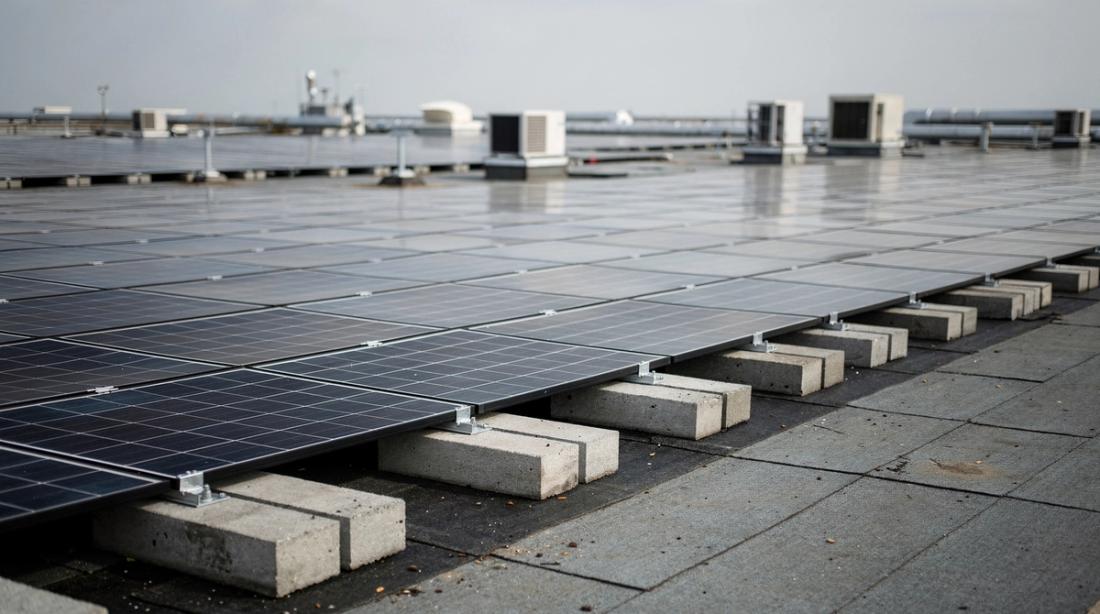
The choice comes down to what the roof can carry and what the membrane will tolerate. Ballasted systems hold panels down with weight, usually concrete blocks or paving slabs, and never pierce the waterproof layer. Mechanically fixed systems bolt through the deck, which gives a lighter, more secure fix but breaks the membrane and needs careful flashing. Most UK flat-roof jobs default to ballast because it keeps the membrane warranty intact.
Ballast has a cost, though, and that cost is weight. A tilted array acts like a sail, so the system needs enough dead load to resist wind uplift without overloading the roof. That is why a structural assessment of the roof's load-bearing capacity comes first, before you settle on ballast quantity or layout. On older warehouse decks the available margin can be surprisingly tight.
- Roof pitch: 10 degrees or less is treated as flat under MCS 012
- Ballasted mount: No membrane penetration, protects waterproofing, adds significant dead load
- Mechanically fixed mount: Lower weight, higher security, requires flashing and can affect membrane warranty
- Typical array tilt: Commonly 5 to 15 degrees for drainage and yield
- Wind evidence: Calculated to BS EN 1991-1-4
- Snow evidence: Calculated to BS EN 1991-1-3
How does the roof membrane affect the installation?
The membrane dictates whether you can even consider mechanical fixings. Felt and GRP roofs generally favour non-penetrating ballasted systems, because cutting into them is difficult to seal reliably and often voids the covering warranty. Single-ply and torch-on bitumen membranes can sometimes take bonded baseplates or mechanical fixings, but only with compatible flashing details agreed with the membrane manufacturer.
Always confirm the membrane type and its remaining service life during survey. Putting a 25-year solar array on a membrane with five years left is a false economy, because removing and refitting panels for a re-roof wipes out the saving. Where the covering is near end of life, the honest conversation with the client is to re-roof first, then mount. A structured site survey approach helps you catch this early rather than on install day.
Wind and snow load evidence for flat-roof arrays
Every flat-roof mounting design has to be evidenced against wind uplift and snow load using the UK structural Eurocodes: BS EN 1991-1-4 for wind actions and BS EN 1991-1-3 for snow. These calculations set the ballast weight or fixing pattern, and they change with building height, exposure, and location. A coastal warehouse in an exposed county needs far more restraint than a sheltered inner-city block of the same size.
This is where a qualified structural engineer earns their fee. The roof has to carry the panels, the mounting frame, the ballast, and the wind and snow forces acting on all of it, without exceeding the deck's capacity. Getting a signed structural check before install protects you if the roof is later inspected or if a claim arises. Wind uplift on tilted flat-roof arrays is the failure mode that catches inexperienced installers out most often.
Can commercial flat-roof solar be installed under permitted development?
Often, yes. The former 1 MW cap on commercial rooftop solar under permitted development was removed in late 2023, which opened up far larger warehouse and industrial arrays without a full planning application (Solar Power Portal, 2024). That change is one reason commercial rooftop deployment has accelerated so sharply across the UK.
Permitted development still comes with conditions on flat roofs. Equipment must sit no more than one metre above the highest part of the roof, excluding the chimney, and no part of the installation should come within one metre of the external edge of the roof. Listed buildings, conservation areas, and sites with an Article 4 direction fall outside these rights, so a quick check of the planning designation belongs in every survey.
The UK commercial rooftop solar market in 2026
It is expanding fast at every scale. The UK added 2.6 GW of solar in 2025, taking total deployed capacity to 21.6 GW, a 13.6 percent rise and the strongest year in a decade (pv magazine, 2026). Rooftop, including flat-roof commercial, was a major driver of that growth rather than a footnote to ground-mounted farms.
MCS data reinforces the picture: certified solar installations passed 203,125 in 2025, a record, while battery storage installs rose 122 percent to reach 59,000 by the end of September. For installers, the takeaway is that flat-roof commercial work is no longer a niche add-on. It is a core revenue line, and clients increasingly expect storage designed in from the start rather than bolted on later.
What safety duties apply when working on a flat roof?
Working at height is the dominant risk, and the statistics are blunt. Falls from height caused 35 of the 124 work-related deaths in Great Britain in 2024/25, more than a quarter of the total and the single most common cause (HSE, 2025). A flat roof feels safer than a pitched one, which is exactly why edge protection discipline slips.
Every flat-roof solar job needs a documented plan for edge protection, safe access, and material handling before anyone goes up. Guard rails or a suitable barrier along open edges, controlled loading of ballast blocks, and weather limits for lifting all belong in the method statement. Once the array is live, a maintenance access plan keeps future inspections safe too, and our solar maintenance guide sets out how to schedule that.
Frequently asked questions
Can you put solar panels on a flat roof without drilling?
Yes, and it is the most common approach in the UK. Ballasted mounting systems hold the tilted frames in place with weight, usually concrete blocks, so nothing penetrates the waterproof membrane. This protects the roof covering and its warranty. The trade-off is added dead load, so a structural check of the roof's capacity is essential before you finalise the ballast layout.
What angle should flat-roof solar panels be tilted at?
Flat-roof arrays are usually tilted between 5 and 15 degrees. The tilt lifts panels off the surface so rain drains and dirt washes away, and it improves yield compared with laying panels flat. East-west layouts use back-to-back low tilts to fit more panels with less wind exposure, while south-facing rows use a single tilt for peak output where space allows.
Do I need planning permission for solar on a commercial flat roof?
Usually not, because the 1 MW permitted development cap was removed in late 2023. However, the array must stay within one metre of the roof's highest point and no closer than one metre to any external edge. Listed buildings, conservation areas, and sites under an Article 4 direction do not benefit from these rights and need a planning application.
Is a ballasted system heavier than a pitched-roof mount?
Generally yes. A ballasted flat-roof system carries the frame plus enough weight to resist wind uplift, which adds meaningful dead load per square metre. That is why the roof's structural capacity, calculated against wind and snow actions, sets the design. On older decks the available load margin, rather than the panel count, often decides how large the array can be.
Does a flat-roof array still need an MCS certificate?
Yes. To register the installation with MCS and access schemes such as the Smart Export Guarantee, the job must use MCS certified panels, an MCS certified inverter, and an MCS 012 certified flat-roof mounting system. Using an uncertified bespoke mounting kit after 10 August 2025 means the installation cannot be MCS certified.
Getting flat-roof compliance right from the survey onward is where installers protect both the client and their own certificate. Tools like Reonic help teams capture the survey, structural, and product-certification detail in one place so nothing slips between quote and sign-off.