
The air to air heat pump grant pays £2,500 per property under the Boiler Upgrade Scheme, yet in September 2026 installers still cannot claim it because installer certification for air-to-air has only just cleared its first hurdle (Installer Online, 2026). The law changed on 28 April 2026, but the certification chain behind it is still being built.
That matters because the scheme is large and moving fast. Ofgem paid 31,104 grants worth £233.1 million in 2025-26, and air source heat pumps made up 97.6% of all grants paid since launch (Ofgem, 2026). Air-to-air is a new, much smaller lane inside a £400 million budget for 2026 to 2027 (GOV.UK, 2026). This guide sets out what is live, what is not, and how to prepare your quotes.
Key Takeaways
- Air-to-air heat pumps have been eligible for a £2,500 Boiler Upgrade Scheme grant since 28 April 2026, in England and Wales, for residential properties only.
- The new system must replace an existing fossil fuel or electric heating system, and it cannot replace a low-carbon system or sit in a hybrid with a boiler.
- Air-to-water and ground source pumps still receive £7,500, plus £1,500 more for off-gas homes using oil or LPG until March 2027.
- As of September 2026, UKAS has approved the redeveloped MCS installer scheme, but certification bodies still need their own accreditation before anyone can certify for air-to-air.
- Never promise grant funding on an air-to-air quote until your certification body, the product and the voucher route are all confirmed.
Does the air to air heat pump grant exist in 2026?
Yes. Air-to-air heat pumps became eligible for a £2,500 Boiler Upgrade Scheme grant on 28 April 2026, when the Boiler Upgrade Scheme (England and Wales) (Amendment) Regulations 2026 came into force (legislation.gov.uk, 2026). Before that date, air-to-air units were excluded from the scheme entirely.
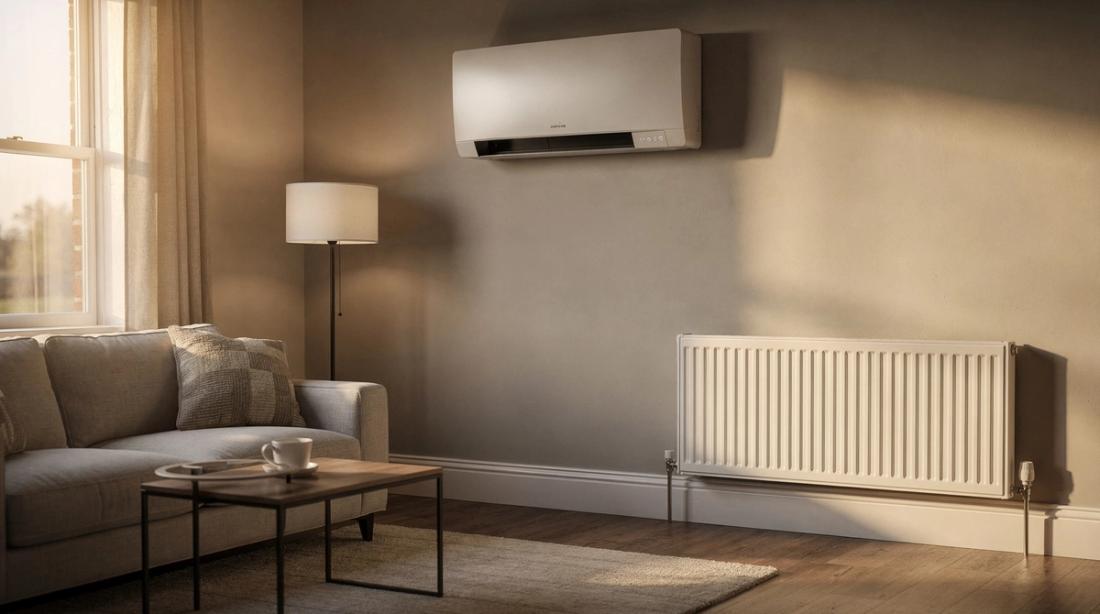
The exclusion had a simple logic. Air-to-air systems move warm air around rooms and do not heat water, so they sat outside a scheme built around wet central heating. The 2026 amendment widened the list of grant-backed technologies to include them, with a lower grant to reflect the narrower scope.
For installers, the shift is bigger than a paperwork change. The old answer, that air-to-air never qualifies, is now wrong. The new answer carries conditions, and getting those conditions right protects both your reputation and your customer's expectations.
How much is the air to air heat pump grant worth?
The air-to-air grant is £2,500 per property, against £7,500 for air source and ground source heat pumps and £5,000 for biomass boilers (GOV.UK, 2026). One grant applies to the property, not to each indoor unit, so a multi-room system still earns a single £2,500.
Off-gas homes get a separate uplift, but not for air-to-air. Properties using oil or LPG with no mains gas connection can claim an extra £1,500 towards an air source or ground source pump until March 2027 (GOV.UK, 2026). That makes £9,000 for a wet system in the right home.
The regulations also changed how the money reaches the customer. The installer must deduct the voucher value from the quoted price up front, so the customer pays the net figure (legislation.gov.uk, 2026). Your business carries the gap until Ofgem pays, which makes cash-flow planning part of every air-to-air quote.
Who is eligible for the air to air heat pump grant?
Eligibility is narrower than the headline suggests. The new system must replace an existing fossil fuel or electric heating system and cannot replace an existing low-carbon system, and the property must be in England or Wales (Ofgem, 2026). Non-residential buildings are excluded for air-to-air.
Three further conditions shape real jobs:
- Performance: the regulations require a seasonal coefficient of performance of at least 2.8 and a capacity of no more than 45 kW thermal (legislation.gov.uk, 2026).
- No hybrids: GOV.UK states that hybrid systems combining a gas boiler with a heat pump cannot receive funding (GOV.UK, 2026).
- Evidence: a valid EPC is no longer required from 28 April 2026, and a recent utility bill plus photos of the existing system can stand in (HEM Guide, 2026).
One practical point comes from trade guidance rather than the regulations. Air Con Adviser reports that the system must meet the property's full space heating demand on its own, which rules out most single-room add-on units (Air Con Adviser, 2026). Check the current Ofgem installer guidance before you quote a small unit as grant-eligible.
Why can installers not claim the air to air grant yet?
Because the certification chain is incomplete. MCS said on launch day that updated scheme documents were awaiting UKAS approval and that certified products would need to reach the MCS Product Directory before grants could be claimed (MCS, 2026). The law moved first; the hardware and the people followed later.
Progress has been real since then. UKAS has approved the updates to the redeveloped MCS Installer Scheme, which lets installer certification bodies start applying for UKAS accreditation for air-to-air. NAPIT and Certsure have both signalled interest (Installer Online, 2026).
On the product side, Daikin has listed 65 residential multi-split and Multi+ combinations on the MCS Product Directory through Eurovent Certification (BRG Building Solutions, 2026). That listing is a step towards eligibility rather than eligibility itself. Even so, Air Con Adviser notes that the Energy and Climate Intelligence Unit reported no installations by July 2026 despite 45 applications (Air Con Adviser, 2026), so treat that figure as a secondary report rather than an official count.
Air-to-air vs air-to-water under the Boiler Upgrade Scheme
The choice comes down to grant value against system scope. Air-to-water attracts £7,500 and heats rooms and hot water, while air-to-air attracts £2,500, heats air only and can cool in summer (GOV.UK, 2026). The right answer depends on the property and its existing heating.
The comparison below sets the two routes side by side.
- Grant value: £2,500 for air-to-air; £7,500 for air-to-water, plus £1,500 for off-gas oil and LPG homes until March 2027.
- Hot water: air-to-air does not heat water; air-to-water does.
- Cooling: air-to-air cools in summer; air-to-water rarely does.
- Typical cost: Air Con Adviser quotes about £3,200 to £5,500 for a two-room multi-split and £4,800 to £10,000 or more for three or more rooms; Which? puts an 8.4 kW air source system at an average £13,431 before the grant (Which?, 2026).
- Existing system replaced: both routes need a fossil fuel or electric system to be replaced, and neither allows a hybrid.
For a flat with old storage heaters or panel heaters, air-to-air can make strong sense: a lower install cost, cooling included and a grant covering a real share of the bill. For a gas-heated house that wants lower carbon and a hot water solution, air-to-water stays the better grant-backed route. Our air source heat pump cost guide covers the wet-system numbers in more detail.
MCS certification for air-to-air installers
Both the installer and the product must be MCS-certified, and the Technical Supervisor must hold competence in Refrigeration, Air Conditioning and Heat Pumps (RACHP) at Level 3 or above (MCS, 2026). A business can hire or subcontract that role if it lacks the qualification in-house.
The route to certification has three steps. UKAS must approve the scheme documents, installer certification bodies must gain UKAS accreditation for air-to-air, and then installers apply to extend their certification scope (MCS, 2026). Only the first step is confirmed complete.
If your business already holds heat pump certification, plan your scope extension now. Our guides to the MCS compliance process and the redeveloped MCS installer scheme explain how certification bodies and standards fit together, and the comparison of NICEIC and NAPIT helps if you are choosing a certification body.
Air-to-air installation costs after the grant
Costs vary widely by room count. Air Con Adviser puts a single split at £1,500 to £3,000, a two-room multi-split at £3,200 to £5,500 and a three-room or larger system at £4,800 to £10,000 or more, before the £2,500 grant (Air Con Adviser, 2026). These are trade estimates, not official prices.
The grant covers most or all of a small system but only a quarter or less of a large whole-home install, according to the same guide. That gap is where customer expectations go wrong, so show the net figure and the assumptions side by side.
Running costs need honest framing too. Which? notes that electricity costs roughly four times as much per unit as gas, and that a heat pump needs a seasonal efficiency of about 2.9 to save money at standard rates (Which?, 2026). Our heat pump vs gas boiler running cost comparison works through the tariff effects.
How installers should prepare for the air-to-air grant
Prepare the business, not the voucher. With certification still pending, the useful work now is training, product selection and quote design, so you can move the day a certified route opens. Promising grant-funded installs before then risks a commitment you cannot keep.
A short checklist keeps the preparation concrete:
- Check your certification body: ask whether it has applied for UKAS accreditation for air-to-air and when it expects a decision.
- Confirm the product: only models on the MCS Product Directory will generate a compliant voucher.
- Line up RACHP Level 3: secure a qualified Technical Supervisor, in-house or subcontracted.
- Model the cash flow: the grant is deducted from the quote, so your business funds the gap until Ofgem pays.
- Screen the leads: keep the replace-an-existing-system rule and the no-hybrid rule in your survey checklist.
For installers who combine heat pumps with solar, the solar and heat pump system guide shows how the pieces fit. Reonic's design and quoting software can help model heat demand and grant scenarios before the survey, but the grant itself stays real only once certified products and installers are in place.
Frequently asked questions
Can I get the air to air heat pump grant with a gas boiler?
The system must replace an existing fossil fuel or electric heating system, so a gas boiler replacement can qualify in principle, but hybrid systems that keep the boiler cannot (Ofgem, 2026). Check current installer guidance first, because the grant is only claimable once certification is live.
Is the air to air heat pump grant available right now?
The rules are live from 28 April 2026, but claims are not practical yet. UKAS has approved the scheme updates, yet installer certification bodies still need accreditation, so no installer can certify for air-to-air (Installer Online, 2026). Prepare quotes, but do not promise funding.
How much is the air to air heat pump grant?
The grant is £2,500 for residential properties in England and Wales, against £7,500 for air source and ground source heat pumps. One grant applies per property, not per indoor unit (GOV.UK, 2026).
Do installers need MCS certification to claim?
Yes. The installer must be MCS-certified for air-to-air, the product must appear on the MCS Product Directory, and the Technical Supervisor needs RACHP Level 3 competence or above (MCS, 2026). The installer then makes the Ofgem application on the homeowner's behalf.
Is air-to-air or air-to-water better value with the grant?
It depends on the home. Air-to-water gives £7,500 and heats rooms plus hot water; air-to-air gives £2,500, adds cooling and usually costs less to install. Match the technology to the existing heating system and the customer's real needs (GOV.UK, 2026).