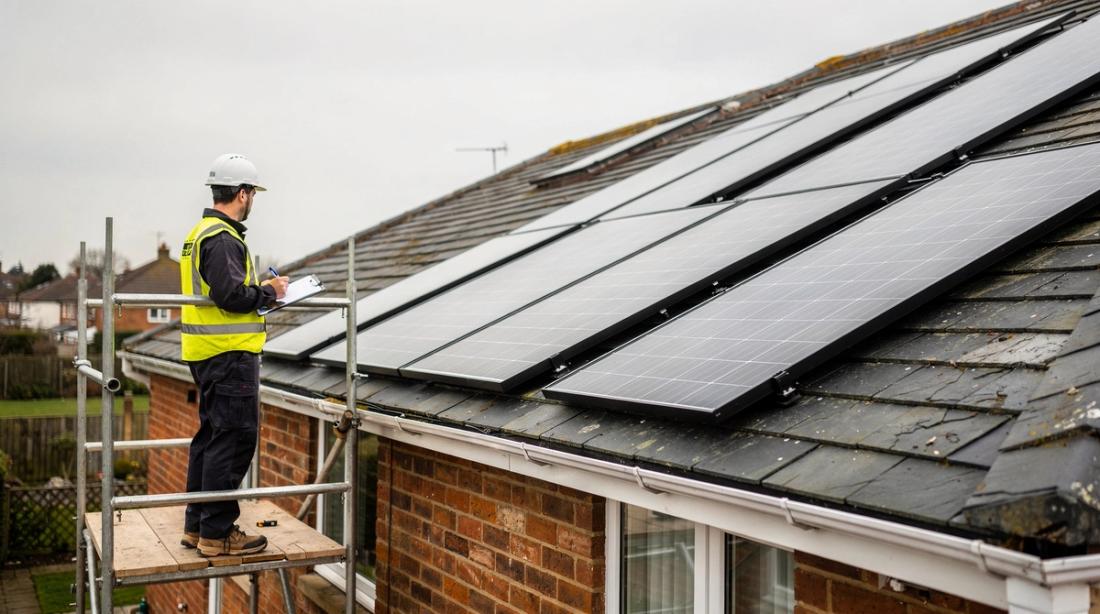

Starting a solar panel business in the UK in 2026 means entering a market that installed 267,032 certified solar PV systems in 2025, a 31% jump on the previous annual record (MCS, 2026). Demand is real, but the route in is a sequence of registrations, not a single licence. You need a trading entity, an electrical competency route, MCS certification through a certification body, and membership of an approved consumer code before you can sell a compliant domestic install.
This guide walks the setup in the order a real installer tackles it: the qualifications behind the business, the accreditations that open the mainstream market, the insurance floor, the startup budget, and the first jobs. It is written for people who can wire a board or hire someone who can, and who want the paperwork to hold up on a Smart Export Guarantee claim.
Key Takeaways
- The UK certified 267,032 solar PV systems in 2025 (+31%) and fitted another 150,000 in the first half of 2026, so the market is expanding fast (MCS, 2026).
- MCS certifies the company, not the individual, and it is effectively mandatory for the domestic market because SEG payments require an MCS certificate.
- You must join an approved consumer code, either RECC or HIES, as part of MCS registration.
- A realistic setup budget for a certified installer is £3,000 to £6,000, plus recurring scheme and insurance fees.
- Public liability cover of at least £2 million is the industry floor, with some contracts asking for £5 million.
Do you need qualifications to start a solar panel business?
Yes. The technical lead must hold a recognised electrical route plus a solar PV competency, because MCS assessments check that a named person can install and commission to standard. The common route is an NVQ Level 3 in electrical installation combined with a Level 3 solar PV award (the 2399 and 2922 units), which certification bodies accept as evidence of competence.
You do not personally need every qualification if you employ or subcontract a qualified installer, but someone in the business must own that competence. MCS is company certification, so a sole trader with the right qualifications and a limited company employing an electrician both qualify. What does not work is registering a business with no qualified installer behind it and expecting to pass assessment.
MCS certification and why it matters
MCS is the Microgeneration Certification Scheme, the UK quality mark for small-scale renewables introduced in 2007. For a solar business it matters because homeowners claiming the Smart Export Guarantee must have an MCS installation certificate for the system, which shuts non-certified installers out of most domestic work. The number of MCS certified installers grew 7% across 2025 as firms chased that demand (MCS, 2026).
MCS does not assess you directly. It approves certification bodies, and one of them audits your business against the installer standard and the solar PV standard, MIS 3002, before issuing certification on MCS's behalf. Our guide on how to become MCS certified breaks the assessment down step by step, and the wider MCS accreditation overview explains where each standard fits.
Registering the business and your electrical competency route
Register a legal trading entity first, either a sole trader with HMRC or a limited company at Companies House, because every downstream scheme needs a business to attach to. Then secure your electrical competency route, usually membership of a Competent Person Scheme such as NICEIC or NAPIT, which lets you self-certify domestic electrical work under Part P instead of notifying building control on every job.
That Part P route is a practical prerequisite for solar work, since a grid-tied system is notifiable electrical work. Many installers bundle it with MCS at application time. If you are weighing certification bodies, our MCS certification cost breakdown shows how the Part P, MCS and consumer code fees stack into one annual figure.
Which consumer code do you have to join?
To hold MCS certification you must belong to one of two consumer codes approved by the Chartered Trading Standards Institute: the Renewable Energy Consumer Code (RECC) or the Home Insulation and Energy Systems scheme (HIES). This is not optional. The consumer code sets the rules for your contracts, deposits, cancellation rights and workmanship guarantees, and MCS checks membership as part of registration (RECC, 2026).
Both RECC and HIES also act as TrustMark scheme operators, so joining one opens the door to TrustMark registration, the government-endorsed quality mark that grant schemes increasingly require. If you plan to deliver funded work later, TrustMark is worth setting up early. Our TrustMark registered business guide covers what that adds on top of the consumer code.
The cost of starting a solar installation business
A realistic setup budget for a certified installer sits between £3,000 and £6,000, before you buy a van or stock (elec.training, 2026). That figure absorbs training, certification body fees, consumer code membership and initial insurance. On top of the one-off cost, plan for recurring annual fees and a small per-job charge, because each MCS installation certificate you lodge costs around £30.
The table below sets out the main line items an installer budget needs to cover.
- Business registration: sole trader is free with HMRC; a limited company costs a small Companies House fee.
- Electrical competency (Part P scheme): NICEIC or NAPIT membership, typically a few hundred pounds a year.
- MCS plus consumer code: often bundled by a certification body into roughly £800 to £1,200 per year (SunSave, 2026).
- Insurance: public liability, professional indemnity and, if you employ, employer's liability.
- Per install: about £30 for each MCS certificate lodged.
What insurance does a solar installer need?
Public liability insurance is the non-negotiable floor, and the industry standard is at least £2 million of cover, with some main contractors requiring £5 million before they will let you on site (Total Skills, 2026). Professional indemnity protects against design and advice claims, which matter once you start specifying systems, and employer's liability is a legal requirement the moment you take on staff.
Costs are modest against the risk. Public liability for £2 million commonly runs £150 to £250 a year, and professional indemnity adds roughly £100 to £200 (Total Skills, 2026). Separately, your consumer code will expect an insurance-backed guarantee so a customer's workmanship warranty survives if you cease trading. We cover that product in our insurance-backed guarantee guide.
Where do the first jobs come from?
New build and retrofit both offer openings, but they behave differently. Retrofit is the volume market that most start-ups target, driven by homeowners chasing bills and export income. New build is growing faster in share: 28% of all 2025 installations were on new builds, rising above 36% for solar alone as building rules push developers toward rooftop PV (MCS, 2026).
Winning either depends on a clean sales and handover process, not just a sharp price. A compliant quote, a documented survey and a tidy MCS certificate build the reviews that feed the next lead. Our guides on how to sell solar panels and the solar quote template cover the compliance points that protect margin while you scale.
Momentum favours new firms that get certified quickly. The UK reached one certified installation every 74 seconds in the first half of 2026, and installation volumes are forecast to keep climbing through the year (Solar Weekly, 2026). Local reputation compounds in that environment. A visible MCS badge, verified reviews on the MCS and consumer code directories, and a fast, accurate quote turnaround win more domestic work than advertising spend, especially in the first year when referrals carry most of the pipeline. Pick a service area you can reach in under an hour and dominate it before widening the radius.
How long does it take to become fully certified?
Plan for a few months from company formation to your first compliant install, because the steps stack rather than run in parallel. Qualifications and Competent Person Scheme membership come first, then the certification body audit, then consumer code and TrustMark. The assessment itself hinges on evidence, so a documented quality management system and a witnessed or well-recorded first installation move things along.
Once certified, the operational load shifts to keeping records straight: design calculations, commissioning data and certificates on every job. Installers who build that discipline early pass surveillance audits without drama, because the assessor is checking process evidence, not memory. A missing calculation or an unlodged certificate is the sort of small gap that turns a routine surveillance visit into a corrective action, so treat documentation as part of the install, not an afterthought once the panels are on the roof. Software that keeps survey, design and handover paperwork in one place, such as Reonic's installer platform, removes a lot of the manual filing that trips up new firms.
Frequently asked questions
Do I need to be an electrician to start a solar panel business?
Not personally, but the business needs a qualified installer behind it. MCS certifies the company against a named technical competence, typically an NVQ Level 3 electrician with a Level 3 PV award. A non-electrician can own the company and employ or subcontract that skill, provided the qualified person genuinely leads installation and commissioning.
Is MCS certification legally required to install solar panels?
No law forces MCS on you, but it is a commercial necessity for domestic work. Homeowners need an MCS certificate to claim Smart Export Guarantee payments, so uncertified installers are locked out of the mainstream market. MCS also opens most grant-funded schemes, which increasingly demand certification plus TrustMark registration.
What is the difference between RECC and HIES?
Both are consumer codes approved by the Chartered Trading Standards Institute, and MCS accepts either. They set contract, deposit and guarantee rules and both operate as TrustMark scheme operators. The practical differences are in fees, sector focus and included guarantee products, so compare them against the technologies you plan to install before choosing.
How much can a new solar installation business expect to earn?
Earnings vary too widely to promise a figure, but the market backdrop is strong: the UK fitted about 150,000 certified solar systems in the first half of 2026 alone (MCS, 2026). Margin depends on job mix, overheads and how cleanly you run surveys, quotes and handovers rather than on headline system prices.
Can I install batteries and EV chargers under the same business?
Yes, and most installers do, but each technology has its own MCS standard, competency and sometimes a separate certification scope. Battery storage and EV charging follow their own qualification routes, so add them to your MCS scope deliberately rather than assuming solar certification covers them. Widening scope carefully is a common way for solar start-ups to grow revenue per customer.