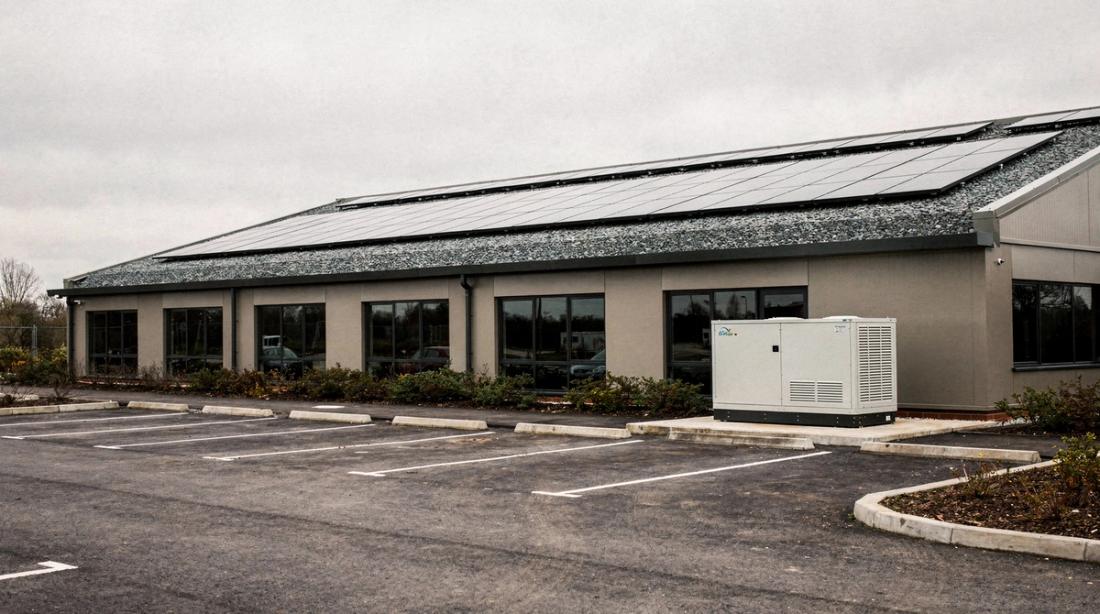

Commercial battery storage in the UK costs roughly £200 to £450 per kWh installed for a typical system, which puts a 100 kWh installation at £20,000 to £40,000 (Heatable, 2026). That single figure hides a wide range, because the price per kWh falls as the system grows and rises when the site needs grid upgrades, fire safety works or complex controls.
This guide breaks commercial battery storage cost into the numbers an installer actually quotes: price per kWh by system size, what drives the total, why the UK figure sits well above the headline cell price, and how the battery earns the money back. The angle is the one you need in front of a commercial client, not a manufacturer brochure.
Key Takeaways
- Expect £200 to £450 per kWh installed for mid-size commercial storage, and £20,000 to £40,000 for a 100 kWh system.
- Larger containerised projects fall to around £140 to £240 per kWh, so scale is the single biggest lever on unit cost.
- Lithium-ion pack prices hit a record low of 108 dollars per kWh in 2025, with stationary-storage packs at just 70 dollars per kWh, but installed UK cost is far higher once inverters, works and margin are added.
- Payback typically runs 4 to 10 years, and under 7 years when the battery pairs with solar.
- The bill of materials is only half the quote: grid connection, fire safety and controls decide whether a job is cheap or expensive.
How much does commercial battery storage cost in the UK?
Commercial battery storage costs about £200 to £450 per kWh installed for a standard mid-size system, with a 100 kWh unit landing between £20,000 and £40,000 (Heatable, 2026). Smaller commercial systems can sit higher, from £400 to £800 per kWh, while larger ones fall toward £300 to £600 per kWh as fixed costs spread across more capacity (Weatherlab, 2025).
Two things explain most of the range. The first is scale, because fixed costs like the grid connection and controls do not grow with capacity, so they weigh far more on a small system. The second is the site itself: a straightforward indoor installation with spare switchboard capacity is cheap, while a site needing a new transformer, external enclosures or fire compartmentation is not. Quote the band, then narrow it with real site data.
Commercial battery storage cost by system size
Cost per kWh falls steadily as commercial systems grow, so system size is the first number to pin down. The table below gives working ranges by size. Treat them as budget figures for a first conversation, then firm them up once you have the load profile, the metering position and a grid connection answer. The spread inside each band is real and driven by the site, not by the battery brand.
- Up to 50 kWh: roughly £20,000 to £40,000, about £400 to £800 per kWh, small retail or office loads.
- 100 kWh: roughly £20,000 to £40,000 in mainstream quotes, about £200 to £400 per kWh.
- 200 to 500 kWh: roughly £80,000 to £250,000 or more, about £300 to £500 per kWh for a manufacturing or logistics site (Heatable, 2026).
- Containerised, 500 kWh and up: around £140 to £240 per kWh, where scale and standard enclosures cut the unit rate (GSL Energy, 2025).
One practical caution on the smallest tier: a 30 to 50 kWh system often costs almost as much to connect and commission as a 100 kWh one, so the price per kWh looks alarming. If the load can justify it, stepping up a size band frequently improves both the unit rate and the payback, which is worth showing a client rather than simply quoting the smallest box that fits.
The five drivers of commercial battery cost
The battery modules are only part of the number. A commercial quote splits across five cost centres, and the last three are where sites diverge most. Getting a client to understand this early stops the awkward conversation when a grid connection quote lands. The five drivers below shape almost every commercial figure you will produce.
- Battery modules: the cells and racks, usually lithium iron phosphate for its cycle life and safety profile, which carries the strongest total-cost case for most commercial duty cycles.
- Power conversion and inverters: the PCS that sets charge and discharge rate, sized to the site's peak demand rather than just the energy figure (Reonic hybrid inverter guide, 2026).
- Grid connection: the DNO application, any reinforcement, and export or import limitation, which can swing a quote by tens of thousands (Reonic G100 guide, 2026).
- Fire safety and siting: enclosures, spacing, ventilation and detection to meet the current guidance, following the electrical energy storage code of practice (Reonic IET code guide, 2026).
- Controls, commissioning and margin: the energy management software, testing, and your own labour and warranty provision.
Chemistry choice sits underneath all five. Most commercial systems now use lithium iron phosphate rather than nickel manganese cobalt, and the price gap is real: LFP packs averaged 81 dollars per kWh in 2025 against 128 dollars for NMC (BloombergNEF, 2025). LFP also cycles more times and tolerates heat better, so for a battery that charges and discharges daily it usually wins on total cost as well as headline price. That is the chemistry to specify unless a client has a genuine reason for high energy density in a tight space.
Why are UK prices higher than the headline cell price?
Because the number you read in the news is the pack price, not the installed price. Lithium-ion pack prices fell 8% in 2025 to a record low of 108 dollars per kWh, and stationary-storage packs dropped to just 70 dollars per kWh (BloombergNEF, 2025). A UK installed system costs several times that once conversion, works and margin are added.
Location matters too. Average pack prices in Europe run about 56% higher than in China, reflecting import dependence and local production costs (BloombergNEF, 2025). So when a client waves a cheap online cell price at you, the gap they are missing is conversion, connection, compliance and the labour to make it safe and legal.
How does a commercial battery earn its money back?
A commercial battery pays back by stacking several savings and revenue streams rather than relying on one. The UK has the most diverse battery revenue stack in Europe, with wholesale trading, ancillary services and network-charge avoidance all accessible (Rabobank, 2025). For a behind-the-meter commercial site the biggest wins are usually demand-charge and network-charge avoidance.
Peak shaving cuts the site's maximum demand and the network charges tied to it, which for many businesses is the clearest saving to model (Reonic peak shaving guide, 2026). Distribution use of system charges are location specific and time-banded, so discharging through the red-band peak avoids the priciest units. Frequency services, once 80% of grid-scale revenue in 2022, fell to about 20% by 2024 as the market saturated, so do not build a behind-the-meter business case on them (Rabobank, 2025).
What is the payback period for a commercial battery?
Payback periods for commercial battery storage typically run 4 to 10 years, and often under 7 years when the battery is paired with solar so it charges on cheap self-generated power (Heatable, 2026). The exact figure depends on the site's demand profile, its tariff, and how many revenue streams the controls can actually capture.
Model payback on the savings you can defend, not the best-case revenue stack. A site with a spiky demand profile and a punitive maximum-demand charge will pay back faster than a flat-load office on a simple tariff, even with an identical battery. The demand data is the most valuable thing you can ask a commercial client for before you quote.
How to price a commercial battery job as an installer
Start from the site, not the battery. Pull at least a year of half-hourly consumption data, identify the demand peaks and the tariff structure, then size the power and energy to the savings rather than to a round number of kWh. This is where a proposal wins or loses, because an oversized battery inflates the price and lengthens payback.
Quote in ranges until the grid connection answer is in, because that single unknown moves the total more than any component choice. The UK grid-scale market grew 45% in 2025 with 4 GWh added, and the Clean Power 2030 plan expects capacity to rise from 4.5 GW in 2024 to 23 to 27 GW by 2030, so DNO queues and connection costs are a live risk to any timeline (Energy Storage News, 2025). Reonic's platform helps installers turn site data into a costed, compliant commercial proposal without rebuilding the maths each time.
How much does a 100 kWh commercial battery cost in the UK?
A 100 kWh commercial battery typically costs £20,000 to £40,000 installed, which works out at roughly £200 to £400 per kWh. The spread depends on the inverter sizing, the grid connection requirement, fire safety works and the controls specified. Get a load profile and a DNO answer before firming up any figure for a client.
Is commercial battery storage cheaper per kWh at larger sizes?
Yes. Fixed costs such as grid connection, controls and commissioning spread across more capacity, so unit cost falls as systems grow. Mid-size commercial storage runs about £200 to £450 per kWh, while larger containerised projects can reach around £140 to £240 per kWh, which is why scale is the biggest single lever on price.
Do commercial batteries qualify for 0% VAT?
No. The 0% VAT rate on battery storage applies to installations in residential accommodation, not to commercial premises, which are charged at the standard rate. Treat commercial battery storage as a standard-rated supply and confirm the VAT treatment with the client's accountant, since it materially affects the payback calculation.
How long does a commercial battery pay back?
Most commercial battery systems pay back in 4 to 10 years, and under 7 years when paired with solar. The driver is the site's demand profile and tariff: a business with high maximum-demand charges and spiky loads recovers cost faster than a flat-load site, even with the same battery capacity installed.
What is the biggest hidden cost in a commercial battery quote?
The grid connection. DNO application, any network reinforcement, and export or import limitation can swing a quote by tens of thousands and are often unknown until the application is in. Quote in ranges until you have the connection answer, and flag it to the client as the main variable in both cost and timeline.