Introduction
BS 5534 is a roofing standard, not a solar standard. Yet every one of the record 267,032 certified solar PV installations completed in 2025 that went onto a pitched, tiled or slated roof touched it. The moment your team lifts a tile to fit a roof hook, you inherit responsibility for a roof covering that was designed, fixed and warranted to BS 5534.
A pattern we see with growing installation firms: electrical competence is rarely the compliance gap. Roofing is. This guide covers what BS 5534 actually requires, where it meets the MCS 012 mounting standard, and what your design and documentation process needs to prove.
What BS 5534 Is and Why Solar Installers Inherit It
BS 5534:2014+A2:2018 is the UK code of practice for slating and tiling on pitched roofs and vertical cladding. It governs how tiles, slates, battens, underlays and fixings are selected and installed so the roof resists wind uplift and stays weathertight over its design life. It does not cover the structural timber; rafters and trusses are designed under separate codes.
Following BS 5534 is not law in itself. But warranty providers such as the NHBC expect compliance, its inclusion in a specification can be upheld in court, and it underpins competency schemes across the roofing trade. For a solar installer, the practical consequence is simple: if your mounting work leaves the roof covering below the standard it was built to, the liability for the next storm sits with you.
The Fixing Rules That Matter on a Solar Job
Since the standard adopted Eurocode wind-load calculations, the fixing requirements have been strict. Every single-lap tile must be mechanically fixed with at least a nail, a clip, or both, and tiles around the roof perimeter need two fixings. Mortar no longer counts: its tensile strength cannot be included in wind uplift calculations, and all mortar-bedded components must be mechanically secured.
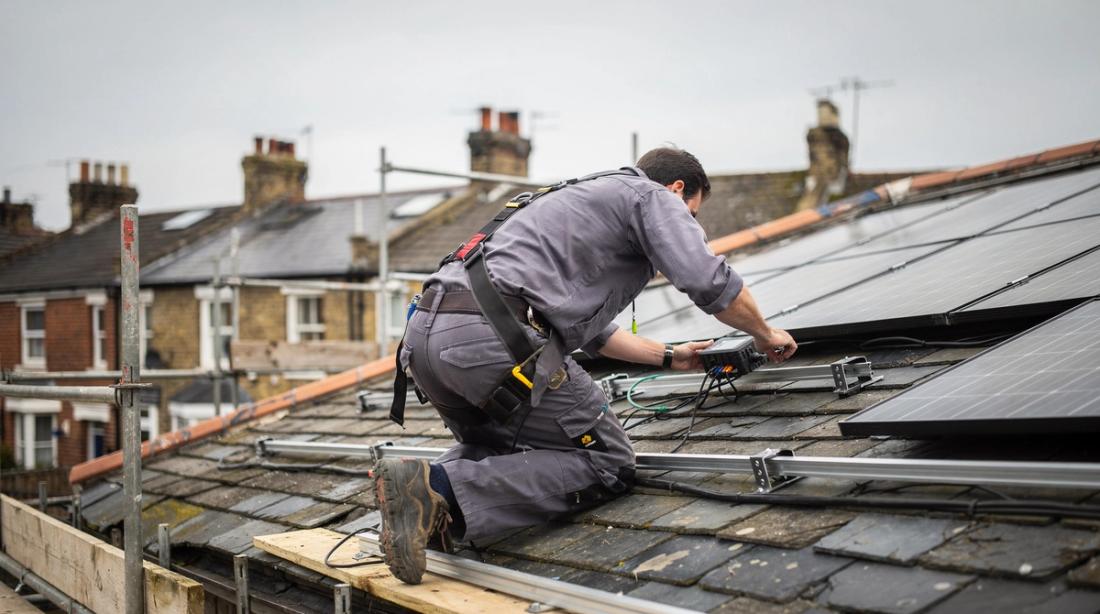
The detail that catches solar teams out is that fixing specifications are site-specific. The correct pattern depends on roof dimensions, pitch, tile type and the location of the property, because a semi in sheltered Surrey and a bungalow on the Cornish coast see very different design wind pressures. When your installers remove, cut or refit tiles around brackets and cable entries, the reinstated covering has to meet the fixing specification for that roof, not a generic one.
Underlay matters just as much. BS 5534 classifies underlays by wind uplift resistance, and any penetration your team makes through it must be sealed in a durable, appropriate manner. A torn or poorly sealed underlay is invisible from the ground and obvious in the loft two winters later.
Where BS 5534 Meets MCS 012
For solar specifically, the two standards interlock. MCS 012 Issue 3.0, the solar mounting standard published in 2025, requires mounting systems to declare a design wind uplift resistance and explicitly states that penetrations through the underlay must not jeopardise its role as specified in BS 5534 sections 4.9 and 6.2. In other words, the solar standard delegates the roofing detail back to the roofing standard.
That creates a documentation chain installers need to close. The mounting manufacturer declares uplift resistance for the system. The installer has to show the system, as installed on this roof in this wind zone, sits within that resistance, and that the disturbed covering was reinstated to BS 5534. On flat roofs the bar is now explicit: since 10 August 2025, flat-roof mounting systems on MCS installations must themselves be MCS 012 certified.
Wind Uplift: The Calculation Behind the Fixings
Wind does not load a roof evenly. Eaves, verges, ridges and hips see the highest suction, which is why perimeter zones demand extra fixings, and why an array positioned near a verge changes the loading picture more than one in the middle of the roof plane. The design wind pressure for the site is derived from the Eurocode method using location, terrain, building height and roof geometry.
In our experience, this is the part of a solar project most often left to assumption. The panel layout gets careful attention; the uplift evidence behind the bracket spacing rarely gets written down. Yet it is exactly what an MCS assessor, a warranty provider or a loss adjuster will ask for after a storm claim. If your process cannot produce the wind-load basis for a roof you installed two years ago, you are carrying risk you cannot see.
What This Means for Your Design Process
The practical answer is to make roofing compliance an output of design rather than a site-day improvisation. Capture the roof type, pitch, exposure and mounting zones at the design stage, keep the manufacturer uplift declarations with the project record, and generate the reinstatement notes your roofers follow. Modern solar PV design software holds all of this in one project file, so the evidence exists before anyone climbs a ladder, and platforms like Reonic keep that documentation attached to the project from design through to handover. For the wider paper trail, see our guide to renewable installation paperwork.
Conclusion
Solar installers do not need to become roofers, but they do need to stop treating the roof as someone else's standard. BS 5534 defines the covering you disturb on almost every pitched-roof job, MCS 012 explicitly points back to it, and the fixing rules are site-specific rather than generic. The firms that document wind zones, fixings and underlay reinstatement as part of design will pass audits, defend claims and win the trust that repeat work is built on. The ones that improvise on the scaffold are betting the business on the weather.
FAQ
Q1: Does BS 5534 apply to solar panel installation?
Indirectly but unavoidably. BS 5534 governs the tiled or slated roof covering your mounting system attaches through. MCS 012 requires underlay penetrations to be sealed per BS 5534, and any tiles you remove or refit must be reinstated to the fixing specification for that roof.
Q2: What are the BS 5534 fixing requirements?
Every single-lap tile needs at least one mechanical fixing, perimeter tiles need two, and mortar cannot be counted towards wind uplift resistance. The exact pattern is site-specific, calculated from roof dimensions, pitch, tile type and location.
Q3: What is the difference between BS 5534 and MCS 012?
BS 5534 is the roofing code of practice for slating and tiling. MCS 012 is the certification standard for solar mounting systems, covering wind uplift resistance, fire performance and weathertightness. MCS 012 Issue 3.0 references BS 5534 directly for underlay and covering details.
Q4: Do flat-roof solar mounting systems need MCS 012 certification?
Yes. Since 10 August 2025, flat-roof mounting systems used on MCS installations must be MCS 012 certified, closing a gap that previously left ballasted systems outside the certification regime.
Q5: What wind-load evidence should an installer keep?
Keep the site wind assessment basis, the mounting manufacturer's declared uplift resistance, the fixing pattern used, and notes confirming tiles and underlay were reinstated to BS 5534. Storing these in the project record protects you in audits and storm-damage claims years later.