
Lithium-ion battery storage in UK homes is not governed by one law but by a stack of overlapping rules, and the newest layer arrived when BS 7671 Amendment 4 added a dedicated chapter on stationary secondary batteries on its publication on 15 April 2026 (IET, 2026). For installers, knowing which rule covers what is the difference between a clean handover and a failed inspection.
This guide maps the regulations that apply to a domestic battery: the fire specification PAS 63100:2024, the wiring standard BS 7671 and its supporting IET Code of Practice, the grid connection rules G98 and G99, plus Part P, planning and VAT. The focus is what you have to design to and document, job by job.
Key Takeaways
- No single lithium-ion storage regulation exists. A domestic battery is covered by at least PAS 63100:2024, BS 7671, the ENA connection rules and Part P at the same time.
- PAS 63100:2024, published on 20 March 2024, is the fire-safety specification for home batteries and bans installation in bedrooms and unprotected escape routes (BSI, 2024).
- BS 7671 Amendment 4 (15 April 2026) added a stationary secondary battery chapter covering location, ventilation and two-way protection (IET, 2026).
- A battery inverter above 16A per phase (3.68 kW) needs G99 approval before connection; at or below it, G98 notify-and-connect applies (National Grid, 2026).
- Retrofit and standalone home batteries keep 0% VAT until 31 March 2027, after which the rate returns to 5% (gov.uk, 2024).
Is there a single lithium-ion battery storage regulation in the UK?
No. A UK home battery sits under several frameworks at once rather than one dedicated law: the grid connection rules G98 and G99, the wiring standard BS 7671, the fire specification PAS 63100:2024, and MCS where the battery forms part of a certified job (BSI, 2024). Each addresses a different risk.
That layering is why compliance feels harder for storage than for solar alone. The connection rules protect the grid, BS 7671 covers the electrical installation, PAS 63100 targets fire, and Part P makes the electrics a legal building-regulations matter. Miss any one and the installation is not fully compliant even if it powers up cleanly.
The practical answer is to treat the standards as a single checklist rather than a hierarchy. A battery job is signed off only when the connection paperwork, the electrical certificate, the fire-safety siting and the building-regulations notification are all complete and handed to the customer.
The home battery rulebook at a glance
Before going deep on any one standard, it helps to see the whole set together, because a single domestic battery touches all of them. The list below is the map most installers keep in their heads, with each rule doing one distinct job in the compliance picture.
- ENA G98 and G99: grid connection. G98 is notify-and-connect at or below 3.68 kW per phase; G99 is a full application and approval above it.
- BS 7671 (Amendment 4, 2026): the wiring standard the installation must meet, now carrying a dedicated stationary battery chapter.
- PAS 63100:2024: the fire-safety specification that decides where in the home a battery can be sited.
- Part P: turns the electrical connection into a notifiable building-regulations matter self-certified through a scheme.
- MCS: the installation-quality scheme that ties the job to consumer-code protection and incentives.
- VAT (Notice 708/6): 0% on qualifying home batteries until 31 March 2027, then 5% (gov.uk, 2024).
None of these overrides another. They stack, and the job is compliant only when each has been satisfied and evidenced. The rest of this guide takes them in turn, starting with the one customers ask about most: fire.
What does PAS 63100:2024 require?
PAS 63100:2024, published on 20 March 2024, is the BSI specification for protecting home battery systems against fire. It sets requirements for battery and fault management, installation location and ventilation, and was sponsored by the UK government (BSI, 2024).
Its most quoted rules concern where a battery can go. PAS 63100 says batteries should not be installed in rooms used for sleeping, in unprotected escape routes such as landings, staircases and corridors, or in the lobbies and shafts of protected escape routes (BSI, 2024). That rules out many of the convenient spots customers first suggest.
The reason is thermal runaway, the chain reaction that can start if a lithium-ion cell is damaged or faulty and is very hard to stop once under way (House of Commons Library, 2025). Siting the battery in a garage, plant space or external enclosure keeps any fire away from sleeping occupants and escape routes.
How do BS 7671 and the IET Code of Practice apply?
BS 7671 is the wiring standard every battery circuit must meet, and Amendment 4 (15 April 2026) added a chapter on stationary secondary batteries covering system design, bidirectional inverters and two-way protection (IET, 2026). The IET Code of Practice for Electrical Energy Storage Systems, 3rd edition, expands on it (IET, 2024).
The battery chapter matters because storage breaks an assumption built into older wiring rules, that current flows one way. Amendment 4 addresses protective devices suitable for two-way energy flow, along with battery location, ventilation and fire-risk mitigation, which aligns the wiring standard with the fire specification. A protective device chosen for one-way flow is not automatically safe once a battery can push current back through it, and that is exactly the gap the new chapter closes.
The IET Code of Practice reached its 3rd edition on 4 June 2024 and remains the practical reference for designing and commissioning storage in dwellings, commercial and industrial settings (IET, 2024). Our IET Code of Practice guide breaks down what it asks of installers on site.
Do battery systems need DNO approval?
Yes. An AC-coupled battery is treated as a generating unit under the ENA rules, so a single-phase inverter at or below 16A (3.68 kW) is notified to the DNO under G98, while anything above needs G99 approval before connection (National Grid, 2026). The rating that counts is the inverter output, not the battery capacity.
The trap is aggregation. The DNO looks at total generation at the property, so a 3.5 kW battery inverter added to an existing 3.5 kW solar inverter combines to roughly 7 kW and moves the whole site into G99 territory, even though neither unit exceeds 3.68 kW on its own.
Where a G99 application would otherwise be needed, an export limitation device set under G100 can keep the site within its agreed export limit and simplify approval. Our G98 notification guide, G99 approval guide and G100 export limitation guide cover each route in detail.
The timing difference between the two routes shapes the job. G98 lets you install and then notify within 28 days, so the work is not held up. G99 has to be approved first and can take several weeks, with the possibility of refusal or a request for network reinforcement, so it belongs on the critical path of the project plan rather than as an afterthought at commissioning.
Battery location and planning permission
A domestic battery inside a property usually does not need planning permission, because it is treated as ancillary equipment under permitted development, though listed buildings and some outbuilding or ground-mounted enclosures are exceptions (Planning Portal, 2026). PAS 63100 then dictates where in the building it can safely sit.
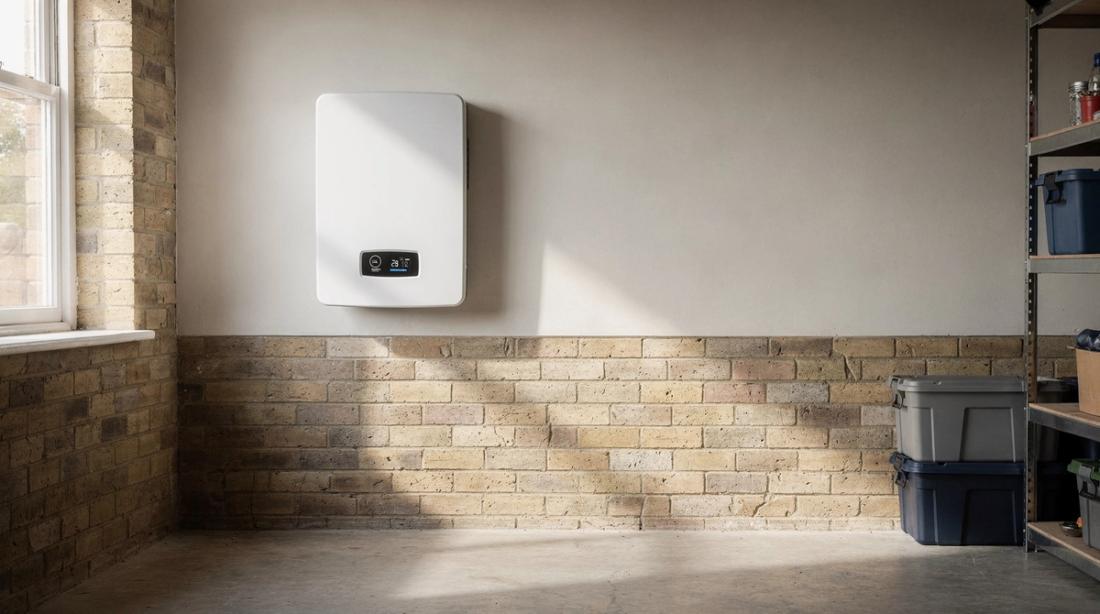
Combine the two rule sets and the practical answer is usually a garage, a plant room, an outbuilding or an external wall enclosure. Those locations keep the battery out of bedrooms and escape routes, allow ventilation, and rarely trouble planning. Always confirm the DNO notification separately, because planning status has no bearing on the connection rules.
Conservation areas and listed buildings are where this gets fiddly. An external enclosure that would be permitted development on a typical house can need consent on a protected one, so the location decision has to weigh planning constraints and the PAS 63100 fire rules together. Resolving both at survey stops a compliant electrical design from being undone by a location the customer cannot actually use.
How installers demonstrate battery compliance
Compliance is shown through documents, not assurances: an electrical installation certificate to BS 7671, a G98 notification or G99 approval reference, evidence of PAS 63100 siting, and Part P sign-off through a competent person scheme (BSI, 2024). MCS certification ties the package together where the job is certified.
A battery is also a taxable supply, and getting the VAT treatment right protects the customer's price. Retrofit and standalone home batteries carry 0% VAT until 31 March 2027, so the invoice should reflect the zero rate for a qualifying domestic install. Applying 20% by habit overcharges the customer and is awkward to unwind later.
The habit that separates a clean battery job from a risky one is filing as you go. Capture the siting decision at survey, the connection reference when the DNO responds, and the test results at commissioning, rather than reconstructing them months later. An installation that cannot be evidenced is treated as non-compliant even when the hardware is faultless.
Reonic helps installers keep these certificates, connection references and siting records attached to each project, so a battery job can be evidenced end to end when an auditor or a buyer's solicitor asks. Our VAT on solar and batteries guide covers the invoicing detail.
Frequently asked questions
Is home battery storage legal without MCS certification?
Yes, a battery can be installed legally without MCS, but it must still meet BS 7671, PAS 63100, Part P and the DNO connection rules. MCS certification is what gives access to consumer-code protection and scheme incentives, so most installers certify domestic work even where it is not strictly required by law.
Does a battery need to be notified to the DNO?
Almost always. An AC-coupled battery inverter is a generating unit, so it is either notified under G98 at or below 3.68 kW single-phase or approved under G99 above that (National Grid, 2026). The inverter rating and any existing generation at the property both count toward the threshold.
Can a battery be installed in a loft or bedroom?
No. PAS 63100:2024 says batteries should not be installed in rooms used for sleeping or in unprotected escape routes, and lofts are generally unsuitable because of heat and access (BSI, 2024). A garage, plant space or ventilated external enclosure is the usual compliant choice.
What changed for batteries in BS 7671 Amendment 4?
Amendment 4, published on 15 April 2026, added a dedicated chapter on stationary secondary batteries covering system design, bidirectional inverters, two-way protection, location, ventilation and fire-risk mitigation (IET, 2026). New designs should follow it before the previous standard is withdrawn in October 2026.
Do home batteries qualify for 0% VAT?
Yes. Since 1 February 2024 retrofit, standalone and hybrid home battery installations qualify for the temporary zero rate of VAT, which runs until 31 March 2027 before reverting to 5% (gov.uk, 2024). The battery must be installed in residential accommodation to qualify.