
Commercial EV charging points now sit across a UK network of 121,171 public chargers at the end of June 2026, up 10% year on year across 46,731 locations (Zapmap, 2026). For installers moving from domestic wallboxes into workplace, fleet and destination sites, the jump is less about the charger and more about the supply, the grant paperwork and the grid.
This guide is written for installers quoting commercial EV charging points in 2026. It covers what counts as commercial, real per-socket costs, the Workplace Charging Scheme grant, how to size and manage the supply, when a DNO connection is needed, and how destination charging differs from a workplace scheme.
Key Takeaways
- A 7kW AC workplace socket runs about 900 to 1,800 pounds fitted, a 22kW unit 2,200 to 3,500 pounds, and a 50kW DC rapid 18,000 to 28,000 pounds per charger (Excel Energy, 2026).
- From 1 April 2026 the Workplace Charging Scheme pays up to 500 pounds per socket, 75% of cost, capped at 40 sockets (GOV.UK, 2026).
- Any load above 17kW per phase triggers a G99 application to the DNO, and the technical study can take up to 65 working days (Energy Networks Association, 2026).
- Dynamic load management can free 30% to 50% more sockets inside the same grid headroom before any reinforcement (Nuvolt, 2026).
- Ultra-rapid 150kW-plus chargers grew 37% year on year to 13,996 units, the fastest growing band for destination and forecourt sites (Zapmap, 2026).
What counts as a commercial EV charging point?
A commercial EV charging point is any chargepoint installed for business use rather than a single household, covering workplace bays, fleet depots, destination car parks and public forecourts. The official public network alone reached 119,080 chargers by 1 April 2026 (GOV.UK, 2026), and private commercial sites add many more.
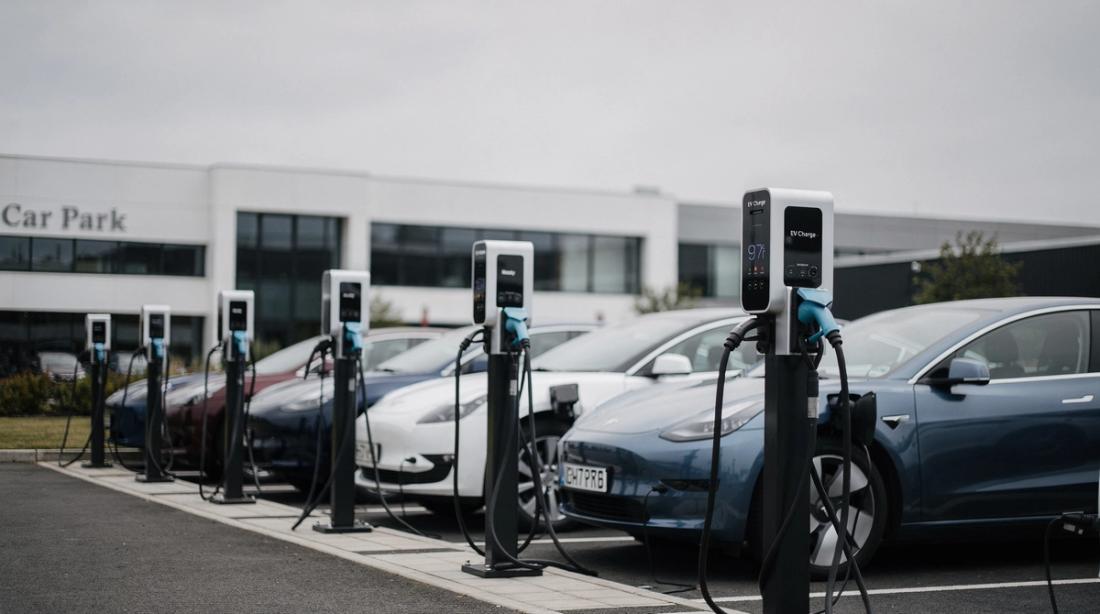
The four models behave differently on site. Workplace charging serves staff during a long dwell time, so 7kW to 22kW AC units suit it well. Fleet depots need scheduled overnight charging and often DC power. Destination charging tempts visitors at retail, hospitality and leisure car parks. Public rapid hubs chase turnover with 50kW to 350kW DC.
Getting the model right first shapes every later decision. Dwell time sets the power band, the number of bays sets the supply size, and the ownership model decides whether the client wants to bill drivers. An installer who fixes these three points before quoting avoids the classic trap of oversizing hardware the incoming supply cannot feed.
The market backdrop favours the faster models. High-power public networks delivering 150kW and above grew 37% year on year to 13,996 units, and the UK now has 1,034 charging hubs with eight or more rapid chargers at one location (Zapmap, 2026). That growth is where destination and forecourt work is heading, so scope a site for the model it will still suit in five years, not just today.
How much do commercial EV charging points cost in 2026?
Commercial EV charging point costs in 2026 depend mostly on power and civils, not the badge on the unit. Per socket, a 7kW AC charger runs roughly 900 to 1,800 pounds fitted, while a 50kW DC rapid reaches 18,000 to 28,000 pounds per charger once groundworks are included (Excel Energy, 2026).
Full commercial EV charger installation cost across a site ranges from about 1,500 pounds for a single AC bay to 50,000 pounds or more for a multi-charger DC layout with a supply upgrade (Simple Green Energy, 2026). The variable that moves budgets most is trenching and the distance from the intake to the bays.
The per-socket bands below help you frame a first-pass quote before a site survey:
- 7kW AC socket: hardware 400 to 900 pounds, install 500 to 900 pounds, roughly 900 to 1,800 pounds fitted.
- 22kW AC socket: hardware 900 to 1,800 pounds, install 1,300 to 1,700 pounds, roughly 2,200 to 3,500 pounds fitted.
- 50kW DC rapid: 18,000 to 28,000 pounds per charger including civils and cabling.
- 20-vehicle fleet layout: 80,000 to 180,000 pounds with load management and any supply upgrade.
Two site factors dominate the overrun risk. A long cable run adds cost per metre of trench, and a supply upgrade to feed several rapids can dwarf the hardware bill. Price the survey, the DNO enquiry and the containment separately so the client sees where the money goes.
Do not forget the running cost when you present the quote. Networked commercial chargers carry a back-office subscription for billing, access control and remote monitoring, and a maintenance plan keeps the units serviceable and warranty-backed. On sites I have surveyed, the clients who understood these ongoing costs up front were the ones who signed without renegotiating later, so build them into the proposal rather than leaving them as a surprise.
Workplace and commercial charging grants
The Workplace Charging Scheme is the main grant for commercial sites, and from 1 April 2026 it pays up to 500 pounds per socket, covering 75% of purchase and installation cost, capped at 40 sockets per applicant (Crystal EV, 2026). That is up from the previous 350 pounds per socket.
Eligibility is broad. Businesses, charities, public sector bodies and small accommodation businesses across England, Wales, Scotland and Northern Ireland can apply, and the scheme runs until 31 March 2027 as its final year (GOV.UK, 2026). Claims must be submitted by an authorised installer, so your accreditation matters to the client.
The workplace ev charging grant only covers bays for staff or fleet use, not public rapids that charge the public for energy. Where a client wants a destination model open to visitors, the grant will not apply, so set that expectation early and quote the two routes separately rather than blending them.
Do commercial chargers need a DNO connection?
Most multi-charger commercial sites need to engage the DNO, because any generation or load above 17kW per phase requires a G99 application before connection, and the technical study can take up to 65 working days (Energy Networks Association, 2026). A single 7kW bay usually only needs notification.
The DNO checks whether the local network can carry the new demand and may cap the connection below your design figure. On a constrained feeder the full reinforcement route can run several months, so raise the enquiry as soon as the bay count is agreed (Nuvolt, 2026). Treat the DNO timeline as the critical path, not the hardware lead time.
A practical field habit saves weeks here. Pull the MPAN and available headroom before you design, then match the charger schedule to what the intake can realistically feed. If the numbers are tight, load management often removes the need for a costly upgrade, which is the next lever to reach for.
Sizing the supply and managing load
Load management lets a site run more chargers than the raw supply would allow by sharing available current across active bays in real time. In practice dynamic load balancing frees 30% to 50% more sockets inside the same grid headroom before any reinforcement is needed (Nuvolt, 2026).
Start from the incoming capacity, not the wish list of bays. Measure total site demand, subtract the existing base load, and give the chargers what is left through a load controller. For deeper detail on balancing methods and CT placement, see our guide to EV charger load management.
Where a site already has commercial solar or storage, the numbers improve again. Pairing chargers with generation shaves the grid peak and can defer an upgrade, a pattern we cover in the commercial battery storage cost guide. Solar carports are a natural fit for car-park charging, explained in our solar carport guide.
Destination charging versus workplace charging
Destination charging and workplace charging solve different problems, so the right model follows the dwell time and who pays. Workplace bays serve staff and fleet vehicles that sit all day, while destination charging draws visitors at retail, hospitality and leisure sites who want a useful top-up while they shop or eat.
The billing model is the real dividing line. Workplace charging is usually a staff benefit funded through the workplace ev charging grant, whereas destination charging is often a paid service or a loyalty draw. A client who wants to earn from the bays cannot use the grant, so the commercial case, not the hardware, decides the route.
Site geometry then confirms it. Destination sites favour a smaller number of faster units to lift turnover, while workplace sites favour more AC sockets at modest power. Map the client's goal to the model first, then let power, bay count and supply follow from that single decision.
Tariff design is where destination projects often stall. A retail client who wants free charging as a footfall draw builds a very different business case from one billing at a premium rapid rate, and the two need different hardware and back-office contracts. Settle the pricing intent before specifying the units, because retrofitting a paid billing system onto free bays is an expensive change of mind.
How do you plan a commercial EV charging installation?
A commercial EV charger installation runs smoothest when the survey, the DNO enquiry and the grant claim start together rather than in sequence. On a typical multi-bay site the DNO study can take up to 65 working days, so parallel working keeps that timeline off your critical path (Energy Networks Association, 2026).
Work through the site in a fixed order. Confirm the model and bay count, survey the intake and headroom, design the load-managed schedule, submit the DNO and grant paperwork, then price civils and containment. Commercial solar often shares the same switchroom, so read it alongside our commercial solar PV design guide.
Keep one Reonic point in view at handover. Reonic's installer platform helps you model the load-managed supply and generate a clear commercial proposal, so the client sees the grant, the running cost and the payback in one place. That clarity is what turns a survey into a signed job.
Frequently asked questions
How much does a commercial EV charging point cost in 2026?
Per socket, a 7kW AC unit costs roughly 900 to 1,800 pounds fitted, a 22kW AC unit 2,200 to 3,500 pounds, and a 50kW DC rapid 18,000 to 28,000 pounds per charger (Excel Energy, 2026). Civils and any supply upgrade move the total the most.
How much is the Workplace Charging Scheme grant worth?
From 1 April 2026 the grant pays up to 500 pounds per socket, covering 75% of purchase and installation cost, capped at 40 sockets per applicant, and it runs until 31 March 2027 (Crystal EV, 2026). Claims are made by an authorised installer.
When does a commercial site need a DNO connection?
Any load above 17kW per phase needs a G99 application before connection, and the DNO study can take up to 65 working days (Energy Networks Association, 2026). A single 7kW bay usually only needs a simpler notification, so raise the enquiry once bay count is fixed.
What is the difference between workplace and destination charging?
Workplace charging serves staff and fleet vehicles that dwell all day, usually as a benefit funded by the workplace grant. Destination charging draws paying visitors at retail and leisure sites. The billing model, not the hardware, sets the route, and paid public bays cannot use the workplace grant.
Can load management avoid a supply upgrade?
Often yes. Dynamic load balancing shares available current across active bays and can free 30% to 50% more sockets inside the same grid headroom, which frequently defers or removes a costly reinforcement (Nuvolt, 2026). Measure the intake headroom first, then design the schedule around it.