
Introduction
The Energy Performance Certificate (EPC) has evolved from a regulatory formality into a critical factor influencing property values, rental potential, and household energy costs across the UK. With energy bills continuing to challenge household budgets and stricter regulations on the horizon, improving your EPC rating has never been more important.
Whether you are a homeowner looking to reduce energy expenses, a landlord preparing for upcoming legal changes, or an installer advising clients on cost-effective energy efficiency improvements, understanding EPC rating dynamics is essential. This guide covers the assessment process, practical upgrade options, and strategic approaches to maximize impact, all while considering financial, environmental, and regulatory factors.
By the end, you will understand how to assess your property’s performance, prioritize improvements, leverage renewable technologies, and plan strategically to achieve meaningful EPC gains.
Understanding EPC Ratings in the UK
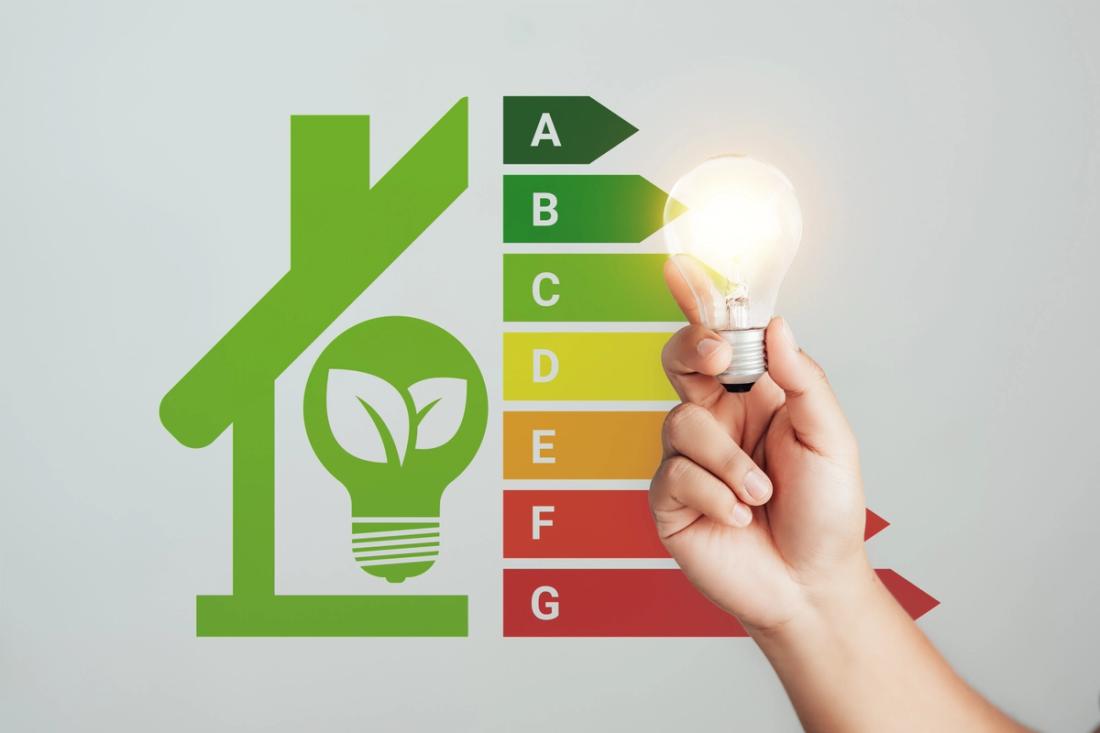
An EPC rates properties on a scale from A (most efficient) to G (least efficient), providing a standardized measure of energy performance. The certificate evaluates multiple factors, including heating systems, insulation, lighting, windows, and renewable energy installations.
In England and Wales, new-build properties are assessed using the Standard Assessment Procedure (SAP), while existing homes use the Reduced Data SAP (RdSAP). Scotland employs a similar methodology.
EPC certificates show both the current rating and the potential rating, based on suggested improvements. Each band corresponds to a point range: Band A is 92–100 points, and Band G is below 21. Knowing your starting point and what separates you from the next band is the first step in a meaningful upgrade journey.
Currently, most UK homes sit in bands D or E, with the national average around D. Regulatory requirements are becoming stricter: since April 2020, rental properties in England and Wales must achieve at least an EPC E, with proposals increasing minimum standards to band C by 2025 for new tenancies and 2028 for existing ones. Landlords failing to comply may face legal restrictions, highlighting the need for proactive improvement.
Understanding how your property compares to national averages and regulatory targets allows you to prioritize interventions, ensuring both cost-effectiveness and compliance.
Why EPC Rating Improvement Matters
Improving EPC ratings yields financial, environmental, and practical benefits beyond mere compliance.
Financial Benefits
Higher EPC ratings are associated with higher property values. Research indicates that improving from band G to E can increase property value by 10–15%. Buyers increasingly consider long-term running costs, making energy efficiency a growing market driver.
Energy bills represent immediate savings. A typical band D home might spend £1,500–£2,000 annually, while a band B equivalent could spend £800–£1,200. Over 10 years, this totals £7,000–£8,000 in savings, often exceeding the cost of upgrades. With energy prices volatile, such savings enhance household financial resilience.
Rental and Investment Impact
For landlords, EPC ratings influence tenant attraction and retention. Energy-efficient properties typically let faster and command higher rents. Properties with low ratings may face longer void periods and decreased appeal, directly impacting return on investment. Upcoming regulatory changes make proactive improvement crucial to avoid financial and legal risks.
Environmental Considerations
Buildings contribute approximately 20% of UK carbon emissions, making residential energy efficiency a key factor in climate strategies. Each band improvement typically reduces a property’s carbon footprint by 1–2 tonnes of CO2 annually. Energy-efficient homes align with growing consumer expectations for sustainability and contribute meaningfully to national emission reduction targets.
Assessing Your Current Position
Before implementing improvements, you must understand your current EPC rating and the factors limiting your score.
Your existing EPC, valid for 10 years, lists property performance and recommended improvements. Recommendations are algorithmically generated based on property data but may not account for recent upgrades, specific site conditions, or current technologies.
Professional consultation with experienced installers ensures a more tailored approach. Key factors assessed include:
- Wall insulation (cavity and solid)
- Loft insulation depth and coverage
- Floor insulation
- Window glazing type
- Heating system efficiency and controls
- Hot water system efficiency
- Lighting throughout the property
- Renewable energy installations
Identifying “low-hanging fruit” ensures cost-effective improvement. For example, a poorly insulated property benefits more from basic insulation than from expensive solar panels. Conversely, a well-insulated home may gain more from upgrading an old boiler.
Cost-Effective EPC Rating Improvements
Insulation Upgrades
Insulation Upgrades
Insulation typically offers the largest cost-to-benefit ratio for most UK homes.
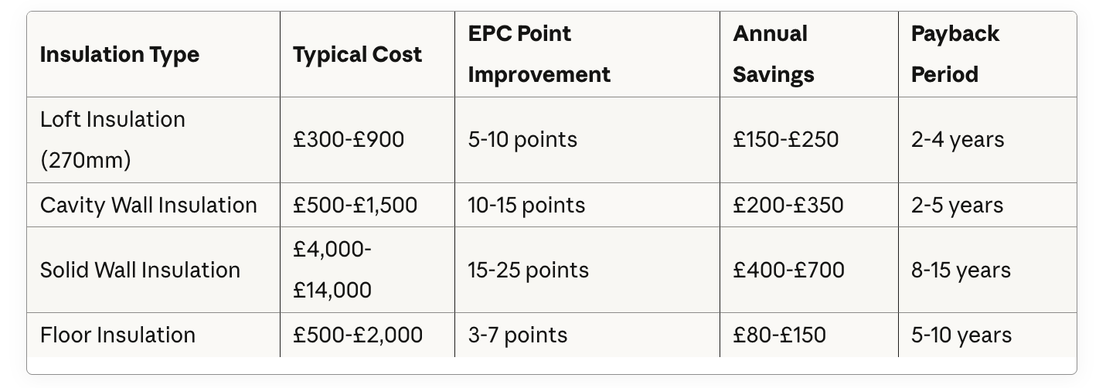
- Loft insulation: Top up to 270mm. DIY costs £300–£500; professional installation £500–£900. Improves EPC 5–10 points; reduces heating costs 10–15%.
- Cavity wall insulation: Costs £500–£1,500; improves EPC 10–15 points and reduces heating costs. Payback period 2–5 years.
- Solid wall insulation: £4,000–£14,000. Improves EPC 15–25 points; reduces heating by 30–40%. External insulation usually performs better, but planning restrictions may apply.
- Floor insulation: Suspended floors £500–£2,000; EPC gain 3–7 points. Solid floor insulation is often part of major renovations.
Window and Door Upgrades
- Windows: Double glazing £400–£1,200 per window; triple £600–£1,500. A typical 10–12 window upgrade improves EPC 8–15 points and reduces heating 10–20%.
- Doors: Insulated composite doors cost £500–£1,500; improve EPC 2–4 points. Draught-proofing costs £50–£200; adds 1–3 points.
Heating System Upgrades
Heating systems dominate energy consumption; efficiency here significantly impacts EPC.
- Boiler replacement: G-rated to A-rated condensing boiler costs £2,000–£3,500; improves EPC 10–20 points; saves £200–£400/year. Correct sizing is critical; oversized or undersized boilers reduce efficiency.
- Heating controls: Programmable thermostats, TRVs, and smart systems cost £200–£800; improve EPC 3–8 points. Smart thermostats also optimize energy usage automatically.
- Hot water systems: Insulated cylinders £30–£300; improve EPC 2–5 points. Time and temperature controls maximize savings.
Renewable Energy Solutions for EPC Improvement
Solar Photovoltaic (PV) Systems
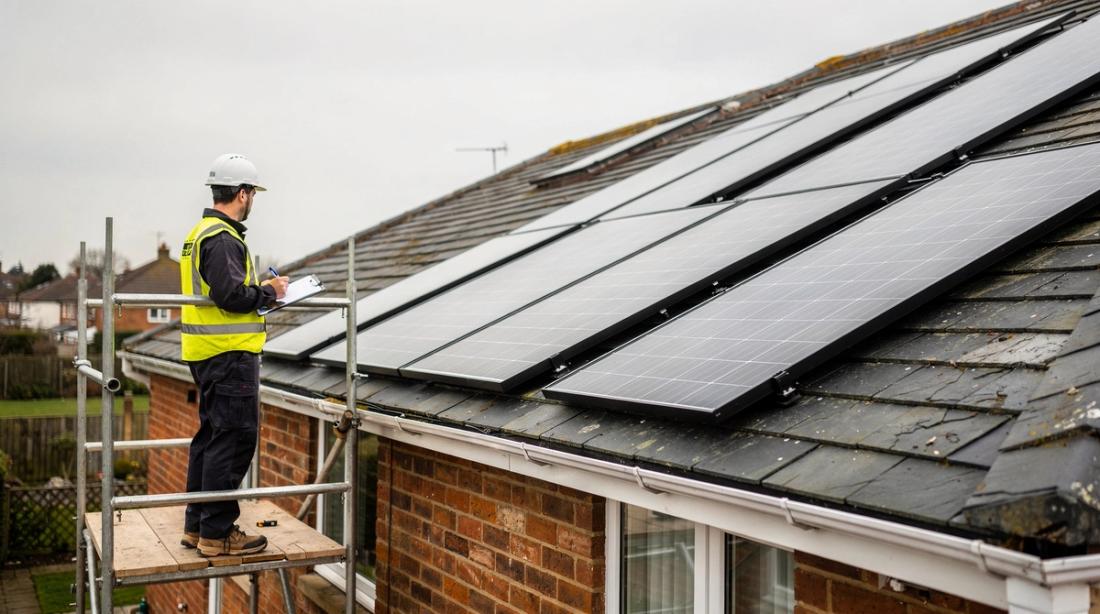
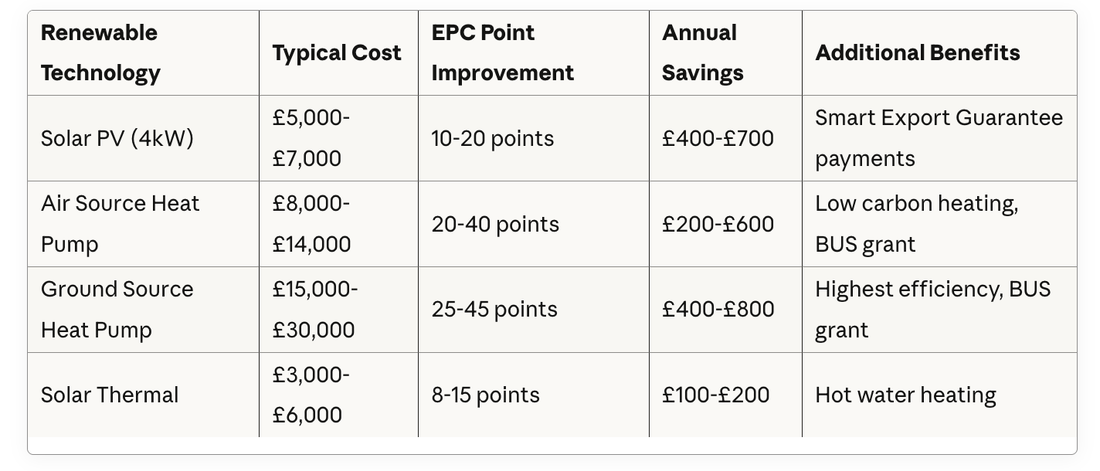
Solar PV installations deliver substantial EPC improvements whilst generating clean electricity and reducing energy bills. A typical 4kW residential solar PV system costs £5,000-£7,000 installed and can improve EPC ratings by 10-20 points, depending on property characteristics and existing rating. Annual electricity generation typically ranges from 3,200-4,000 kWh in the UK, saving £400-£700 annually at current electricity prices.
The EPC assessment considers solar PV generation when calculating energy costs and carbon emissions, rewarding properties that generate renewable electricity. Larger installations naturally achieve greater EPC improvements, though cost-effectiveness should balance system size against available roof space, shading factors, and budget. Most residential installations range from 3kW to 5kW, providing meaningful generation without requiring extensive roof coverage.
Battery storage, whilst not yet fully reflected in standard EPC assessments, enhances solar PV benefits by storing excess generation for use during evening peak demand periods when grid electricity is most expensive. A 5-10kWh battery storage system costs £3,000-£6,000 installed and can increase solar self-consumption from 30-40% to 60-80%, improving payback periods and energy independence.
For installers advising clients on solar PV, accurate site assessment is crucial. Factors including roof orientation, pitch angle, shading from nearby trees or buildings, and roof condition all influence system performance and cost-effectiveness. Professional installers should use solar design software to model expected generation and provide realistic performance projections based on specific site conditions.
Heat Pump Technology
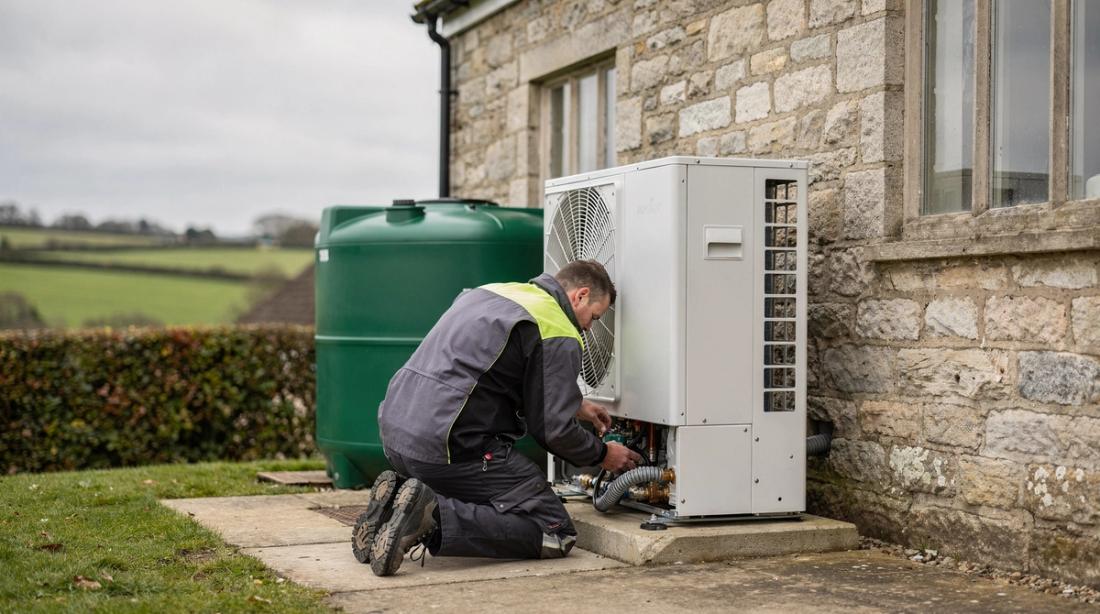
Heat pumps represent one of the most impactful upgrades for EPC ratings, particularly for properties replacing fossil fuel heating systems. Air source heat pumps (ASHP) typically cost £8,000-£14,000 installed for a 5-8kW system suitable for an average UK home, whilst ground source heat pumps (GSHP) cost £15,000-£30,000 depending on ground conditions and installation complexity.
An air source heat pump replacing an old gas boiler can improve EPC ratings by 20-40 points, potentially elevating a property from band D to band B in a single upgrade. The dramatic EPC improvement reflects both the high efficiency of heat pumps (300-400% efficient compared to 90% for condensing boilers) and the assessment methodology that favours renewable heating technologies.
Government incentives significantly improve heat pump economics in the UK. The Boiler Upgrade Scheme provides £7,500 grants for air source heat pumps and £7,500 for ground source heat pumps, substantially reducing upfront costs. Combined with the renewable heat incentive available for some installations, heat pumps become financially attractive even before considering EPC improvements and long-term running cost reductions.
However, heat pumps require careful specification and installation to achieve optimal performance. Properties with poor insulation may struggle to reach comfortable temperatures with heat pumps operating at their most efficient settings. Best practice involves improving insulation to reduce heat demand before installing a heat pump, allowing smaller, more efficient systems operating at lower flow temperatures. Installers should conduct thorough heat loss surveys and specify appropriately sized systems with suitable emitters (radiators or underfloor heating) for efficient operation.
Solar Thermal and Hybrid Systems
Solar thermal systems, which heat water directly using solar collectors, offer an alternative or complement to solar PV. A typical system costs £3,000-£6,000 installed and can improve EPC ratings by 8-15 points whilst providing 40-60% of annual hot water requirements. Whilst solar PV has become more popular due to versatility and declining costs, solar thermal remains highly efficient for water heating and performs well in the EPC assessment.
Hybrid heating systems, combining heat pumps with supplementary gas boilers, offer a practical transition path for properties where full heat pump heating may be challenging. These systems use the heat pump for most heating demand, switching to the gas boiler only during extreme cold periods or peak demand. Hybrid systems cost £6,000-£10,000 installed and can improve EPC ratings by 15-25 points whilst maintaining heating reliability.
Strategic Planning for Maximum EPC Improvement
Achieving substantial EPC improvement requires strategic planning rather than piecemeal upgrades. The most cost-effective approach typically involves addressing the "fabric first" – improving insulation and airtightness before upgrading heating systems and adding renewable technology. This sequence ensures that expensive heating system upgrades are correctly sized for reduced heat demand and operate at peak efficiency.
Understanding band thresholds helps prioritise improvements for specific goals. If your property scores 48 points (band D) and minimum rental standards require band C (69 points), you need to identify improvements totalling at least 21 points. Rather than implementing the most expensive single upgrade, a combination of loft insulation (8 points), cavity wall insulation (12 points), and heating controls (4 points) might achieve the target for £2,000-£3,000 rather than £10,000+ for a heat pump.
For properties targeting the highest ratings (bands A or B), renewable technology becomes essential. Achieving band B typically requires a combination of excellent insulation, efficient heating (usually a heat pump), and renewable electricity generation (solar PV). Band A properties almost invariably feature heat pumps and solar PV, often with additional measures like mechanical ventilation with heat recovery (MVHR).
Installers can add significant value by conducting whole-house assessments and developing improvement roadmaps showing clients the most cost-effective path to their target EPC rating. Digital tools and EPC calculators allow modelling different improvement scenarios, comparing costs and benefits to identify optimal strategies. Some installers offer free energy assessments to identify priority improvements, building trust and demonstrating expertise before proposals.
Reonic Platform for Energy Professionals
For installers and energy professionals managing multiple EPC improvement projects, efficient workflow management is crucial for business success. Reonic's software platform streamlines the entire process from initial consultation through installation and compliance documentation. The platform enables installers to conduct rapid site assessments, generate accurate quotes incorporating equipment specifications and labour costs, and manage project timelines to ensure efficient delivery.
Reonic helps energy professionals demonstrate value to homeowners by providing clear visualisations of proposed improvements and expected outcomes. Clients appreciate seeing professional assessments showing exactly how proposed upgrades will improve their EPC rating, reduce energy costs, and increase property value. This transparency builds confidence and helps homeowners make informed investment decisions.
The platform's compliance management features ensure all necessary certifications and documentation are captured and organised, simplifying MCS certification, building control notifications, and other regulatory requirements essential for installations qualifying for government incentives. For businesses handling multiple concurrent projects, this systematic approach prevents costly administrative errors and delays.
Common Challenges and How to Overcome Them
- Budget constraints: Phase improvements; start with cost-effective measures like loft and cavity wall insulation.
- Government support: ECO4, local authority schemes, green mortgages, and loans ease affordability.
- Technical limitations: Listed buildings, conservation areas, and period properties may restrict upgrades; internal insulation, secondary glazing, and heating solutions offer alternatives.
- Conflicting EPC recommendations: When external wall insulation is impractical, installers can combine internal measures and renewable technologies to achieve similar EPC gains.
The Role of Professional Installation
Professional installation quality fundamentally determines whether efficiency improvements deliver their theoretical benefits. Poor installation can severely compromise performance – for instance, badly installed cavity wall insulation may leave gaps reducing effectiveness by 50% or more, whilst incorrectly commissioned heat pumps may operate inefficiently or fail prematurely. Choosing appropriately qualified installers with relevant certifications (MCS, TrustMark, industry-specific qualifications) protects both performance and warranty coverage.
For renewable energy installations, MCS certification is mandatory for accessing government incentives like the Boiler Upgrade Scheme and Smart Export Guarantee. MCS installers undergo regular assessment ensuring technical competence and customer service standards. Beyond regulatory requirements, MCS certification signals professionalism and expertise, providing homeowners with confidence in installation quality.
Post-installation support distinguishes excellent installers from mediocre ones. Heat pumps, solar PV systems, and smart heating controls require user education for optimal operation. Installers should provide comprehensive handover briefings explaining system operation, maintenance requirements, and troubleshooting guidance. Many homeowners never achieve full benefits from efficiency improvements simply because they don't understand how to operate systems optimally.
Warranty and aftercare support protect homeowners' investments. Reputable installers offer multi-year warranties on workmanship beyond manufacturer warranties on equipment, providing comprehensive coverage. Prompt responsive service for issues or questions builds lasting client relationships and generates referrals – research indicates that satisfied customers typically recommend their installer to 5-10 potential clients.
Measuring and Verifying Improvements
Updated EPC assessments (£60–£120) confirm gains. Provide complete documentation:
- MCS certificates
- Building control approvals
- Product specifications
- Boiler commissioning records
Smart meters and energy monitoring validate savings beyond EPC scores. Improved EPC ratings also enhance rental appeal, attracting tenants and justifying higher rents.
Future-Proofing Your Property
EPC regulations continue evolving toward stricter requirements as the UK pursues net-zero carbon targets. Current proposals suggest minimum EPC band C for all rental properties by 2028, with potential further increases to band B by 2035. Owner-occupied properties may face future minimum standards at point of sale. Anticipating these regulatory shifts and planning improvements proactively protects property values and rental viability.
Technology developments will expand improvement options over coming years. Emerging solutions like hybrid solar tiles integrating PV into roofing materials, high-temperature heat pumps suitable for older properties with existing radiators, and advanced home battery systems with vehicle-to-grid capability will offer new pathways to high EPC ratings. Staying informed about technological developments helps property owners and installers identify optimal solutions as they become available.
The broader transition to renewable energy affects home efficiency through grid decarbonisation. As the electricity grid increasingly relies on renewable generation, the carbon intensity of grid electricity decreases, improving the environmental performance of electric heating and reducing the carbon penalty for electric heating compared to gas. This trend strengthens the long-term case for heat pumps and electric heating systems.
Planning for electric vehicle charging infrastructure during major property upgrades provides future flexibility. Installing appropriate electrical capacity and cable routes during renovation work is far cheaper than retrofitting later. As EV adoption accelerates, home charging capability becomes increasingly valuable, potentially influencing property values and rental appeal.
Conclusion
Improving your EPC rating delivers multiple benefits spanning regulatory compliance, reduced energy costs, enhanced property values, and environmental responsibility. The most effective approach combines strategic planning with quality implementation, prioritizing improvements delivering maximum impact for available budget. Whether targeting minimum rental standards or pursuing the highest efficiency ratings, a structured improvement programme achieves goals cost-effectively.
For homeowners, understanding the relationship between different improvements and EPC ratings enables informed investment decisions aligned with personal priorities and circumstances.
For installers and energy professionals, EPC improvement represents significant business opportunity as regulatory requirements drive demand for efficiency upgrades.
The journey to improved energy efficiency transforms properties from energy-consuming liabilities into efficient, comfortable, and valuable assets. Whether you're taking the first steps with basic insulation or implementing comprehensive renewable energy systems, each improvement contributes to a more sustainable, affordable, and comfortable home whilst protecting property value for the future.
Frequently Asked Questions
Q1 How much does it cost to improve an EPC rating by one band?
£2,000–£4,000 for minor upgrades; £3,000–£8,000 for heating replacements; £8,000–£15,000 for solid wall insulation or heat pumps, often offset by grants.
Q2 What is the fastest way to improve an EPC rating?
Loft and cavity wall insulation plus heating controls; boiler replacement for insulated homes. Solar PV and heat pumps also add substantial points in days to weeks.
Q3 Will solar panels improve my EPC rating?
Yes, a 4kW system adds 10–20 points, reducing grid electricity use and carbon emissions. Larger systems add more points proportionally.
Q4 Do I need an EPC rating of C for my rental property?
Currently, minimum is E; band C will likely be required for new tenancies by 2025 and existing tenancies by 2028. Planning ahead avoids compliance issues.
Q5 Can I improve my EPC rating without major renovations?
Yes: loft insulation, cavity wall insulation, LED lighting, heating controls, draught-proofing, and cylinder insulation can add 15–25 points with minimal disruption.
Q6 How long does an EPC rating last?
10 years; new assessments can be obtained after improvements to reflect upgrades.
Q7 What's the difference between an EPC rating and SAP rating?
SAP is the calculation method (1–100+ points); EPC bands (A–G) are derived from SAP scores.
Q8 Are heat pumps worth it for improving EPC ratings?
Yes, 20–40 points improvement; essential for high bands. Grants improve affordability; long-term running costs are competitive.